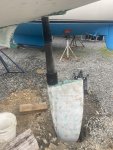
Beneteau 361 Rudder removal advice needed

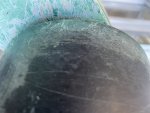
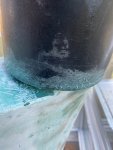
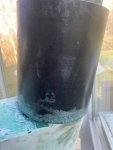
Cleaned off the antifouling as best I could. However, it definitely interacted with the epoxy coating, exposing fiberglass strands.
Going to contact Tides Marine tomorrow to get clear direction on repairs. They had directed so use some epoxy and add thin layers to build back up.
Have 5:1 Epoxy from Total boat. Will roll on thin coats and sand with 180 grit between coats.
Any suggestions?
IMG_1018.jpeg IMG_1023.jpeg IMG_1024.jpeg IMG_1025.jpeg IMG_1026.jpeg
 
For hull #'s from 1 through 259, the rudder assembly is NOT produced by Beneteau. They sourced it from Tides Marine.
So, the pictures and parts on the spareparts.beneteau.com will be of no use to you.
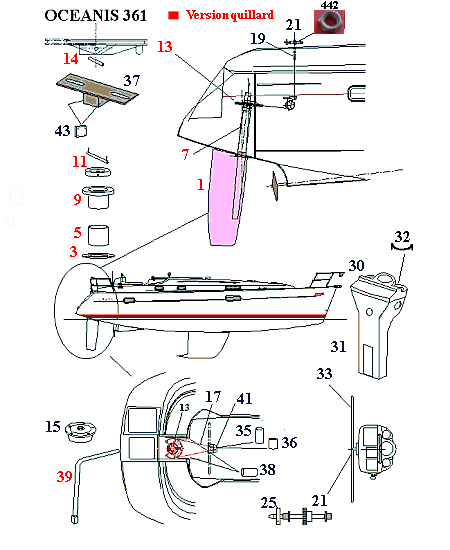
Here is the picture of the assembly on that site.
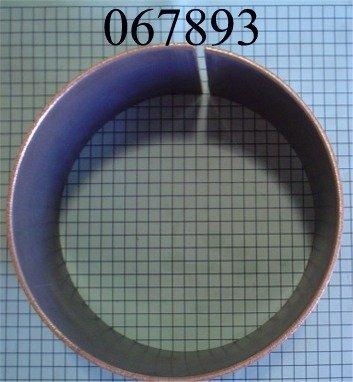
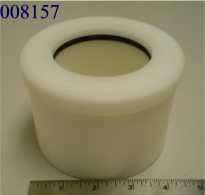
Item 3 (Delrin spacer) is not there. Item 5 (split ring insert into stand tube) is not used. Nor is there item 9 (delrin bushing).

1436100044a.gif
067893.jpg
008157.jpg


Instead, the stand tube has a UHMW plastic sleeve.
There are upper and lower bushings made of carbon fiber and fiberglass. Again, no lower delrin spacer.

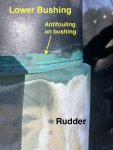
Here is the reason for the stiff steering. The prior owner had antifouling sprayed on a regular basis. Whomever did it, didn't mask off the tube, so antifouling worked its way up onto the lower bushing.

View attachment 103810
That lower bushing is the bearing, it shouldnt come out with the rudder. I suspect that you cant see the washers because they are under the antifoul. I mentioned this before. That bearing/ bushing, should be stuck in the hull. I suspect that it is seized on the shaft and has been rotating in the hull recess instead of the rudder rotating in it.
 
Last edited:
Have 5:1 Epoxy from Total boat. Will roll on thin coats and sand with 180 grit between coats.
Any suggestions?
Sounds like the method I would use. I'm not sure about temperatures where you are this time of the year, but to achieve thin/even coats it will really help to apply the epoxy in warm conditions. Don't mix too vigorously (while ensuring you still mix the hardnerer in fully) as this can introduce bubbles that will appear in the coating. And if bubbles are in issue, consider 'tipping off' each coat with a dry roller before it goes tacky. As you say, sanding between coats will catch any imperfections anyway (be sure to wash off the 'amine blush' first, assuming that Total Boat isn't amine blush free).
 
Beneteau381, thanks for the comment. The parts described in Post #20 are what's used for hull #'s above 259. My boat does not have this assembly.
I included this information for someone in the future with a 361 attempting to diagnose/repair their rudder assembly issues.
My hull # is 107, which uses an assembly supplied by Tides Marine in Florida. It is very different than the later system.
Both the lower and upper bushings are made of wraps of carbon fiber and fiberglass.
The rudder shaft stand tube is made of carbon fiber and fiberglass, with a UHMW black plastic sleeve. That is the actual 'slippery' surface.
There are no other parts to the assembly. There is no lower delrin bushing (p/n 008157) on the rudder shaft or a split ring (p/n 067893) installed in the stand tube.
There is no delrin spacer (item 3 in the posted Beneteau assembly drawing).

All of this has been reviewed and confirmed by Tides Marine. They have a rep assigned to me and he's been very helpful so far.

IMG_1008.jpeg IMG_1013.jpeg
 
Last edited:
Sounds like the method I would use. I'm not sure about temperatures where you are this time of the year, but to achieve thin/even coats it will really help to apply the epoxy in warm conditions. Don't mix too vigorously (while ensuring you still mix the hardnerer in fully) as this can introduce bubbles that will appear in the coating. And if bubbles are in issue, consider 'tipping off' each coat with a dry roller before it goes tacky. As you say, sanding between coats will catch any imperfections anyway (be sure to wash off the 'amine blush' first, assuming that Total Boat isn't amine blush free).

Thankfully, nothing has to be done to the stand tube in the boat. The rudder is at home where I can work on it at warm temperatures. Going to give Total Boat a call to double check the process.
Pretty proficient with glass and resins. I agree about minimizing the introduction of bubbles.
Was even researching the introduction of powdered teflon and graphite but decided not to get 'clever' with the repair. I'm a recovering engineer so couldn't help myself. Some interesting papers on the subject with good short-term results. Issue would be longevity.
 
Beneteau381, thanks for the comment. The parts described in Post #20 are what's used for hull #'s above 259. My boat does not have this assembly.
I included this information for someone in the future with a 361 attempting to diagnose/repair their rudder assembly issues.
My hull # is 107, which uses an assembly supplied by Tides Marine in Florida. It is very different than the later system.
Both the lower and upper bushings are made of wraps of carbon fiber and fiberglass.
The rudder shaft stand tube is made of carbon fiber and fiberglass, with a UHMW black plastic sleeve. That is the actual 'slippery' surface.
There are no other parts to the assembly. There is no lower delrin bushing (p/n 008157) on the rudder shaft or a split ring (p/n 067893) installed in the stand tube.
There is no delrin spacer (item 3 in the posted Beneteau assembly drawing).

All of this has been reviewed and confirmed by Tides Marine. They have a rep assigned to me and he's been very helpful so far.

View attachment 104010 View attachment 104011
The pic of your rudder, that thing above the rudder, I am certain is the bearing bush, the UHMW thing you refer to. I would bet that it is partially seized on the shaft. No manufacturer would make a rudder stock housing without a replaceable bushing/bearing. By the way I am talking about circa 2000 models
Edit, that pic of what you call the stand tube, looking up, there is a step which I suspect is what locates that bushing that I suspect is seized on to your rudder shaft. You can see the vertical slide marks made when you took out the rudder where the bush slid down. If that had been a bearing surface then I would have expected to see horizontal wear patterns where the rudder stock turned in the bearing area.
 
Last edited:
The pic of your rudder, that thing above the rudder, I am certain is the bearing bush, I would bet that it is seized on the shaft. As I said, I suspect that it has been turning in the hull housing. No manufacturer would make a rudder stock housing without a replaceable bushing/bearing. By the way I am talking about circa 2000 models

That would be the case for hull numbers above 259. Not so for mine, which is a 2001 361 hull #107.
There is no split ring to detach, which is a common problem with the other design.
The UHMDW plastic sleeve in the rudder vertical stand tube is in great shape and not detached.
The issue was with the buildup of anti-fouling on the lower bushing (carbon and fiberglass wrap), which swelled over time in the water causing binding.
Case in point, when the boat was hauled and the assembly thoroughly dried out, there was no binding in the steering at all. Could turn with a fingertip.
 
That would be the case for hull numbers above 259. Not so for mine, which is a 2001 361 hull #107.
There is no split ring to detach, which is a common problem with the other design.
The UHMDW plastic sleeve in the rudder vertical stand tube is in great shape and not detached.
The issue was with the buildup of anti-fouling on the lower bushing (carbon and fiberglass wrap), which swelled over time in the water causing binding.
Case in point, when the boat was hauled and the assembly thoroughly dried out, there was no binding in the steering at all. Could turn with a fingertip.
OK, looks as if Total and Tidal have it covered!
 
For hull #'s from 1 through 259, the rudder assembly is NOT produced by Beneteau. They sourced it from Tides Marine.
So, the pictures and parts on the spareparts.beneteau.com will be of no use to you.
Here is the picture of the assembly on that site.
Item 3 (Delrin spacer) is not there. Item 5 (split ring insert into stand tube) is not used. Nor is there item 9 (delrin bushing).

1436100044a.gif
067893.jpg
008157.jpg


Instead, the stand tube has a UHMW plastic sleeve.
There are upper and lower bushings made of carbon fiber and fiberglass. Again, no lower delrin spacer.

Here is the reason for the stiff steering. The prior owner had antifouling sprayed on a regular basis. Whomever did it, didn't mask off the tube, so antifouling worked its way up onto the lower bushing.

View attachment 103810
 
To SCFoster:
Thank-you for posting this job review.
I plan on dropping the rudder this fall to replace the Prop shaft.
The advice from Beneteau wasn't too helpful.
2001 , B361, Hull 177.
 
Top