Beneteau 323 mystery relay......

tonywardle

New Member
Joined
3 Oct 2017
Messages
20
Visit site
I have recently bought a Bene 323 and learning about the boat as much as I can. I have already been back to the previous owner several times with questions and feel a little embarrassed going back again. Our boat has a Yanmar 3YM20 engine and there are two questions I would like an opinion on:

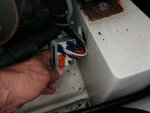
  1. Just below the engine, at the front, there is dangling a small relay circuit board - see picture. The LED is lit when the engine is running. I cn't find anything about it in the manuals an the ad-hoc nature indicates a non-standard item. Anybody any ideas what this is?
  2. I have been toying with my engine start process (Beneteau recommend using the batteries as a single bank, both on or both off). I'm not happy with that and would like to use them as two separate banks. Both House and Engine batteries are paralled and both feed all systems including start. I tries starting from the Engine battery (House off) only to find both batteries are being charged when the engine is running. Not like the circuit reads. Is this a common modification to Beneteau circuits?
Any thoughts on the two questions would help

Tony
Beneteau Oceanis 323 Clipper
 

Attachments

  • Relay.jpg
    Relay.jpg
    58.2 KB · Views: 69
There is a current thread on intermittent starting, where one correspondent mentioned a relay inserted into the starter motor line, activated by power from the key switch. This means that the current to actually power the starter motor does not have to suffer the voltage drop of the cable run up to the key switch and back. Not withstanding the potential failure of an extra electro-mechanical component, it should help improve the reliability of starting. Maybe it is just such a relay.
 
There is a current thread on intermittent starting, where one correspondent mentioned a relay inserted into the starter motor line, activated by power from the key switch. This means that the current to actually power the starter motor does not have to suffer the voltage drop of the cable run up to the key switch and back. Not withstanding the potential failure of an extra electro-mechanical component, it should help improve the reliability of starting. Maybe it is just such a relay.
Thanks for that suggestion. I will look to see if it is a second relay in the starter motor circuit. However, I would have though the LED would be momentary as the switch is set to start? This is suggesting that the voltage drop is too much from key to the solenoid switch to actuate, and thence the starter motor.
 
Second thoughts: it could be a split-charge relay, to ensure starter battery charging prior to house bank charging. Is the input from the alternator?

I didn't address your second point: I'm with you in that I wouldn't want the starter battery permanently paralleled to the house bank. If you leave something on accidentally, you lose the ability to start the engine. When talking about 'banks' though, I take it to mean house batteries, with the starter battery separate. In this context, I'd rather have one large bank, rather than two smaller banks, as this has advantages on charge cycle times and related efficiency of charging from the alternator.
 
Second thoughts: it could be a split-charge relay, to ensure starter battery charging prior to house bank charging. Is the input from the alternator?

I didn't address your second point: I'm with you in that I wouldn't want the starter battery permanently paralleled to the house bank. If you leave something on accidentally, you lose the ability to start the engine. When talking about 'banks' though, I take it to mean house batteries, with the starter battery separate. In this context, I'd rather have one large bank, rather than two smaller banks, as this has advantages on charge cycle times and related efficiency of charging from the alternator.

She only has two batteries, both 70Ah and they are labelled Engine and House but are wired/switched in parallel as though they were one big bank. Not so sure about a Split charge relay - I fitted a VSR to my last boat and it was current rated at 125Amp. This thing looks like its rated for 5A max. The difficulty is the wires disappear into the engine mount and I havent been able to trace them.

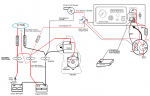
Here's the manual picture
 

Attachments

  • Batery Manual.PNG
    Batery Manual.PNG
    102.8 KB · Views: 19
That's a warning circuit to indicate that your engine bearer is rusted to limits. It should trigger any day now :ROFLMAO::ROFLMAO:
Just joking.

I assume you've checked it's not the engine room blower relay? I would disconnect the single black wire (next to the white one) turn on the ignition and see what happened, or rather what didn't happen that previously did!


On the battery arrangement you can think about it two ways. Dedicated start battery as is common or only split the batteries when the voltage is below a set level. Think of it like a reserve for starting.

Both require a charging system of some type and of course split diode or VSR is the common modern solution or the old 1,2, both switch for the luddites. However, as soon as you add a constant charge via solar to a system with a VSR you are effectively running both batteries in parallel all the time you have sunlight and starting from both too as the VSR will see the charge voltage on the house battery and keep them connected until the voltage is dragged down by the starter load.
 
I assume you've checked it's not the engine room blower relay?
I was going to suggest this, but the diagram puts this relay behind the engine panel. I don't know if the OP has checked this. It would be understandable if someone has had to replace it at any time.
 
I was going to suggest this, but the diagram puts this relay behind the engine panel. I don't know if the OP has checked this. It would be understandable if someone has had to replace it at any time.
A lifetime reading technical manuals has left me with a healthy cynicism for their contents.
 
As for splitting the batteries so that the starter battery is not drawn on for house loads:
As you have three handles (an alternative to 1-2-Both) give the starter battery time to charge after being used to start, then switch it off. The alternator will then power the house load only. Remember to switch starter battery back on when you next start.
 
As for splitting the batteries so that the starter battery is not drawn on for house loads:
As you have three handles (an alternative to 1-2-Both) give the starter battery time to charge after being used to start, then switch it off. The alternator will then power the house load only. Remember to switch starter battery back on when you next start.
:ROFLMAO:
 
That's a warning circuit to indicate that your engine bearer is rusted to limits. It should trigger any day now :ROFLMAO::ROFLMAO:
Just joking.

I assume you've checked it's not the engine room blower relay? I would disconnect the single black wire (next to the white one) turn on the ignition and see what happened, or rather what didn't happen that previously did!


On the battery arrangement you can think about it two ways. Dedicated start battery as is common or only split the batteries when the voltage is below a set level. Think of it like a reserve for starting.

Both require a charging system of some type and of course split diode or VSR is the common modern solution or the old 1,2, both switch for the luddites. However, as soon as you add a constant charge via solar to a system with a VSR you are effectively running both batteries in parallel all the time you have sunlight and starting from both too as the VSR will see the charge voltage on the house battery and keep them connected until the voltage is dragged down by the starter load.

Ah, a little bit unfair....... I can count my ownership weeks on one hand and most of those she has been in the yard unavailable to me. The engine mounts are on my list of must do's. Alongside the engine inlet and stern seal seacock (why she was ashore.

I will check the blower, tomorrow - it sounds the most plausible answer. The Engine panel has been repaired at some point (no panel bezel) and I took some photos of the rear yesterday. I couldn't see a blower relay. I'm surprised it doesn't have it written on it - most things Beneteau have a label.

Tony
 
As for splitting the batteries so that the starter battery is not drawn on for house loads:
As you have three handles (an alternative to 1-2-Both) give the starter battery time to charge after being used to start, then switch it off. The alternator will then power the house load only. Remember to switch starter battery back on when you next start.

Hi Hissy,
both batteries charge whenever the engine is on. No matter which battery started the engine or if switched on or off. Obviously one will be on while the engine is running
 
I have exactly the same on my Ben 343.

I don't have a clue what it is either, im guessing its something to do with the charging relay.
 
Top