Beating to windward - stupid question!

skyflyer

Well-Known Member
Joined
26 Jan 2011
Messages
1,433
Location
Worcester, UK
Visit site
If I am trying to make best possible VMG to windward, does leeway change (increase) with increasing windspeed?

Obviously the boat speed is limited by hull speed, no matter how much wind we have.

Presumably therefore once you have achieved hull speed, any further increase in windspeed will simply manifest itself in extra 'slippage' of the hull downwind?

But leeway seems always (I think) to be quoted as a fixed angle.

It only recently dawned on me (Ive been sailing only 8 years) that although I can often make a good angle to the wind, when it starts t blow I end up tacking again and again and again and making very little progress!

Presumably the best strategy is to reef to carry just enough sail to make hull speed?

Is this a fair assessment or am I missing the point?
 
If I am trying to make best possible VMG to windward, does leeway change (increase) with increasing windspeed?

Yes. You should allow for it when dead reckoning. Hitting waves saps speed too especially in a cruiser with buff bows.

It really makes a difference keeping the boat flatter - when racing this means crew weight hiking - until you see it done you'll not believe what a difference hiking a bit harder can have when trying to climb up on a nearby competitor.

As a cruiser you probably don't have as many options. Flattening the sails and otherwise trimming for stronger winds makes a difference. If that isn't good enough, then you'll need to reduce sail.

And remember the axiom. Speed first, pointing second. keels rely on boat speed to give lift to windward.
 
It's not a stupid question at all. The quick answer is that leeway does change as the yacht heals more and gets pressed. On my Rival it changes from 5 degrees for normal close hauled, not stressed, to 10 degrees in a good blow at hull speed, to 15 degrees when pressed hard. Measure it for your boat by sighting through the back stay then along the stern wake slick and subtracting the hand bearing readings. You can make up a table if you wish. Or check it via the plotter.

At hull speed anything extra just tries to burry the stern further down it's stern wave and push the boa higher up the bow wave. At hull speed you should have a bow wave at the bow and a stern wave at the stern, over canvassed and there is a tendency for the stern to to run down the stern wave (wake). It's a rough guide as well as weather helm and angle of heel.

Personally, when the wind is up and I am pressed, I sail slightly free, crack off the sheet and inch or two and sail by the tell tales. My own tub powers up and gets to windward. If I try and sail best course to windward, I slow down through a combination of pinching and being stuffed at slower speed by a wave. I have sailed with fantastic helms who keep the yacht in the groove going to windward but I am not like them, so I free off a bit.

I always reef if I am pressed and might drop .1 or .2 of a knot water speed but the ride is smoother, the course is straighter, the loads less and I think VMG is faster. A better helm than me could probably squeeze faster VMG but it just means he gets the pints in, I will only be 15 to 30 minutes behind.
 
Last edited by a moderator:
Bear in mind that 'hull speed' is not a brick wall.
It just means you need a lot more power for every % of speed above that.
 
If I am trying to make best possible VMG to windward, does leeway change (increase) with increasing windspeed?

Obviously the boat speed is limited by hull speed, no matter how much wind we have.

Presumably therefore once you have achieved hull speed, any further increase in windspeed will simply manifest itself in extra 'slippage' of the hull downwind?

Yes hull speed acts as a soft speed limit and yes leeway increases with wind strength and wave height.

However, counterbancing this the difference between AWA and TWA gradually decreases as wind speed increases.

As the wind increases one can can therefore often free-off a smidge, make a little more leeway, but still make a better VMG, if that makes any sense.

Edit: Oops, not answered your question. Slow progress to windward in a blow probably comes down to some combination of five factors: i) cut/quality/set of the sails, ii) whether or not you have a suitable blade jib, iii) foil/hull efficiency, iv) steering technique and v) windage. A few more dets would open the door to more precise advice.
 
Last edited:
If I am trying to make best possible VMG to windward, does leeway change (increase) with increasing windspeed?

Obviously the boat speed is limited by hull speed, no matter how much wind we have.

Presumably therefore once you have achieved hull speed, any further increase in windspeed will simply manifest itself in extra 'slippage' of the hull downwind?

But leeway seems always (I think) to be quoted as a fixed angle.

It only recently dawned on me (Ive been sailing only 8 years) that although I can often make a good angle to the wind, when it starts t blow I end up tacking again and again and again and making very little progress!

Presumably the best strategy is to reef to carry just enough sail to make hull speed?

Is this a fair assessment or am I missing the point?

You are short of some knowledge rather than missing the point.

Boat speed isnt limited by hull speed. Hull speed isnt a brick wall. Its simply a speed at which the amount of power needed to go faster starts to rise exponentially. So you can go faster than displacement hull speed without planing but it takes a lot of power to do so.

When beating your sails dont develope a force dead upwind. Instead you can see it as a force pushing you forward together with a force at right angles pushing you sideways. |As the wind gets stronger the forces get larger but for the hull speed reason you dont see much change in forward speed but you do in leeway.

Leeway isnt a fixed number. You can measure it by taking your hand bearing compass and looking over the stern at your wake.

There are two classic errors in beating to windward. The first is to pinch ie sail too close to the wind. The second is to have excess sail up, a boat heeling a lot and lots of rudder on to correct the resulting helm. You look back over the transom and you can see the rudder acting as a sort of brake.

So keep the boat upright and dont pinch. After that its down to such issues as sail trim , rig set up etc.
 
When beating your sails dont develope a force dead upwind. Instead you can see it as a force pushing you forward together with a force at right angles pushing you sideways. |As the wind gets stronger the forces get larger but for the hull speed reason you dont see much change in forward speed but you do in leeway.

Excellent explanation! I hadn't thought of it quite that way and so simply.:encouragement:
 
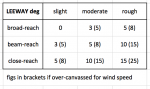
I always envision it as a bit of a three-axis matrix, where leeway increases:
+ the higher you point
+ the rougher the water
+ the less upright you sail

Simplified example:
Screen Shot 2017-08-03 at 07.01.21.png

Sea-state will be only partly dependent on wind-speed: wind over/with tide, depth of water and fetch will all factor.

I once shot past much bigger modern yachts on a short reach to Cowes in brisk conditions: they were carrying too much canvass, over-heeling and braking due to excessive helm.

Don't have a wind-instrument or use the GPS/plotter for VMG, but cracking off the wind a bit will always keep the boat moving - which will therefore reduce leeway.
 
Last edited:
I have never attempted to measure this in detail but my impression starts with the idea that leeway is actually high at low wind speeds until the keel gets to work. Above that, the main determinant is the sea state, especially at the point where it is not possible to avoid the occasional wave slowing the boat.

Keeping boat speed up is clearly the way to reduce leeway, but VMG can suffer if this is done to excess. On my HR 34 I can view VMG on the meter and in reasonable conditions my best VMG is actually achieved when pinching slightly, with the luff of the jib lifting slightly, providing this can be done accurately.
 
Fascinating thread, thank you to the OP and all contributors.

I had only partly been aware of the syndrome but now understand that I have been sailing somewhat inefficiently for most of my life. :o Although I have of recent years realised that too much sail/heel is not the way to go about it and that sailing a little "off" is more comfortable and better.

The Forum at its best. :encouragement:
 
Am I right that the ideal is to have about 7 degrees of weather helm (but certainly no more than 10 degrees) to counter act leeway? Apparently the rudder at 7 degrees combines with the shape of the keel to give some "lift" as the water flow is similar to air over a wing. So the lift to windward counteracts leeway. Too much weather helm makes the rudder act as a brake. Of course this must vary according to the shape of the keel and the design of the rubber

Tudorsailor
 
Am I right that the ideal is to have about 7 degrees of weather helm (but certainly no more than 10 degrees) to counter act leeway? Apparently the rudder at 7 degrees combines with the shape of the keel to give some "lift" as the water flow is similar to air over a wing. So the lift to windward counteracts leeway. Too much weather helm makes the rudder act as a brake. Of course this must vary according to the shape of the keel and the design of the rubber

Tudorsailor

In essence, yes. 5 degrees is the number most boats aim for.

To answer the OP... If you ignore the effect of waves knocking you sideways, then leeway in essence is a factor of how fast you are going and how much heel you have. The faster you're going then the more "grip" your keel and rudder have on the water. Then obviously as the boat heels the keel is at a less and less advantageous angle to the water and loses grip that way.

So most boats will have an ideal heel angle for beating to windward. In essence the more power you can hold down for that heel angle the faster you will go, so the less leeway.
 
OK, this thread is very informative and a joy to read. I'm curious about this though:

Yes. You should allow for it when dead reckoning. Hitting waves saps speed too especially in a cruiser with buff bows.

It really makes a difference keeping the boat flatter - when racing this means crew weight hiking - until you see it done you'll not believe what a difference hiking a bit harder can have when trying to climb up on a nearby competitor.

I've got a modern hull (Sun Odyssey 30i) which has a fairly flat bottom and as a result can be prone to slamming when faced with waves on the bow. The slamming tends to massively rob the boat of speed.

One way to ease the slamming is to heel the boat, and present more of a knife edge to the oncoming wave.

But this is incompatible with keeping the boat flat.

My thoughts are that, given slamming can often almost stop the boat dead when it happens, the thing to do is put on a bit of extra heel and accept the additional leeway?
 
OK, this thread is very informative and a joy to read. I'm curious about this though:


I've got a modern hull (Sun Odyssey 30i) which has a fairly flat bottom and as a result can be prone to slamming when faced with waves on the bow. The slamming tends to massively rob the boat of speed.

One way to ease the slamming is to heel the boat, and present more of a knife edge to the oncoming wave.

But this is incompatible with keeping the boat flat.

My thoughts are that, given slamming can often almost stop the boat dead when it happens, the thing to do is put on a bit of extra heel and accept the additional leeway?

For just about every racing boat ever made there is a list of class specific tips to make the boat fast that wouldn't work on other boats. What you've found is a technique to get the best out of your boat that is counter intuitive to sailors of other boats.
In this case what you're doing is trying to maximise VMG by going faster and trading that off for a bit of leeway. Another technique that I'd try in that sort of boat is to add a little twist to the main (car up the track, kicker slightly eased and sheet boom to centre line) and intentionally sail 1/2 knot or so faster than true upwind but a little flatter. If that gets you enough of a better angle to the waves to limit the slamming then you could well find that you're in effect going the same net direction as heeled over with leeway but a bit quicker and flatter.
But would depend on the angle you were achieving being enough to prevent the boat being stopped by the waves, and will change with the conditions.
 
For just about every racing boat ever made there is a list of class specific tips to make the boat fast that wouldn't work on other boats. What you've found is a technique to get the best out of your boat that is counter intuitive to sailors of other boats.
In this case what you're doing is trying to maximise VMG by going faster and trading that off for a bit of leeway. Another technique that I'd try in that sort of boat is to add a little twist to the main (car up the track, kicker slightly eased and sheet boom to centre line) and intentionally sail 1/2 knot or so faster than true upwind but a little flatter. If that gets you enough of a better angle to the waves to limit the slamming then you could well find that you're in effect going the same net direction as heeled over with leeway but a bit quicker and flatter.
But would depend on the angle you were achieving being enough to prevent the boat being stopped by the waves, and will change with the conditions.

Helpful, thanks. Being a bog standard cruiser though, we don't have a mainsheet traveller :-/
 
Helpful, thanks. Being a bog standard cruiser though, we don't have a mainsheet traveller :-/

Unfortunate. In that case try a little ease but with a tad more kicker. In essence you're trying to keep the boom as close to the centre line as possible but not having the leach of the main straight. You'll just have to play with the kicker and sheet to try and achieve something suitable.
 
Helpful, thanks. Being a bog standard cruiser though, we don't have a mainsheet traveller :-/

Travellers are readily available in a range of widths, and are fairly easy to fit (depending on whether coachroof-mounted or bridge-deck or aft of the cockpit) by drilling through and fixing with machine-screws, penny washers and nylock nuts, and sealing the whole caboodle with marine sealant.

Even on my low-tech, heavy, long-keeled cruiser the ability to manually shove the bottom block up or down the traveller and lock it in place makes a good deal of difference to speed, performance and reduction of heeling - depending on whether one wants to flatten the mainsail for closer pointing in higher winds (move it down) or give it lots of belly in lighter winds (move it up), etc.
 
Even on my low-tech, heavy, long-keeled cruiser the ability to manually shove the bottom block up or down the traveller and lock it in place makes a good deal of difference to speed, performance and reduction of heeling - depending on whether one wants to flatten the mainsail for closer pointing in higher winds (move it down) or give it lots of belly in lighter winds (move it up), etc.

It's on the list, but other things are above it, like a decent solar power system.

Basically, if it becomes that much of an issue, we tend to just engage the magic iron sail.
 
Travellers are readily available in a range of widths, and are fairly easy to fit...

T'aint cheap though, looks like 2-300 quid to replace mine. Currently just have a U-bolt that the previous owner put in when the last traveller's car exploded on him.

Unfortunately it doesn't seem to be something people take off boats when scrapping them or e-bay would be full of suitable kit...

I was thinking I might experiment with an additional line from the boom to the aft cleats to help move the sheeting angle and see if there's 300 quid of performance to be gained or not.
 
Top