Beaching yacht legs - what lines to run?

wonkywinch

Well-Known Member
Joined
30 Jul 2018
Messages
3,884
Location
Hamble, UK
Visit site
My boat (2016 38' Beneteau Oceanis with lifting keel) came with a pair of beaching/yacht legs to fit the plate already installed on the hull. I am fortunate that the original purchaser spec'd her with every single Beneteau option except a generator and air conditioning.

Ancasta Hamble have been really helpful and sent me the instructions. They do not mention the best type of rope to run fore/aft as stabilising lines. I was thinking of something about 6mm that floats.

I've checked the excellent resource provided by Vyv Cox and others but wondered if anyone could suggest whether this should just be the cheapest poly or worth spending a little extra on dyneema and whether 6mm is up to the task of stopping forward/lateral motion of the leg when the tide is coming in/out?

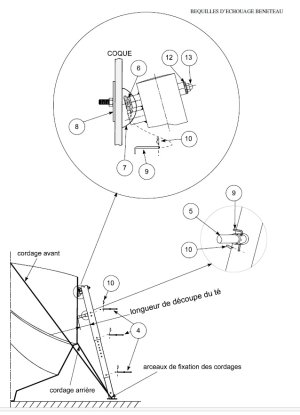
The slightly annoying thing is as the kit hasn't been used, the T section stand offs have not yet been trimmed to length (as suggested in "les instructions") and this should be done out of the water such that the feet sit c one foot above the keel.

Installing Yacht Legs - Cox Engineering

The Yacht Leg and Cradle Company
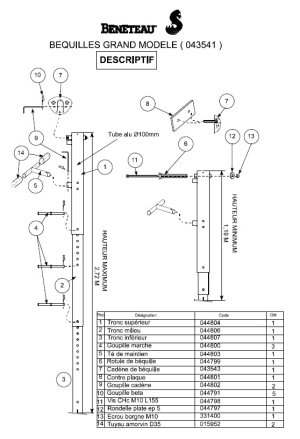
leg1.jpg
leg2.jpg
 
I have a set of those legs on my Seal 28 lift keel and use them for mid season scrub offs. You might find 6 mm is a bit slim for comfortable use although plenty strong enough. Standard polyester 8 mm three strand should do the job. I find that I usually only have to rig the forward or after lines, depending on which way the tide is flowing. The weight of the legs tends to hold them in place. I don't have them set so splayed out as in your diagram, though. Mine have fixed feet, not tilting ones. It's worth fitting the lines with quick connect ends (snap shackles, maybe) because it's always a bit of a rush to get everything sorted when taking the ground. If you can, it's always comforting to be able to wade around your boat as she touches down so you can adjust the legs precisely.
 
I have a set of those legs on my Seal 28 lift keel and use them for mid season scrub offs. You might find 6 mm is a bit slim for comfortable use although plenty strong enough. Standard polyester 8 mm three strand should do the job. I find that I usually only have to rig the forward or after lines, depending on which way the tide is flowing. The weight of the legs tends to hold them in place. I don't have them set so splayed out as in your diagram, though. Mine have fixed feet, not tilting ones. It's worth fitting the lines with quick connect ends (snap shackles, maybe) because it's always a bit of a rush to get everything sorted when taking the ground. If you can, it's always comforting to be able to wade around your boat as she touches down so you can adjust the legs precisely.
I was thinking of shackles for the lines as there are welded rings fore & aft on the foot which is also welded at a fixed angle of approx 7-8 degrees off vertical. This is probably the reason for the requirement to trim the stand off tee to the right length to suit the particular boat.

We're planning an Isles of Scilly trip this season and the ability to take the ground would open up a lot more opportunities. Just need to buy a small collapsible ladder now.
 
I was thinking of shackles for the lines as there are welded rings fore & aft on the foot which is also welded at a fixed angle of approx 7-8 degrees off vertical. This is probably the reason for the requirement to trim the stand off tee to the right length to suit the particular boat.

We're planning an Isles of Scilly trip this season and the ability to take the ground would open up a lot more opportunities. Just need to buy a small collapsible ladder now.
7-8 degrees sounds about right, I have those stamped plate shackles with captive half-turn pins for the connections to the feet. The Seal 28 has pronounced tumble-home so my stand -off tees need to be quite short.

Good luck for your Scillies cruise! Had a fin keel at the time of my visit so didn't try any drying out - but lovely area. I've still got Norm's book 'A yachtsman's guide to Scilly'
 
I'm not into legs for going aground - with a cat you simply check the day before, go aground and let the tide do the work.

But unless you are going to touch, dry out and then refloat (at the next high tide), which is not very long you will need shore lines. When the tide returns, and you intend staying, then you will need stern lines, 2 off and bow lines, 2 off (one bow line can be the anchor). We could get away with one bow line, the anchor and 2 stern lines. We would beach stern first as then you can come out bow first.

We would deploy the anchor as we arrived, with enough rode to allow us to touch by moving into more shallow water. Then take the 2 prepared stern lines, with anchors inshore, by dinghy, (but still in the water) to secure the stern. Once the 2 stern anchors are secure take in the tension using sheet winches so that the yacht is secured between the anchor rode and 2 stern lines. In your case you then need to secure the legs - you need competent crew and good preparation.

You can deploy the stern lines by hand, wading - it depends on what draft you have with the keel up. Wading through 4' deep water with a Fortress anchor and its rode is not quick.

It all sounds complicated - but its quite simple really. Ideally performed with good shelter, no wind and no swell nor chop. Once you have the anchor deployed and the 2 stern lines tensioned - you will have more than enough time to secure the legs..

When you float off you should be able to lift the 2 stern anchors from the dinghy and use the windlass, gently, to pull the yacht forward

Apologies if this does not suit - simply trying to extrapolate what happens with a cat to a mono. :)

Jonathan
 
Last edited:
We had legs on our Deb 33. The fore and aft lines aren't under much strain (if they are, something has gone wrong). I think I just used whatever was lying around, like Vyv says old genoa sheets are perfect
 
Why dont people attach these things to shrouds/chainplates, which I would expect to be strong enough and to provide lateral stability too? I suppose the legs would have to be longer, though.
 
Last edited:
Why dont people attach these things to shrouds/chainplates, which I would expect to be strong enough and to provide lateral stability too? I suppose the legs would have to be longer, though.
I am not familiar with the hull attachments in the diagrams, post #1, but the Yacht Legs ones are made to a clever design that works perfectly and rapidly. Tying the legs to the chainplates is none of these, definitely not recommended.
 
I have just replaced mine with ratchet straps, after the genoa sheet i was using stretched my an inch or so and the boat moved, just enough to give me a big fright. it possibly slipped off a pebble or slipped /stretched just enough and ended up at a slight angle. I dont run them bar tight, but tight enough so nothing can move. It was not expensive but will likely outlast me!
 
I am not familiar with the hull attachments in the diagrams, post #1, but the Yacht Legs ones are made to a clever design that works perfectly and rapidly. Tying the legs to the chainplates is none of these, definitely not recommended.
well, the ones I've seen IRL were bits of shaped tree trunk bolted through the topsides. Lots of leverage potential which didn't seem very clever either, though they made me feel a lot better about my triple keel,.
 
Recent local experience revealed the advantage of drying out stern to the incoming tide.
We didn't and, each little wave lifted the bow causing the rudder to touch the sand. Bigger waves could possible have done some damage.
The beach had only a gentle slope but enough.
 
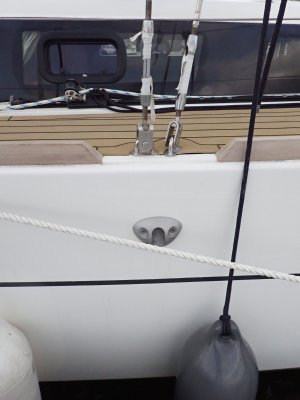
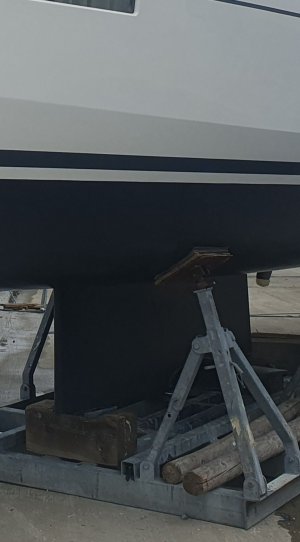
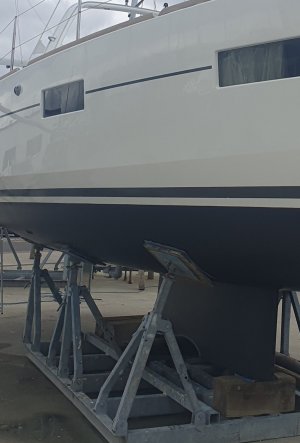
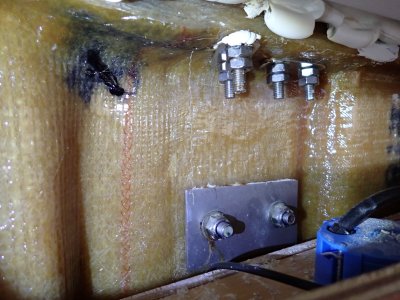
Had a look at the boat today and how it fitted together. The leg socket is mounted midships below the shrouds and is just held on with a backing plate.

The leg clips in securely and is set at the correct angle just by the socket alone. The T bar stand-off I can now cut to size and add some rubber grip handle stuff so it doesn't scratch the boat.

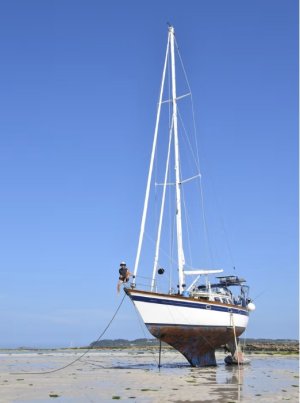
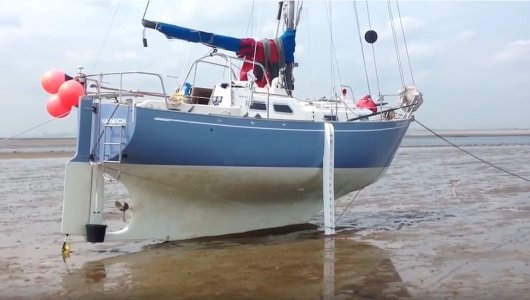
The pics on the Yacht Legs website look similar to the Beneteau supplied items and it gives me confidence that in the image the guy is sat right on the bow without the boat tipping forward.

yachtlegs.jpg
Image above copyright https://www.yachtlegs.co.uk/

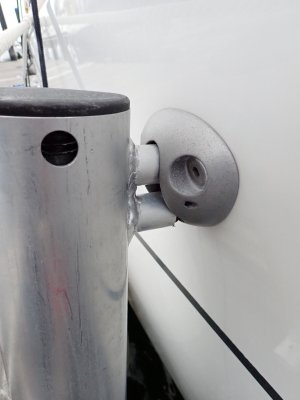
The attachment of legs on Beneteau ..

leg1_sm.jpg

leg2_sm.jpg

leg3_sm.jpg

All you cast iron boat owners will be shocked at the shroud fixing to the deck on these mass produced AWBs.
 
I cannot quite see from your photos - what stops the leg from dropping down? The YL sockets are closed, the spigot held in by a U bolt that engages with a rim on the inboard end.
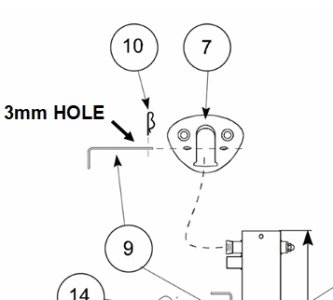
A 5mm dia SS cotter pin slides horizontally under & behind the leg knuckle in the hull fixing then secured with R clip. Not clear in the drawing but top left of my diagram.

You can see the hole for this pin in my image with the leg in position.
peg.jpg
 
Last edited:
Not my boat, but 'I wish'....

52740422874_f1839bdd08_c.jpg

This neatly illustrates one of the more important aspects of using yacht legs.... The bucket of seawater on a string, and the brush - for one's muddy boots.
Careful inspection shows that the 'bow' and the 'stern' lines are each fed around the bows/stern to t'other side - imparting 'toe-in'.

Opinions may vary....
 
The lifting keel on the O38 is quite a chunky cast iron box that has protruding wings with an aerofoil shape and completely flat bottom.

The lifting section is a blade that folds into the box on a bolt/pivot at the forward end. Raised in position it's going to help prevent mud and silt from plugging the keel box as it lays along the slot nicely

First impression is the boat could take the bottom and have a great deal of lateral stability even without the help of the legs although I'd never put that to the test.

I like the design of other legs where there is a crank to adjust the foot height. The one's supplied by Beneteau are preset holes in the telescopic legs with a cotter pin that doubles as a step locked in the an R Clip.

Photos are not recent, boat currently in water so no chance to plug and play.

Screenshot_20250609_221210_Dropbox.jpgScreenshot_20250609_221048_Dropbox.jpg
 
Last edited:
Had a look at the boat today and how it fitted together. The leg socket is mounted midships below the shrouds and is just held on with a backing plate.

The leg clips in securely and is set at the correct angle just by the socket alone. The T bar stand-off I can now cut to size and add some rubber grip handle stuff so it doesn't scratch the boat.

The pics on the Yacht Legs website look similar to the Beneteau supplied items and it gives me confidence that in the image the guy is sat right on the bow without the boat tipping forward.

View attachment 194524
Image above copyright HOME | The Yacht Leg and Cradle Company
The attachment of legs on Beneteau ..

View attachment 194521

View attachment 194522

View attachment 194523

All you cast iron boat owners will be shocked at the shroud fixing to the deck on these mass produced AWBs.
An L-shaped bracket backing plate, or a "knee" bracket web, might connect the chain plate with the leg attachment, with advantage to both, if you didn't mind being potentially considered a bit un-clever in some quarters.
 
Last edited:
Top