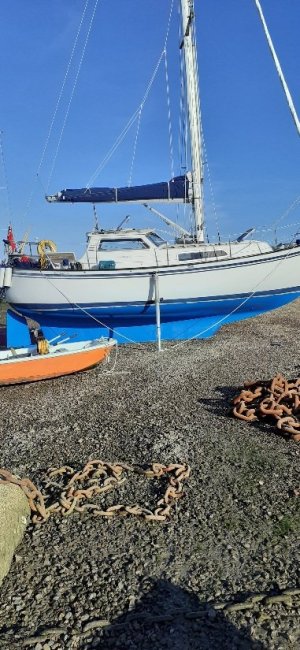
Beaching legs ?

Marceline

Well-Known Member
Joined
12 Sep 2020
Messages
389
Visit site
Hi - we're still looking for our next boat and have now after viewing a few have changed to pilothouse motorsailers as we're looking to sail initially Irish Sea (we're based in North Wales), then to go further afield to Scotland, Ireland, Scilly/Channel Isles, Northern France and hoping to build skills/experience to get over to Norway for a summer season - but that's our hopefull 10+ year plan so the boats we're looking are pilot house boats with space for two people but ideally not too big (seen some nice 28'+ boats) as our budget is pretty small but likely 28' - 33' - and though we're still wanting bilge keels for many reasons we've seen a few interesting fin keelers in that range

Because we will be based on a swing mooring in North Wales (and a lot of swing moorings really need bilge keels as they dry or partially dry at times) we've been focusing on bilge keelers - but last time I asked a similar question on an old thread others said beaching legs for fin keel/long keel boats could be a good option for occasional use (and we might be able to get a deep water swing mooring).

So just wanted to ask some advice from those with a fin keel who use beaching legs in the more tidal regions (eg: Brittany, Irish Sea) how they tend to use them for scenarios such as

- staying overnight in a drying harbour
- if tied up alongside drying on a quay/harbour wall do you also put out the leg on the other side 'just in case'
- drying out on a flat beach you've scouted beforehand for maintenance / having some time on the beach etc
- any other scenarios where they are useful ?

many thanks for any advice
 
I have legs for my Seal 28 - (shallow draft long keel motorsailer). They work very well for occasional use (as you describe) for me, but the previous owner kept the boat permanently on legs at Redwharf bay - although I can't believe it was a swinging mooring.
 
We have used ours a lot on a Sadler 34, shallow fin version. Many photos here Installing Yacht Legs. We were based in Menai Strait and have used them in the Strait, many places in Irish Sea, Netherlands, France. We have overwintered on them ashore.

Years ago two Sigma 33s moored permanently at Ramsey on a drying mooring on legs. I assume they berthed fore and aft, risks would be too great on a swinging mooring.
 
From all my sailing experience going back to the mid 60's, I avoid bilge keels like the plague. The first boat my parents had was a twin keel and to be frank, it was not a good sailing boat compared to fin keeled yachts. We only dried out in one harbour whilst cruising, they were only useful for drying out to scrub the boat (and yes I had to go between the keels as I was the smallest).

My general sailing area was the shallow Medway and Thames. I have cruised from north Holland to St Malo, all round the coast of the UK and never needed to use a drying berth. I am now based in N Wales and this year I am planning to sail round Ireland. So I have covered most of your intended area you intend to sail.

My personal view of beaching legs are they can be useful, but where do you you store them on a small boat. If you can solve this problem without affecting either your cabin space or usability of the boat in general, then go for them. My advice would be to sail for at least a year on whatever boat you choose before deciding whether you need them.

For your cruising comfort, the larger you can go for your budget will make life so much more comfortable. You can carry more water, fuel, clothes, food, etc. and sail faster. Some of your planned sailing area will mean fairly long legs, so getting there faster will mean shorter sailing days, therefore making it easier.

You have not indicated your budget, but pilothouse motor sailers are more expensive than regular sailing boats. They also sail slower, which means extending the time taken to reach your destination. The term motor sailer means you are far more likely to use your engine rather than sail as they have shorter rigs, which means you will use more fuel that may affect your sailing budget.

On a few occasions I have had to dry out against a wall with my fin keel, there have been no problems provided the boat has a few degrees of heel towards the wall. So to answer your question about fitting a leg, just not worth doing.

If you would like a suggestion for a good easy to sail boat with lots of internal volume, take a look at a Westerly Fulmar. Mine is a fin, but they built more twin keel versions. They layout is the same, just the keels are different and they sail better then most bilge keel yachts. They are 3/4 rigged, so the large mainsail is very easy to handle and the headsails are similar in size to a 28/30 ft boat making life easier to winch. Have a look at some of the links in my signature to learn more about my boat and my travels.

If you would like any further advice then I am happy to help. Buying the right boat is a big decision and so easy to get not the perfect boat for your needs.
 
Last edited:
Firstly, legs work just fine on the type of boat you are envisioning. We have and use legs on our (pimped) Colvic Watson, see avatar.

I made them myself using tubular aluminium pipe and a simple bayonet style fitting that allows the legs to be mounted in seconds (don't ask me why that is a good feature). They can be divided in the middle and easily stored in the aft locker when not in use.
I looked at the Yacht Leg brand and found them rather expensive, considering there is not a lot to them.

The problem with the general offering of pilot house motorsailers are their miserable sail area/displacement ratios and this is why they tend to be slow. There are very few actual motorsailers with twin keels and, as far as I know, hardly any were ever originally designed with bilge keel/plates. This goes especially for all the Colvic Watsons you see with bilge keels. These are almost always amateur fitted, not necessarily in the right place or with the necessary internal structure to take any of the loads to be expected in an accidental grounding. I would avoid these like the plague and they do not do the already marginal sailing performances any favours either. Legs are definitely the way to go.

The biggest bonus of twin keels are their shallower draft and I do believe this to be a significant bonus when cruising. With a nominal draft of 4' 4'' we have sailed the Dutch Waddenzee, explored Breton rivers, gunk holed around the Danish Isles, accessed tiny harbours in Ireland, Brittany, Holland, Denmark, Scotland, all barred to deeper draft vessels and still crossed the Irish and North seas and the Channel numerous times and in all reasonable weather. For drying out situations we have legs. Just as an example: Roscoff's new marina is a soulless construct, designed to test your skills with a vicious cross current, whereas the old, drying port is brimming with Breton charm. It is also considerably cheaper, just sayin'.

Pilot houses are wonderful, but they need to be truly functional as a helm and nav station, allow an unrestricted, all-round views, permit comfortable seating on either tack and, preferably, double as a deck salon. Ours has permitted us to cruise extensively in Ireland, Scotland, Orkney, Shetland, Norway and much of the rest of Northern Europe in gracious comfort, even in the off season. All on just over 30'.

The idea that MS don't sail is entirely due to the mostly miserable SA/D ratios. Fix this (as we did) and you will have a fine, comfortable cruiser, capable of carrying you and all the guff needed to explore many of the more remote or inaccessible places and to do so in safety and comfort.
Increasing SA will significantly improve their windward ability. It will never be as stellar as a fin keel sloop, but on all other, more cruising oriented courses there will be little or no difference in performance. It has been our observation that, and no matter how supposedly well something might go to weather, they all seem to motor when cruising in that direction. If anything, we appear to try harder at this than most. Not having to sit in the wind and taking a cold shower every other wave may have something to do with that. Feel free to check my Youtube video, "Rehabilitating the Traditional Motorsailer", for what is possible in that regard.
 
We had a set of Yachtlegs adjustable legs for a 33ft lift keel boat, and they were useful because in lieu of a boatyard, piles, or wall to dry against, I could just sit the boat down at the bottom of my croft every spring for antifouling and anode changes.
I was always tempted to use them when cruising but in practise I was afraid to ever dry the boat out somewhere unless I had thoroughly inspected it first. Having the boat dried out on legs also presents the quandary of whether you dinghy or walk ashore, because whatever you choose you are then stuck waiting for the same state of tide to get back. Also you obviously can't use your heads whilst dried out.
I know some people use legs as a way of keeping a fin keel boat on a drying mooring, but I would only ever consider that if the seabed was hazard free and the boat was moored fore and aft. I once dried out laid to a single anchor, and the wind shifted 180°, so that when we floated off, we swung round in a big arc, bumping the keel off the bottom as we went. Fortunately I had the legs a good bit shorter than the keel and neither of them caught on anything. They're not designed to take a lateral load like that. The downside of keeping the legs short is that you dry out with quite a noticeable lean on.
 
Hi - we're still looking for our next boat and have now after viewing a few have changed to pilothouse motorsailers as we're looking to sail initially Irish Sea (we're based in North Wales), then to go further afield to Scotland, Ireland, Scilly/Channel Isles, Northern France and hoping to build skills/experience to get over to Norway for a summer season - but that's our hopefull 10+ year plan so the boats we're looking are pilot house boats with space for two people but ideally not too big (seen some nice 28'+ boats) as our budget is pretty small but likely 28' - 33' - and though we're still wanting bilge keels for many reasons we've seen a few interesting fin keelers in that range

Because we will be based on a swing mooring in North Wales (and a lot of swing moorings really need bilge keels as they dry or partially dry at times) we've been focusing on bilge keelers - but last time I asked a similar question on an old thread others said beaching legs for fin keel/long keel boats could be a good option for occasional use (and we might be able to get a deep water swing mooring).

So just wanted to ask some advice from those with a fin keel who use beaching legs in the more tidal regions (eg: Brittany, Irish Sea) how they tend to use them for scenarios such as

- staying overnight in a drying harbour
- if tied up alongside drying on a quay/harbour wall do you also put out the leg on the other side 'just in case'
- drying out on a flat beach you've scouted beforehand for maintenance / having some time on the beach etc
- any other scenarios where they are useful ?

many thanks for any advice

I had legs on two boats over 40 years, the first I made myself and the later ones were the sectional, from the Yacht Leg Co. The sectional legs could easily be stowed on board a smaller 32 footer, totally out of sight in the lockers.

"- staying overnight in a drying harbour.." I seldom did this, not worth the bother for short stays. I can imagine situations where it would be very handy, for example where you are staying in one spot for a week or in situations where there is little or no deep water available, places like Sauzon where you could be very snug inside or otherwise hugger mugger outside the harbour.

"- if tied up alongside drying on a quay/harbour wall do you also put out the leg on the other side 'just in case'" As others have said, not worth bothering, especially with a longer keel design of modest draught.

"- drying out on a flat beach you've scouted beforehand for maintenance / having some time on the beach etc" Good, as long as there is no cross tidal flow or heavy wash around.

"- any other scenarios where they are useful ?" It means most yards will accept that you don't need a cradle, excellent for your proposed longer trips where you may need unexpected maintenance stops or even overwintering away from your base. No bother with cradle pads or the expense of hiring a cradle.
In extremis it gives you an alternative in poor weather, in Scilly you can imagine a situation where it would be very nice to be able to take the ground high up on the beach at Green Bay Bryher, one of the most sheltered spots in the islands.

Good luck with the hunt for a bilge keeler but I would look at long fin keels as well, they will track better, point higher and sail faster though this is less of matter for a motor sailer. The sectional legs are very expensive, though I have seen some good bargains secondhand.

.
 
My pilothouse motorsailer came with yacht legs. I have not used them yet - my biggest concern is any swell or surging when drying out. So in 100% sheltered, no tide flow areas with flat predictable bottom I would use them. I wouldn't leave a boat on a swinging mooring on them - definitely not Menai.

With regard to pilothouse boats, they are great (I am N Wales based) and I agree with Laminar Flow's comments. Don't be fooled by the term motorsailer - look at the SA/D ratio and the keel configuration. Many are long keeled (like mine) and are slower than modern designs but will sail respectably once you understand what they can and can't do. My % motoring hours when cruising is around 50% and similar I understand to 'pure' sailing yachts when cruising.

Same argument with bilge keels - Westerly and Moody twin keels sail respectably. Konsort Duo? LM?

Being able to see out at anchor and when keeping watch is a big plus, especially in our Northern climate.
 
One (and a few others) of the photos on the Yacht Legs site is mine. Taken in the harbour at Ile d'Yeu, dried out with the dinghy alongside. The alternative was a buoy in deep water outside, in a Catherine wheel with 10 other boats. No contest.
 
Top