Beaching legs- easy?

NickRobinson

Well-Known Member
Joined
23 Dec 2007
Messages
2,143
Location
Near Burton-on-Trent
Visit site
All my yachts have been bilge keel.

OK, not the best sailers but I've parked on many beaches, walked ashore etc, often on purpose..

I've looked at some boats with beaching legs. Do they work? They look extremely vulnerable.
I imagine one sinking into the mud, crunching the hull fitting as the boat leans over..

Am I not getting it?
 
You are getting it. I had a boat with legs and used them BUT -

- always case the joint at low water first before going aground using the legs the following day.
- be sure you are completely sheltered
- be sure that the fore and aft rigging of the legs is such that they cannot shift.
 
I've got telescopic beaching legs for my Deb 33. Really like them, and as I am quite far from the nearest boatyard they have more than paid for themselves, allowing me to beach the boat every year for antifoul and anode changes.
Obviously they're not as robust as bilge keels, but the company that made them claimed that no yacht had ever fallen over using them.
A few pointers: as Kukri says, you need to check out the drying area beforehand, surely a sensible precuation when drying out any type of boat I would have thought.
Secondly, and a little counter-intuitively, you need to ensure that the legs are about six inches shorter than the boat's draft, so that it will definitely tip over one way or the other. One leg will be left a foot off the ground.
There are two reasons for this. One is that it ensures that almost all of the weight goes on the keel, with one leg acting just as a stabiliser. You certainly want to avoid the possibility of both legs taking the full weight between them, with the keel suspended off the ground. They are not designed to take that kind of load.
The other reason is that you want the boat to have to float back onto an even keel and then lift cleanly off the bottom, with the legs well clear of the ground. This avoids the possibility of the legs dragging sideways along the bottom as the boat refloats.
If sitting out through several tides, I always rig up a fore and aft mooring so that the boat comes down in the same place, and so that if there has been a wind shift the legs will not risk catching in the anchor chain.

It probably sounds more complicated than it is in reality! I am a big fan of these legs, and just knowing I had them aboard has always been a comfort when exploring shallow waters.
 
We've got great oak affairs for legs so it's a bit tricky getting them to sink. I've learnt to get a bolt through them now and then lever them down.
Just as Kukri says above. Also Kelpie's comments - we always have an anchor fore and aft to try and hold the bow to the waves and hold it in the same place.
Surprisingly stable when dried out!
https://1drv.ms/u/s!AnTfH9NpYEvt7GHjDhxT_XmSHs1q?e=MfdP6q
 
It is many years since I had a boat with legs, and where she was moored, she dried out at most low tides. I think that legs should be made with removable feet, so that feet to suit the ground conditions are fitted beforehand. Hard ground - small feet. Soft ground - big feet.
 
....
Am I not getting it?

You are probably right to question the idea if you do not have a pressing need. I have had legs on boats for 35 years and overwintered on them for 25 but have gradually used them less.

If I was a young man with maybe a Barbican, Island Packet, Vega or similar shallow draught boat and I was setting off over the western horizon then I think they could be very useful. Shallow draught is important in getting into the best places but there are places where the range makes them no use at all except when going into a yard.

You really need something that breaks down and stows within the boat; it's not cheap, not particularly convenient to set up but could save money on a long trip and can beat rolling about at anchor.
 
The Anderson 26 has integral grounding legs in tubes from the hull bilge to the deckhead, they're raised and lowered from on deck, the foot pads fair in with the hull when raised.

The potential for horrible damage if a leg sank in and the boat went over on it is toe curling; the last I heard nobody uses them, like all legs they are probably OK for a sheltered stop with crew keeping an eye, but the idea of legs all season on a half tide, firm seabed mooring makes me cringe.
 
It is many years since I had a boat with legs, and where she was moored, she dried out at most low tides. I think that legs should be made with removable feet, so that feet to suit the ground conditions are fitted beforehand. Hard ground - small feet. Soft ground - big feet.

We see lots of boats in France using them . Yes they work, but are extremely expensive.

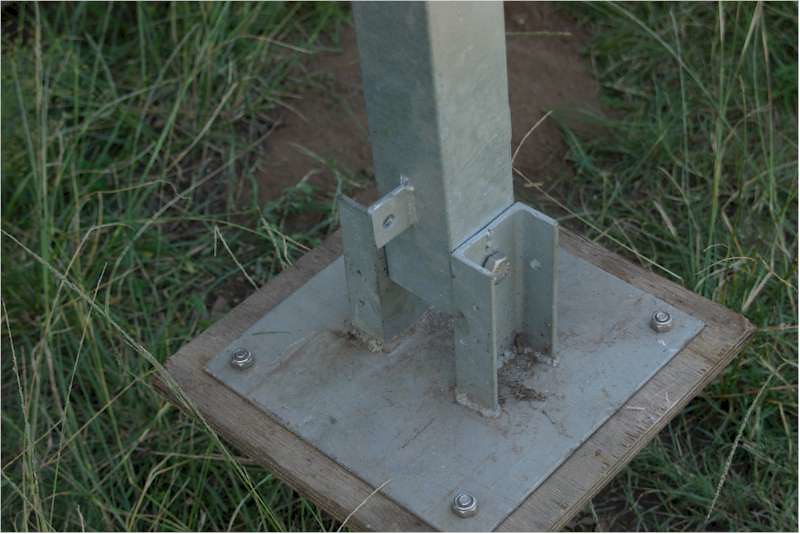
Big feet

35696427270_fb2f69e33c_c.jpg


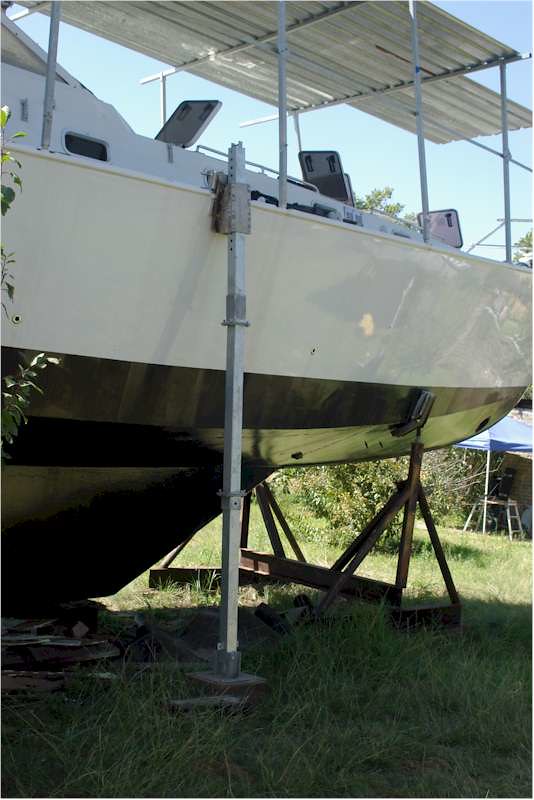
Simple fabrication from steel square tube.

35246087664_e1a63cd111_c.jpg


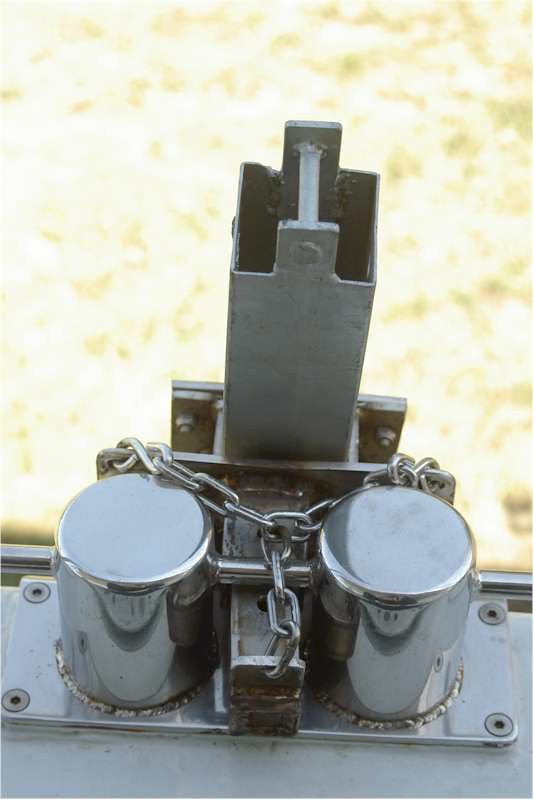
Attached to centre bollard

36086036525_ffe36a2371_c.jpg
 
You have the advantage there of a steel hull, where everything is massively strong. Mine were for a wooden boat, so though similar, needed a pad against the hull, down towards the WL. Mine, like yours were made of galvanised steel, except that mine were made of pipe. I see no reason why legs need to be expensive.
 
I used legs daily for years. All the problems have been mentioned above, but:
if you are on soft ground a leg can sink, mine did once and I had to get to it at LW and take the bolt out, as a similar boat had been held down that way and filled on the flood.
if you use a large foot pad the keel may sink in and leave the weight of the boat on the legs.
Length, round here we use 2in short both sides, the boat can range back and forth but settles on the keel before leaning one way. For the same reason there is only one bolt, should the leg catch the ground it will swivel rather than split, I have seen a two-bolt leg split.
I would think you could make a leg from square section ally with a wood cheek to fit the hull. The bolt would be in the middle of the curve of the cheek, captive in the ally, but of course you need access inside the hull for someone to put the nut on, and a bung/spare bolt for the hole. Angled out a bit is good.
I always thought round tube was the ideal, until my engineer friend pointed out that square section has flat planes in two orientations at 90 degs, and better resists bending.
 
We’ve got some of the posh ones that are telescopic. Happy to use in settle weather on a good bottom. Others are more confident and they seems to be fine even in a blow some say. If you love taking to ground then they’re not a great alternative to a bilge keeler.

22C62D41-67FD-44F5-849F-56F046AEBF17.jpeg
 
I know of at least three boats that berth permanently on legs. They are fore and aft moorings, not fully swinging. We have used legs many times on anchor, without knowing the bottom, but were always on board when we settled. The reality is that it has always been stress-free and we usually find the water level half way down the rudder when we are still waiting for the bump as the keel settles. Info on my website may help the OP.

Unfortunately Yacht Legs are no longer made but it should be easy and not expensive to make simpler copies.
 
Unfortunately Yacht Legs are no longer made but it should be easy and not expensive to make simpler copies.

I’m really surprised that Yacht Legs haven’t sold the rights and someone hasn’t taken it on with better branding and marketing.
 
I’m really surprised that Yacht Legs haven’t sold the rights and someone hasn’t taken it on with better branding and marketing.

The adjustable version must be quite expensive to make, although their mark-up seems very high. They wanted £160 for a pair of hull fittings about a year ago. The design is quite clever but very basic machining.
 
More to the point, what is under those fastenings? If the boat were to shuffle fore and aft or lean a bit heavily there might be a bit of alas and alack.
 
Top