Beaching legs and balance

Joined
13 Oct 2017
Messages
1,953
Location
solent
Visit site
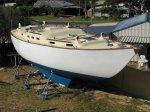
Our "other" trident that came in bits is almost finished, so off came the props and wedges for moving it to a better place for later pick up.
Upon putting it back down off the telelhandler I setttled the keel on good flat solid concrete in the yard, then put the beaching legs on only, without props. I ensured the weight was going through the keel with the props doing no mare than a balancing act.
I then climbed up onto the boat with a ladder over the stern, and I could feel it rock on the keel a bit to the stern. I am 12 stone soaking wet so no giant. This has made me think a touch more about ever using the legs in anger.
Paranoid or justified caution?
 
On my last boat with beaching legs, the legs were ~30mm or so higher than the keel. I understand it was designed to account for the keel sinking into sand/soft bed taking the majority of the load, and the legs being there to steady the boat.
 
Was it pivoting on the aftermost corner of the keel (so could have continued falling backwards) or just rocking slightly because the base of the keel wasn't in contact with the concrete all the way along?

Pete
 
It sounds more like a factor of keel shape or something under it if the boat was moving fore and aft, rather than a problem with the legs. Thousands of boats use legs every day with very few reported problems. There is a page about them on my website.
 
they are the proper legs for the boat, I spaced one of the legs to take up the slack. On reflection, I never climbed up the stern before but always put the ladder up the side to the cockpit. I am just going to put it down to the concrete maybe being uneven under the keel so it is able to rock.
 
Suspect it is just your additional weight at the end of the boat - think of a pendulum. would probably do the same if you were dried out against a wall and tried to climb over the stern.
 
Nothing wrong with the boat rocking slightly. I actually set up my legs so that they are a good six inches short of the keel.
 
On another note: The deed has has been done now, but you mentioned using a telehandler to lift her. There was a discussion on Facebook recently where compression damage to boats had occurred due to being lifted without the lifting machine having spreader bars. If you have access to the Hiab & plan to do future lifts yourself, it may be worth rigging some up.
 
Fore and aft balance of a keel boat is a major concern when on the hard. Much depends on the chord of the keel at the bottom. (length fore and aft at the bottom) Obviously a long chord keel relative to the boat length gives less chance of tipping onto it's nose or stern. However long chord means less efficient keel. So modern boats tend to be shorter chord longer keel. Many boats have a keel shape swept aft ie the bottom is further aft than the top. (looks fast but the real reason is to place the bottom of the keel under the c of g of the boat while keeping the centre of lateral resistance forward under the sail centre of lateral resistance. ) Next problem is that the flat bottom of the keel so good for sitting the boat on is not the best for efficiency indeed a semi elliptical keel bottom with rounded bottom when viewed port to starboard is best. None of which are much good for sitting the boat on.
So much depends on the boat design. But even so for a small to medium sized boat I would always have support at bow and stern when on the hard. In some cases tie the bow down to the cradle to stop tipping aft down. Just be very careful.
I have no experience of drying out moorings and legs but I imagine it is not such a disaster if the boat tips down into the mud but still a bit frightening if you are on board. All you can do is get the balance as close as possible if you have just two posts for legs. Much better the 4 posts and a rail across the bottom. olewill
 
I can't use timber props as I am building my yacht on a backyard lawn so I made up a system using acrow props I can now sleep at night even when the winds are close to cyclonic! I wonder if a modified system could be used for beaching legs?

Temp Yacht.JPG

Clive
 
Beaching/drying out legs down here are routinely a couple of inches short, so if the boat is ranging about the legs don't touch until the boat has settled, otherwise they can be displaced or break. Also fixed with only one bolt and rope foot stays, so they can move a bit. You wouldn't be able to adjust things acrow style in a beaching/falling tide scenario.
 
On another note: The deed has has been done now, but you mentioned using a telehandler to lift her. There was a discussion on Facebook recently where compression damage to boats had occurred due to being lifted without the lifting machine having spreader bars. If you have access to the Hiab & plan to do future lifts yourself, it may be worth rigging some up.

We didnt use spreader rig, just looped the wide strops around the two forks and secured. We moved two 24ft yachts that way on the day, no damage, but then again they were both old boats with very thick lay up. One of them did not even have any internal bulkheads, but with a layup half an inch thick in places I was not too worried! At the boatyard we have all the right gear, but not at my old workshop
 
Morning Mark, when I first had Red Kite she was on a double axled trailer and would start to tilt just slightly if if I went aboard over the stern, I appreciate entirely different scenario but when ashore now she's fine but is a triple keeler, you could make up props fore and aft just to be on the safe side for when ashore on level ish ground.
 
Morning Mark, when I first had Red Kite she was on a double axled trailer and would start to tilt just slightly if if I went aboard over the stern, I appreciate entirely different scenario but when ashore now she's fine but is a triple keeler, you could make up props fore and aft just to be on the safe side for when ashore on level ish ground.

we will try them out this summer at some point, and yes I am thinking of maybe making up a couple of extra props. These are the proper trident jobbies in wood shaped correctly to match the hull.
 
The problem you chaps have and F/Vs don't, is we can reach down and fit leg bolts near the waterline, just above the deck, and in the middle of the shaped cheeks which follow the hull curve. Difficult on a yacht unless you have a second person inside, with access to a bolt hole through linings etc. It would, however, be possible to have a captive nut and backing pad inside the hull and insert the bolt from outside. I would think that square section ally with a wood cheek would be fairly simple to make, but on board storage is another issue. Sorry this is off subject a bit.
 
Top