Battery monitor

DaveyG

Active Member
Joined
10 May 2016
Messages
49
Visit site
I've got 2 leisure batteries and an engine battery. But there is no display showing voltage, charge or discharge current.
What could I fit to do this ?
 
I've got 2 leisure batteries and an engine battery. But there is no display showing voltage, charge or discharge current.
What could I fit to do this ?

A battery monitor such as the Nasa BM1 or BM2 will fully monitor your house battery bank , presumably that's will be your two leisure batteries and monitor the volts of your engine start battery.

Alternatively you could fit a voltmeter and an ammeter to each except wire he engine battery ammeter so that the starter current bypasses it
 
Last edited:
Under 600 amps on batteries then BM1 is fine over that them BM2.

Where are you as I am about to remove a BM1 to fit a BM2 so BM1 going cheap. LOL


Sorry BM1 has gone - boat next door needed on and I owed him a favour.
 
Last edited:
Much better than the NASA, IMO :encouragement:

But about twice the price. OK if you want all the smart dnogles, blue teeth and other OTT features i suppose although one of the good points about the Victron is that it is more difficult to wire incorrectly as some many people seem determined to do with the Nasa one.
 
I asked the man at JG technologies for his advice on battery monitors and he recommended one of these. http://www.smartgauge.co.uk/smartgauge.html I live close to his workshop and buy all my electrics from him so I don't think he would sell me something that is not functional. After reading more about them I was none the wiser how they worked, but he maintained they were the only device that gave an accurate "state of charge" of the batteries.
 
I asked the man at JG technologies for his advice on battery monitors and he recommended one of these. http://www.smartgauge.co.uk/smartgauge.html I live close to his workshop and buy all my electrics from him so I don't think he would sell me something that is not functional. After reading more about them I was none the wiser how they worked, but he maintained they were the only device that gave an accurate "state of charge" of the batteries.

The smartgauge monitor certainly has its merits but on the downside it does not measure current, as other battery monitors do.

If a display of charge or discharge current is important then the Smartgauge is not the one
 
The smartgauge monitor certainly has its merits but on the downside it does not measure current, as other battery monitors do.

If a display of charge or discharge current is important then the Smartgauge is not the one

There is the new Balmar SG200 which claims to use similar technology but includes a shunt to measure current. However, I would not recomend at this stage, but perhaps they will iron out the bugs with future software updates.
 
I've been very pleased with my Victron BMV712 Smart.
The gauge itself fitted neatly into the hole left when I removed the old ammeter.
It's nice to be able to view everything from my phone over Bluetooth.

The NASA ones take up more space, but also have bigger figures so you don't need your glasses to read them!
 
The smartgauge monitor certainly has its merits but on the downside it does not measure current, as other battery monitors do.

If a display of charge or discharge current is important then the Smartgauge is not the one


It does measure the charge on both leisure and start batteries, but as you say it doesn't display your present current draw.
I am led to believe that other battery monitors will not make allowances for the reduction of A/H over the years, so current draw doesn't tell you how long you have to go before you need to start charging.
Apart from ease of fitting, this is the reason I was swayed to the smartmeter.
The way it was explained to me was, even though I know the amount of current I'm drawing, unless they are brand new batteries, it doesn't tell me how long I can draw it for without taking the batteries to a critically low level.
The smart meter calculates the number of A/hours in the leisure bank. It doesn't tell you how long you can go, but when the SOC display shows 50% you are running dangerously low, so It is time to start charging
 
Thanks for the responses everyone, I bought the BM2 compact. Good to get to page 2 of comments without drift or argument ...
 
It does measure the charge on both leisure and start batteries, but as you say it doesn't display your present current draw.
I am led to believe that other battery monitors will not make allowances for the reduction of A/H over the years, so current draw doesn't tell you how long you have to go before you need to start charging.
Apart from ease of fitting, this is the reason I was swayed to the smartmeter.
The way it was explained to me was, even though I know the amount of current I'm drawing, unless they are brand new batteries, it doesn't tell me how long I can draw it for without taking the batteries to a critically low level.
The smart meter calculates the number of A/hours in the leisure bank. It doesn't tell you how long you can go, but when the SOC display shows 50% you are running dangerously low, so It is time to start charging

That was the point I was making. In the opening post DaveyG says, " there is no display showing voltage, charge or discharge current. What could I fit to do this ?".
The Smarguage does not measure, or display actual current flow. If he does want an instantaneous reading for current charge or discharge then the Smartgauge is probably not for him despite its other attributes.

The Nasa BM1/2 does this, as do the others mentioned in the thread
 
Last edited:
It does measure the charge on both leisure and start batteries, but as you say it doesn't display your present current draw.
I am led to believe that other battery monitors will not make allowances for the reduction of A/H over the years, so current draw doesn't tell you how long you have to go before you need to start charging.
Apart from ease of fitting, this is the reason I was swayed to the smartmeter.
The way it was explained to me was, even though I know the amount of current I'm drawing, unless they are brand new batteries, it doesn't tell me how long I can draw it for without taking the batteries to a critically low level.
The smart meter calculates the number of A/hours in the leisure bank. It doesn't tell you how long you can go, but when the SOC display shows 50% you are running dangerously low, so It is time to start charging

I've been pretty happy with my Smartgauge since 2012. I wouldn't say it "calculates the number of Ah in the battery". It knows nothing about the capacity in Ah but it does know the state of charge (SOC).

e.g. You might get capacity of 500Ah when batteries are new and this might fall over the years to 300Ah. If you always use 100Ah overnight and recharge during the day then Smartgauge would give 80% when new but only 66% on old batteries.

The important feature is that you get accurate SOC no matter what the actual capacity has become.

I bought a “100A Wireless Bluetooth DC Ammeter Voltmeter Power Analyser” on eBay. It works perfectly and I never look at the LCD as I can see the information via Bluetooth, Unfortunately, I can’t find any on sale just now, only ones either using a shunt or not with Bluetooth. No shunt, just a sensor over the wire. I was thinking of building a similar device but it was only £18 and I couldn't even buy the sensor for this amount. It displays Voltage, amps, running total of Wh, Ah plus Ah In/Out and hours.
 
I've been pretty happy with my Smartgauge since 2012. I wouldn't say it "calculates the number of Ah in the battery". It knows nothing about the capacity in Ah but it does know the state of charge (SOC).

e.g. You might get capacity of 500Ah when batteries are new and this might fall over the years to 300Ah. If you always use 100Ah overnight and recharge during the day then Smartgauge would give 80% when new but only 66% on old batteries.

The important feature is that you get accurate SOC no matter what the actual capacity has become.

I bought a “100A Wireless Bluetooth DC Ammeter Voltmeter Power Analyser” on eBay. It works perfectly and I never look at the LCD as I can see the information via Bluetooth, Unfortunately, I can’t find any on sale just now, only ones either using a shunt or not with Bluetooth. No shunt, just a sensor over the wire. I was thinking of building a similar device but it was only £18 and I couldn't even buy the sensor for this amount. It displays Voltage, amps, running total of Wh, Ah plus Ah In/Out and hours.


Reading all the blurb on it, and talking to others I believe it learns over time what the capacity of your batteries are. Therefore it can tell you the SOC. After a run my four year old batteries always show 100%
From their manual.
----------------------------------------------

Conventional battery monitor systems count amp hours in/out of the batter to determine SoC. This
method is inherently inaccurate due to the SoC of the battery not necessarily being linked to the
amount of energy a battery can deliver. Factors such as temperature, battery charge/discharge rate,
incorrectly installed shunts and battery age all contribute to this inaccuracy. Unless the conventional
battery monitor is regularly reset (either automatically by fully charging the battery or manually), the
reading error will compound (known as synchronisation error).

SmartGauge uses a self-correcting algorithm to determine battery SoC – over time it becomes more
and more accurate. This self-correction also means that SmartGauge automatically adjusts for
battery degradation over time. SmartGauge only needs 2-3 charge/discharge cycles to synchronize
with the batteries.
 
That was the point I was making. In the opening post DaveyG says, " there is no display showing voltage, charge or discharge current. What could I fit to do this ?".
The Smarguage does not measure, or display actual current flow. If he does want an instantaneous reading for current charge or discharge then the Smartgauge is probably not for him despite its other attributes.

The Nasa BM1/2 does this, as do the others mentioned in the thread

Yes I agree, I wasn't replying to his question properly. Though the thread title still says "Battery Monitor"

I asked advice about what to buy and, was asked why I wanted a battery monitor.

My answer was, when sailing on longish trips, especially at night, and running lots of gizmos I wanted to know when my batteries were getting too low.
I was made aware that my four year old batteries would not have the same A/H's as when new and that meters running from a shunt will give you your present consumption, but the SoC is likely to be very inaccurate.
 
I was made aware that my four year old batteries would not have the same A/H's as when new and that meters running from a shunt will give you your present consumption, but the SoC is likely to be very inaccurate.

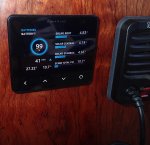
Decent shunt-based battery monitors should give you an accurate SOC reading. The Nasa monitor seems to have a reputation for an inaccurate SOC reading, although the voltage and current readings are seemingly OK.
 
Top
