Battery monitor recommendations

Yeoman_24

Well-Known Member
Joined
15 Jun 2014
Messages
176
Location
Gloucestershire
Visit site
I have just bought a pair of Hankook 110v deep cycle calcium batteries which I intend to wire in parallel.

I also have a fairly new starter battery rated as recommended by my Beta engine company.

I have a 20 amp Sterling 1220 charger and 65 amp alternator. I have a basic level voltage meter and a BlueSea “1, Both, 2” manual battery switch over switch.

I’m on a budget and the Victrom smart battery monitor is out of my price range. Any suggestions as to how I can maximise my battery efficiency on a budget please? Thanks
 
I have just bought a pair of Hankook 110v deep cycle calcium batteries which I intend to wire in parallel.

I also have a fairly new starter battery rated as recommended by my Beta engine company.

I have a 20 amp Sterling 1220 charger and 65 amp alternator. I have a basic level voltage meter and a BlueSea “1, Both, 2” manual battery switch over switch.

I’m on a budget and the Victrom smart battery monitor is out of my price range. Any suggestions as to how I can maximise my battery efficiency on a budget please? Thanks
Not sure what you mean by battery efficiency but I assume you mean avoiding excessive discharge?

I have a similar set up to yours, but with individual isolation switches for each battery. I replaced a 30 year old charger with a Sterling and I added two more isolators on the charging lines so that I can charge service batteries or engine start battery. I did this because the different batteries are different sizes and ages, and the engine start should be kept charged by engine use. I then added a Victron 702 battery monitor (£145 ebay) which is worth every penny to me as it shows me the voltage of both banks and the instantaneous and accumulated current drain on the service batteries. It's the current measuring that makes it really useful. It also made me rewire my negative wiring to the service batteries and add a buss bar. I use a multimeter for checking but it's a fiddle to get at the battery terminals so the battery monitor is good for instant indication.

So I would vote for a battery monitor, preferably one that measures both battery voltages and current on the service bank. You may find a cheaper monitor. If careful battery management gives me a couple more years of battery life it probably pays for itself, not to mention the confidence and security of knowing what's going on.
 
I can recommend this monitor from Elite Element (they also have similar units for other current ranges): Battery Monitor DC 5-40V 0-50A Volt Amp Ah Power Combo Meter Charge Discharge | eBay
Very clean and undistracting display, no unnecessary clutter or bright blue backlights. Numbers big enough to see from the cocpit. Dedicated led to show charging status. Shows voltage, current, power, Ah remaining, % remaining. Self resets when battery full.
On the negative side (for some), IIRC needs calibrating before use to get accurate results. Especially calibrating the upper end of current measurement needs equipment not likely to be found in average boat. But a cheap enough UT210E does the job just fine and is also otherwise a good tool to have.
 
Thanks for the replies but this looks like the one for me at the moment. The link takes me to 2 options. Could you have a look for me please and let me know what the difference is? Thanks
The "Black B" version looks identical to the Ketotek I recently installed on a 2 x 110Ah OFF/1/BOTH/2 system. (Battery 1 is engine, battery 2 "house".). I wanted a simple digital voltmeter and ammeter that gave measurements to two decimal places. For me, voltage sensitivity was more important than absolute accuracy.
 
The "Black B" version looks identical to the Ketotek I recently installed on a 2 x 110Ah OFF/1/BOTH/2 system. (Battery 1 is engine, battery 2 "house".). I wanted a simple digital voltmeter and ammeter that gave measurements to two decimal places. For me, voltage sensitivity was more important than absolute accuracy.
So, each time you switch from battery 1 to 2 and vice versa, do you have to reset the battery monitor?
 
I have just bought a pair of Hankook 110v deep cycle calcium batteries which I intend to wire in parallel.

I also have a fairly new starter battery rated as recommended by my Beta engine company.

I have a 20 amp Sterling 1220 charger and 65 amp alternator. I have a basic level voltage meter and a BlueSea “1, Both, 2” manual battery switch over switch.

I’m on a budget and the Victrom smart battery monitor is out of my price range. Any suggestions as to how I can maximise my battery efficiency on a budget please? Thanks
You do not say how you are defining "efficiency" A monitor will only give you data. Efficiency is a function of your charging and consumption management. To my mind the first thing to do is to ditch your 1,2,both and separate the engine start from the house so each bank only does one job. Ensure efficient charging by split charging using something like a VSR. That will ensure your engine start battery is always fully charged and then the house battery takes the whole charge from the alternator. You don't have to do any "switching" to choose which battery to charge/use, nor if you fit a monitor to read either bank.

Where a battery monitor helps you (and a BM1 is under £100) is in understanding how much you are taking out of your house bank each day and particularly what devices consume what. They also give you standing voltage as a proxy for state of charge. Your 220ah gives you a long term usable capacity of 110 without over discharging, which on a typical small yacht will be 1-2 days consumption before you need to put something back in. Your monitor will give you some idea of your remaining capacity at any given time, although actual figures are not too accurate.

The biggest challenge for a typical UK "weekend" with a couple of longer cruises each year is that relying on the alternator, which of course only works when the engine is running, is not enough to consistently replace what you are using. This is not because the alternator is too small but because of the low acceptance rate of the batteries. So in reality you may replace less than half of what you use each day - and nothing if you anchor for a day and a night. In a weekend you may well find your deficit is as much as half your usable capacity. The obvious way of dealing with this is to plug into shorepower as within less than a day the bank will be fully charged ready for next weekend. If on a mooring a decent size solar panel will achieve much the same over a week.. If wishing to spend more time free of shorepower you need to consider increasing the size of the bank and fitting solar panels to increase your charging capacity.

If funds are limited better to spend the money on building a good basic charging system - you have most of it already and then get a monitor to help you understand and get the best out of it.
 
So, each time you switch from battery 1 to 2 and vice versa, do you have to reset the battery monitor?
You are correct. The shunt is on the common negative line so I don't use it as a proper battery monitor. It replaces the hassle of regular open circuit voltage checks on the batteries which are in a less than accessible locker. The ammeter is a bonus, it keeps me aware of what's on. The two decimal place resolution helps monitor changes including voltage recovery.
If I had two house batteries I would want to find a way to check the voltage on each separately.
 
I’m pleased with my setup. 1x110Ah service battery. Regular alternator on 1GM10 engine. Folding portable 120W solar panel. Mains hookup when available. Compressor fridge on 24x7 when cruising. My NASA BM gauge is very handy and tells me that the service battery never discharges to a point that would worry me. For a time I thought my solar panels were not working well until I realised that the low charging current was due to the battery being near fully charged. This time of year the panels have already delivered a good charge by the time I get up.

The wireless Victron unit was not available when I purchased my NASA gauge. Today I would choose the Victron to avoid drilling holes to run cables.
 
To my mind the first thing to do is to ditch your 1,2,both and separate the engine start from the house so each bank only does one job. Ensure efficient charging by split charging using something like a VSR.
This, though I'd keep the 1-2-both to allow starting from the domestic bank in an emergency. Common to the starter, engine battery to 1 and domestic to 2, VSR to link 1 & 2.

If the budget really is tight, use a cheap headlamp relay - this sort of thing:

SW02649-40.jpg

I had one on Jissel for years and it worked fine. Feed it from the alternator warning light terminal and link 1&2 on the 12B switch
 
. To my mind the first thing to do is to ditch your 1,2,both and separate the engine start from the house so each bank only does one job. Ensure efficient charging by split charging using something like a VSR. That will ensure your engine start battery is always fully charged and then the house battery takes the whole charge from the alternator. You don't have to do any "switching" to choose which battery to charge/use, nor if you fit a monitor to read either bank.

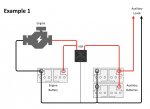
I like this idea a of the VSR addition and there are some reasonably priced options. If I go down that route as per my attached image I found, how would I wire the battery monitor as suggested by some on this thread so it just looks at house battery usage?
 

Attachments

  • 02CF4224-0803-4E7F-9971-C6A2EE488370.jpeg
    02CF4224-0803-4E7F-9971-C6A2EE488370.jpeg
    96.4 KB · Views: 24
This, though I'd keep the 1-2-both to allow starting from the domestic bank in an emergency. Common to the starter, engine battery to 1 and domestic to 2, VSR to link 1 & 2.

If the budget really is tight, use a cheap headlamp relay - this sort of thing:

SW02649-40.jpg

I had one on Jissel for years and it worked fine. Feed it from the alternator warning light terminal and link 1&2 on the 12B switch
The need to use the house bank for engine start is in my experience vastly overrated. A start battery has an easy life and will probably last for 10 or 15 years because it is always fully charged except if laid up for long periods. My original Bavaria was still on the original engine battery when a sold it - 14 years. Easy to arrange a parallel switch if you want to, or use a BEP switch cluster as I do.

As you might have guessed, I am a convert to dedicated banks and automatic split charging. So simple and idiot proof. Also the use of small AGMs for engine start - my Morgan is still on its original after 19 years with a trickle charger in the winter.
 
The need to use the house bank for engine start is in my experience vastly overrated. A start battery has an easy life and will probably last for 10 or 15 years because it is always fully charged except if laid up for long periods. My original Bavaria was still on the original engine battery when a sold it - 14 years. Easy to arrange a parallel switch if you want to, or use a BEP switch cluster as I do.

As you might have guessed, I am a convert to dedicated banks and automatic split charging. So simple and idiot proof. Also the use of small AGMs for engine start - my Morgan is still on its original after 19 years with a trickle charger in the winter.
…plus there’s always jumper cables if you get caught out
 
Top