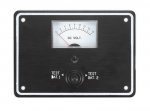
Battery monitor, cheap and easy.

Re: Surely a cheap £5 meter ....

But its an analogue needle meter .... and only uses battery for Ohms .... so throw out battery .... and anyway - even if it did need a few mA .... that can come from a 12v converter ...

I knoiw a lot of you are talking Digital displays ... but considering that commercial switch panels have 'orrible needle meters withy red, white and green sectors ... my analogue is far better than that !!
 
[ QUOTE ]
The current drawn by a digital multimeter is miniscule so even the thinnest of wires will not cause any voltage drop if it is just the meter connected to the circuit.

Personally I would prefer to monitor at the battery terminals or with a (fused) dedicated circuit from there.

[/ QUOTE ]

So would I. Cigarette lighter sockets are notorious for poor contact, particularly in the marine environment, and very often will give a low volt reading - not because of thin wires, but because of bad connections particularly between the plug and socket. Even with the miniscule current drawn by the meter there can be a significant (in terms of .1's of a volt which is what we are measuring) drop in measurable voltage givomg an inaccurate impression of battery state.
 
Re: Surely a cheap £5 meter ....

The problem with analogue meters is that you are actually only interested in a very small range of voltages - in almost all cases you will be looking at voltages in the range 12.2-12.7V.

I did at one point consider putting something like a 10V Zener in series with the meter, so using a greater part of the FSD of the meter

- the cheap red/yellow/green meters are to my mind totally useless.
 
Small range .... agreed

But in digital terms my Plotter gives me that and as checked seems pretty accurate having checked with a digital hand meter ... So fluctuations on the decimal are possible via the Volts display of plotter.

What I am considering is the dead, half dead and full charged available battery - which the analogue caters for well enough. Certainly better than the silly colour segment meters.

I have found that the Halfords Battery / Alternator LED checker has saved me embarrassment often and is an excellent quick tool for the non-technical among us !!
 
Re: Surely a cheap £5 meter ....

boat-battery-monitor-70061.jpg
Hi,
Thought I'd resurrect an old topic - in a moment of eagerness I bought one of these for £24 for which I'm now mumbling at myself, but still might use it - standard set up, starter battery and domestic battery, fuse to each, usage side of main batteries switch. Anyone else used one of these??? Ta!
 
Re: Surely a cheap £5 meter ....

View attachment 52118
Hi,
Thought I'd resurrect an old topic - in a moment of eagerness I bought one of these for £24 for which I'm now mumbling at myself, but still might use it - standard set up, starter battery and domestic battery, fuse to each, usage side of main batteries switch. Anyone else used one of these??? Ta!

The advantage of the digital meter is the greater precision You will be hard pressed to read the analogue scale even to ± 0·2 volt. A difference of 0·2 volt is equivalent to approx 20% difference in SOC
 
Re: Surely a cheap £5 meter ....

The problem with analogue meters is that you are actually only interested in a very small range of voltages - in almost all cases you will be looking at voltages in the range 12.2-12.7V.

I did at one point consider putting something like a 10V Zener in series with the meter, so using a greater part of the FSD of the meter

- the cheap red/yellow/green meters are to my mind totally useless.

Using a moving coil meter witha 9v zener in series can be very useful. You set the moving coil meter up to read 0 to 5v thus with a 9v zener in series you get 9 to 14v spread across the scale.
However really our friends in China are the cheapest best way to go for digital volt meters.
http://www.banggood.com/0_28-Inch-2_5V-30V-Mini-Digital-Voltmeter-p-974258.html would take a lot of beating. It appears to be powered from the voltage being measured. (important) good luck olewill
 
Re: Surely a cheap £5 meter ....

This is a job for a digital meter, for reasons discussed earlier.

I would be concerned with the zener approach suggested unless you carefully check that the zener voltage is what you think it is as the zener breakdown voltage will move depending on current through it.

I replaced the analogue meter on my instrument panel with this https://uk.rs-online.com/web/p/digital-panel-voltmeters/0255963/ fairly straightforward to wire and calibrate as long as you follow the datasheet. Gives 2 decimal places at 12V which is ideal for keeping track of the batteries, unfortunately not a £5 job tho...

Note, I did have to make my own bezel to ensure a good fit.

Before, the 0V to 30V!!!! analogue meter, as much use as a chocolate teapot.
https://www.flickr.com/photos/69637547@N00/16932178063/in/album-72157652589980765/

After, bit of a shaky photo but much better...
https://www.flickr.com/photos/69637547@N00/17547972332/in/album-72157652589980765/
 
What about this

http://www.ebay.co.uk/itm/Digital-M...809?pt=LH_DefaultDomain_3&hash=item4d28e698b9

Even if it reads a little bit under or over, once you have checked it with a reliable multimeter you can make allowances for any small errors.

I fitted one of these for a friend a while ago and it works fine. Comes with it's own shunt which goes in the -ve wire before your -ve bus bar.

http://www.ebay.co.uk/itm/261233998678?_trksid=p2060353.m1438.l2648&ssPageName=STRK:MEBIDX:IT

It took a bit of working out as the wiring diagram was a bit confusing. If I remember correctly I had to leave the small black wire disconnected and it then worked OK
 
I've just removed the single cig lighter socket from the chart table panel, and fitted in it's place an exact same size round LED voltmeter from Ebay. Added a triple socket panel: with two cig lighter sockets and a double USB outlet, also from Ebay. Cost about £15, a significant part of that was buying locally some tinned copper wire and spade connectors to fit.

The cheap voltmeter reads 0.1v below my rather more expensive multimeter, and 0.2 v below the reading on my Raymarine instruments in the cockpit. All I want is an easily visible sign inside of when the volts drop below about 11.9-12.0, so good enough. The usual time for volts to drop is moored at night, lots of lights on plus fridge and maybe Eberspacher. The meter is wired to and is lit all the time cabin lights are on, and uses about 20ma.
 
I fitted a cheap( but reliable) Ebay digital voltmeter with a 1-0-2 switch that is spring loaded to the 0 position. Along with a Bluesea 0-1-2-both switch. I can easily check the voltage of either domestic battery, both when connected and disconnected from the boats circuitry. The bilge pumps and active corrosion protection system are always conneced to both the batteries, using diodes to prevent one battery discharging the other. It works very well.
 
Top