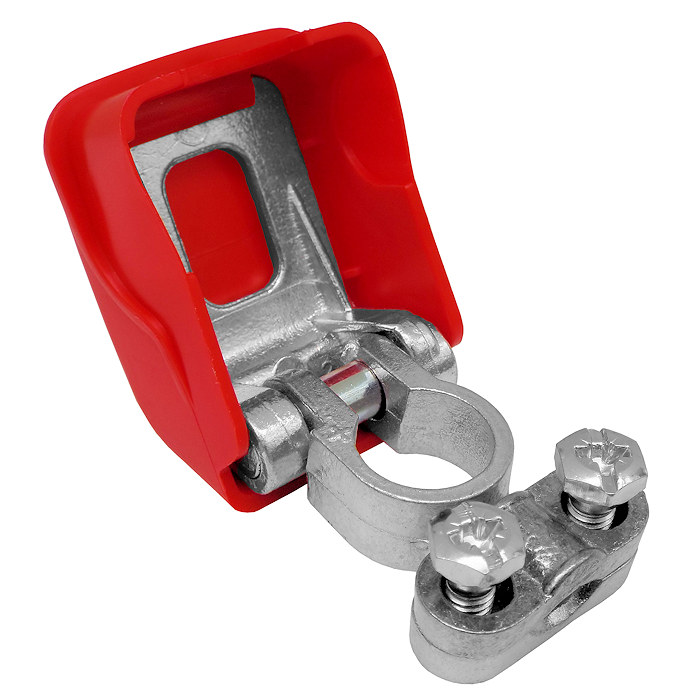
Battery isolator

I decided on BEP isolators from 12Volt Planet.... both reliable outfits, providing reliable product and guidance.... following that from PaulD of this parish..... and cube fuses, for the 2 groups of 'services' batteries to P and S. These are positioned to be readily accessible.


47928407747_fec1851941_z.jpg


The Start battery is unfused. Access is more difficult and I don't have the space for the BEP isolator product.

That's not a BEP isolator, it's a Durite one. No matter though, still a perfectly good product.

If you have isolated the banks with these switches, why do you want those nasty isolators at the battery ? If it's to isolate individual batteries within the bank, i wouldn't bother. If you had a battery fail, you just switch the whole bank off and turn the emergency switch on. Then you can identify and fix the problem at your leisure.
 
Last edited:
I am slightly worried about the Durite clamps.

The Durite site

https://www.durite.co.uk/itm/69913/Q...rminals/002300

quotes the max as

"Max Amperage 1000Ah" and the max cable size as 50mm2.

Very interesting image: http://www.ybw.com/forums/images/smilies/smile.png

, but what does it really mean ? That is can only pass 1000A in 1 hour ? And given that a single cable at 50mm2 is rated for ~200A, I think that Durite should be checking their text for inconsistencies.

[pedant mode] 50mm battery cable is 345a [/pedant mode] :)
 
[pedant mode] 50mm battery cable is 345a [/pedant mode]


That's different from the Conductor Requirements for ISO 10133 and ISO 13297, where 50mm2 is even lower than the practical one I quoted. Unless you want to run your 50mm cable at 200oC.

https://www.energy-solutions.co.uk/technical-information

50mm battery cable is still 345a Tim, pick a random make and check for yourself.

Here's a starter for 10 : https://www.durite.co.uk/itm/66193/...-Flexible-PVC-Starter-Cable-50mm-x-10m/097710
 
I bought some cheapy terminal clamps from ebay, for battery charging from a small solar panel. Nothing like as meaty as the Durite solution from PRV, but I would certainly not let them anywhere on board.. The ones in use are rusting after a few weeks.

And how one would get a circular cable to fit into the elliptical clamp without squishing it....

TkQRzIv.jpg
 
50mm battery cable is still 345a Tim, pick a random make and check for yourself.

Here's a starter for 10 : https://www.durite.co.uk/itm/66193/...-Flexible-PVC-Starter-Cable-50mm-x-10m/097710

But we have established that Durite have problems with maths and SI units already.

Try this

http://wecoconnectors.com/data_source/fichiers/wire_size_specifications.pdf

and this

http://www.aic-controls.com/wire-size

and this

https://www.cerrowire.com/products/resources/tables-calculators/ampacity-charts/

(50mm2 is ~= 1/0 AWG.)


There must be a discrepancy in specs somewhere (type of wire, conductor material, ambient temp, number of cores, thickness of insulation, in air or surface fixed, etc) And I hate discrepancies.
 
But we have established that Durite have problems with maths and SI units already.
And I hate discrepancies.

So do I and where there are discrepancies it brings into question the specifications.

It seems to me that the specs are written by the marketing department and not proper qualified Engineers.
 
I bought some cheapy terminal clamps from ebay, for battery charging from a small solar panel. Nothing like as meaty as the Durite solution from PRV, but I would certainly not let them anywhere on board.. The ones in use are rusting after a few weeks.
The Durite ones are brass ( tinned presumably) so not going to rust. Much more solid looking cable clamps too
 
That's not a BEP isolator, it's a Durite one. No matter though, still a perfectly good product.

If you have isolated the banks with these switches, why do you want those nasty isolators at the battery ? If it's to isolate individual batteries within the bank, i wouldn't bother. If you had a battery fail, you just switch the whole bank off and turn the emergency switch on. Then you can identify and fix the problem at your leisure.

ITYWF that he explained that he has conventional isolator switches on the house bank but has no room to fit them on the engine start battery .... Hence the interest in this type
2-021-00.jpg
...He was not asking about or even suggesting using the quick release type.
 
ITYWF that he explained that he has conventional isolator switches on the house bank but has no room to fit them on the engine start battery .... Hence the interest in this type ...He was not asking about or even suggesting using the quick release type.

Indeed he wasn't, but it was you that brought them up in post #17 :confused::confused:
 
Some do look pretty flimsy but the Durite ones are rated at 1000amps, but made in Italy :ambivalence:

I understand there are multiple options..... including one rated at 300A continuous/1000A for 5 seconds.


Note to self: I must stop having 'senior moments' and learn to double-check my sources. Am I glad I'm not in politics and being interviewed by those rottweilers Andrew Neil and Andrew Marr....;)
 
Last edited:
I simply don't understand it it. We have a perfectly good argument going on, and the OP comes in and spoils it with some facts.


Given VicS' details about the power consumption of a starter at three points of its operating cycle I think that those sort of figures would be acceptable. If you want some caveats, I am sure we can find some. How about orientation of the boat's principal DC wiring along the lines of terrestrial magnetic flux thus diminishing the EMF flow along the conductors, or the convex polyhedron shape of the battery when the normal phase state is flat , or even the anti-clockwise rotation of the battery cable itself which conflicts with the Coriolis force of the coulomb drift ?
 
T

You now have me worried :)

What's up with the cheap red key ones please ? I know there are many suppliers and hence probably many differing load specs, but they do seem to be pretty much fail-safe (unless one drops the key in the bilges.....)

Those fiendishly clever rally car people seem to use a similar 'key' type but specced to 100A continuous and 500A for 5 secs.. I had to look up the current used by the starter for the engine (Yanmar 3cyl 10hp) and it says 1400 W ! Please tell me :) that must be the initial surge to get the flywheel turning, after which the energy required is less...

That example has a resistor which claims to protect the alternator. Does that overcome the dread I have of an inadvertent switch off causing the alternator to eat its diodes with back EMF , and much £££ for a alternator repair ?
Hi Tim

Whilst chasing my starting fault on my starboard engine I had at least 3 red handled cheapies simply stop working. The high current oxidises the contact area where the copper bar presses gains some brass bolt heads inside the switch. This caused me red herrings whilst I sought the true cause of my intermittent starting problem.

I ended up with the Durite switches from Force 4 chandlers as part of a full re-wire of the 12 volt power distribution from the batteries. Interestingly I liberated ~ 8m of unnecessary 50mm2 cable by making the runs less of a zig zag affair (twin engine set up).

The engine fault turned out to be an incorrectly assembled fuel cut off solenoid. The pintle return spring (essentially a biro spring) was not located in its deep recess, instead it has lodged on the shoulder stop for the pintle, effectively and only sometimes, preventing the stop solenoid from opening.
 
Top