Battery isolator switch amp / Ah maximum rating question

yodave

Well-Known Member
Joined
31 Dec 2010
Messages
400
Location
up North
Visit site
Hi,

I'm in the middle of sorting out some electrical issues. I recently replaced my battery isolator switch with what I thought was an identical switch [ http://www.ebay.co.uk/itm/130775462485?ssPageName=STRK:MEWAX:IT&_trksid=p3984.m1438.l2649 ], but I think that the rating might be lower than the original. The new switch has a rating of:

175amp continuous rating + 300amp intermittent

I have two linked batteries:

1 x 120 Ah + 1 x 143 Ah

I don't know enough about batteries to understand whether I might come up against a problem. Perhaps that comes down to load - most load would occur when motoring and using the bow thruster plus other electrics such as the chart plotter and depth log etc.

Any advice would be very much appreciated.
 
The largest load is probably the engine starter motor ... So you need to allow for what that takes.

Check the engine specs for the starter motor details.

Id guess the bow thruster is the next biggest. Check the specs for that too.


Most other electrical equipment will be a much lower load unless you are running a massive inverter.


Beware of poor quality battery isolators. Ensure that it is a good quality item.
 
Last edited:
The largest load is probably the engine starter motor ... So you need to allow for what that takes.

Check the engine specs for the starter motor details.

Id guess the bow thruster is the next biggest. Check the specs for that too.

Most other electrical equipment will be a much lower load unless you are running a massive inverter.

Beware of poor quality battery isolators. Ensure that it is a good quality item.


VicS: Thanks for your advice. I'll track down that info. I'd assume that the starter motor and the bow thruster will typically never be used at the same time so at least that should mean that there's no cummulative effect.

Are you suggesting that the switch I have is poor quality? I hadn't really considered that as I just sourced one which looks to be a straight replacement for the switch that was already there. Please let me know if you're suggesting that I've bought something that's under spec. Thanks again!
 
I doubt you will have any issue with the 300a int switch, an average 4cyl 2l diesel will draw about 350a to get it moving and then drop, the average yacht auxilliary will draw a lot less, if the switch is of decent quality it will be fine.
 
Just to clarify the Amp hour rating of your batteries is of no real significance to this question. It is a measure of battery size and just how long you can draw current from it.
Batteries are also rated at CCA cold cranking amps which might be mor esignificant. Often smaller batteries are designed for engine start (car batteries) and have relatively low Amp hour rating but high CCA.
However as said it is the starter cranking current that is of concern. Yes the switch you have is probably OK. If it fails it will probably be on engine start and will probably get hot and melt. You could make up a lead for emergency starting that will bypass the switch.
Having this emergency option will guarantee you will never need it. (sods law)
The batteries should normally only be linked for charging. You should ( at least occasionally) only start on one battery. This to ensure that each battery is still well and capable of starting engine. Alternate starting from each battery occasionally.
good luck olewill
 
Last edited:
David2452: Thanks for your thoughts. I'm not actually sure what size of engine our Lombardini is, but I'll be trying to find out what the starter motor requires. The heavy duty switch looks and feels identical to the last one, which was robust.

William_H: Thanks for your help. Our new battery number 2 has a CCA of 900. Not sure how that translates to the switch specs of 175amp continuous rating + 300amp intermittent. Perhaps it means that the battery has three times the maximum power than the switch can handle, and that's without taking the other battery into consideration. That said, I can't imagine the switch getting hot and melting within the second or two that it takes to start the engine ...but then I could be wrong. Thanks also on your advice re-usage and charging - I'm going to have a more structured approach to this over the coming season, as over the last two years I've just altered usage in a random fashion.
 
David2452: Thanks for your thoughts. I'm not actually sure what size of engine our Lombardini is, but I'll be trying to find out what the starter motor requires. The heavy duty switch looks and feels identical to the last one, which was robust.

William_H: Thanks for your help. Our new battery number 2 has a CCA of 900. Not sure how that translates to the switch specs of 175amp continuous rating + 300amp intermittent. Perhaps it means that the battery has three times the maximum power than the switch can handle, and that's without taking the other battery into consideration. That said, I can't imagine the switch getting hot and melting within the second or two that it takes to start the engine ...but then I could be wrong. Thanks also on your advice re-usage and charging - I'm going to have a more structured approach to this over the coming season, as over the last two years I've just altered usage in a random fashion.

A bit of Googling found what I think is your original switch ....... same rating as the one you have bought. If the old one was OK the new one should be too.. assuming its not a cheap and cheerful copy, but are you replacing the switch because it was not up to the job.

As William said the capacity of the batteries is not relevant. What counts is the current consumption of the equipment you want to run.
 
VicS: Thanks for your advice. I'll track down that info. I'd assume that the starter motor and the bow thruster will typically never be used at the same time so at least that should mean that there's no cummulative effect.

Are you suggesting that the switch I have is poor quality? I hadn't really considered that as I just sourced one which looks to be a straight replacement for the switch that was already there. Please let me know if you're suggesting that I've bought something that's under spec. Thanks again!

A 300A intermittent switch is rather low and like most eBay buys the switch lacks any sort of in-depth specifications or a definition of what they consider "intermittent" to be....

This is an example of a battery switch I install quite a lot of . Note the specs and that it is designed to handle 2750A for up to 10 seconds and 900A for 5 minutes.

http://www.bluesea.com/products/3000/HD-Series_Heavy_Duty_On-Off_Battery_Switch

Even their lower cost standard battery switches are very, very robustly built and offer the complete specs so you actually know what you are getting.
http://www.bluesea.com/products/9003e/e-Series_On_Off_Battery_Switch


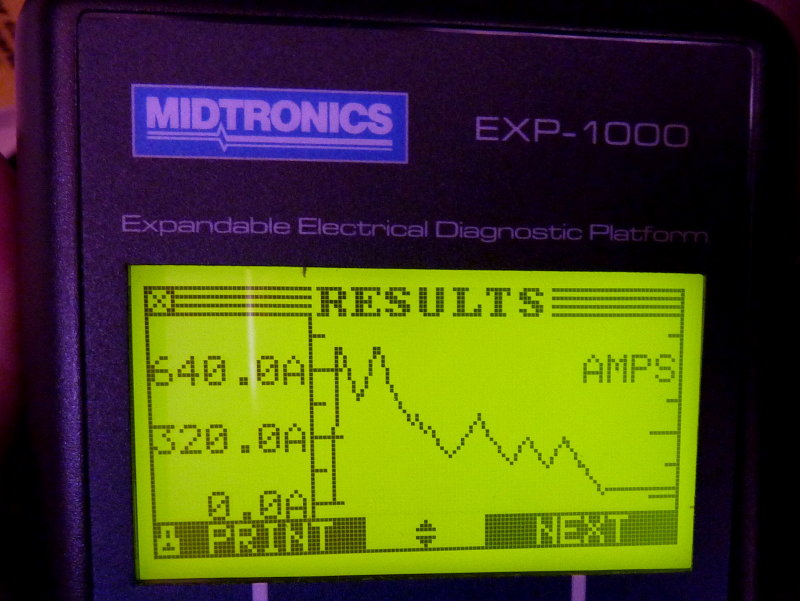
Here's what it takes to start a four cylinder Westerbeke in a 36 footer, note the in-rush current.....
147301391.jpg


While you may never have any issues I have seen inexpensive battery switches with melted plastic cases, a scary thought.....
 
Last edited:
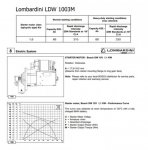
Well I've been to the boat and carried out some more diagnostics on the bigger picture. I've also been digging out paperwork. The engine is a Lombardini LDW 1003M ...and I found the following spec in relation to the starter motor:

LombardiniStarterMotorInfo01s.jpg

Click above image to enlarge.

I also now know that our bow thruster is a 'Max Power, Mini-Max, Series 35 Composite Thruster' that consumes approximately 250 amps and approx 11V on the motor's connections.

There is absolutely no chance of both being used through the switch at the same time, as the bow thruster currently doesn't go through the switch. I've decided that I'm going to fit a separate isolator switch for the bow thruster - which will need to be capable of handling 250+ amps.

VicS: I replaced the old switch in case it might have been faulty (it wasn't). I have my suspicions that the old switch might have had a higher rating (275 continuous) in the same chassis. Unfortunately as the switch was working and a friend happened to need a switch ...I gave it away yesterday. I should be able to check this over the next few days when I catch up with the new owner. Thanks again for your input.

Maine Sail: Thanks for your advice. Thanks also for the links. I didn't specifically buy the replacement switch on price ...I was simply trying to buy a direct replacement as the original switch had done the job. The Blue Sea switches look good though, so I'll consider these if the switch that I bought isn't up to the job. Thanks also for taking the time to upload the image. That's a lot of amps. I don't really want to have a handful of molten plastic the next time that I turn the switch off, so I'll be doing my homework to ensure that the switch I have is fit for purpose.
 
Last edited:
ghostlymoron: Thanks for the link and the suggestion of a vsr.

nigelmercier: Thanks also for your comment on what's at the end of the link.

At this stage I'm still trying to decipher the power requirements of the starter motor. If the requirement is under 175 amps continuous then there isn't a problem with the new switch. If it's over that then I'll have to have a re-think. I'm not overly stressing about this now, as I think that the switch is probably up to the job and know that it has been used to start our engine two or three times without any problems. From here I need to get my head around the Lombardini technical info, as the power requirement isn't readily apparent to me.

As we're really keen to go sailing asap this season, I'm taking a pragmatic view of the bigger picture. I am planning on adding an isolator to battery 2 (battery 1 already has an isolator) and that should effectively mean that I can simply disconnect the batteries when we're away from the boat. Any bigger solution including the likes of vsr is now on the horizon and may appear on my 'to-do' list come crane-out.

Thanks again!
 
At this stage I'm still trying to decipher the power requirements of the starter motor. If the requirement is under 175 amps continuous then there isn't a problem with the new switch. If it's over that then I'll have to have a re-think.

It's not the continuous rating that's the problem, it's the intermediate one, starter motors, and bow thruster are not continuous rated, starter motor may be 30 seconds.

your starter motor could be 400 - 600 amp spike as it gets the engine rotating, as the starter motor revs increase it will fall to around 200 - 400 amp depending on size, but only short time period.

If the intermittent switch rating is for so many minutes, you should be okay, if it's only surge amps you could be in trouble.

Brian
 
Last edited:
halcyon: Thanks for your input. Having done some homework I now think that the starter motor is a "Bosch dw 12v 1,1". Still to find out what sort of amps that unit draws, but at least I'm getting a bit closer. Not sure on the durations of the switch spec, but my first priority is to find out whether the maximum requirements for the starter motor are covered ...and if they are, I can look at the durations involved. I tend to like a healthy margin of error, so if it's close then I'll probably still swap the switch out.

ghostlymoron: No problem whatsoever ...and yes I get your drift - thanks
 
halcyon: Thanks for your input. Having done some homework I now think that the starter motor is a "Bosch dw 12v 1,1". Still to find out what sort of amps that unit draws, s

Looking at the graph in the manual, the stall ( initial load to get engine turning ) could be 550 amp, falling to 250 - 350 amp running, cranking the engine. It's a bit vague as it depends on voltage delivered from battery, and cranking speed.

I would say you are on the edge, you could be okay, equally you could have a meltdown as you do not know build quality, if it was a production boat it would be well under spec.

Brian
 
halcyon: Sounds like the switch we have isn't a great long term solution. We have two batteries the older one is 120 Ah (not sure of the CCA), the newer one is 143 Ah & 900 CCA. So I should probably look at a minimum spec of 600 amps intermittent for a replacement switch.

Thanks for your help with this Brian.
 
Top