
ghostlymoron
Well-Known Member
This seems to be the ideal battery switch in conjunction with a vsr. http://www.bluesea.com/products/products/5511e/e-Series_Dual_Circuit_Plus_Battery_Switch/featured



Whilst it's an undoubted improvement on the dreadful and antiquated 1-2-Both switch, I still don't think it's ideal. If you ever find you have a flat start battery, and need to use the domestic battery to try to start the engine, it would be much better to have a bypass switch which connects the domestic battery direct to only the starter, rather than also to a flat battery. This is easily achievable with separate switches.

This seems to be the ideal battery switch in conjunction with a vsr. http://www.bluesea.com/products/products/5511e/e-Series_Dual_Circuit_Plus_Battery_Switch/featured

Theres a big range of switches available from Blue sea
If you want a VSR based system you might also like to look at the BEP VSR / battery switch clusters which group together two isolator switches, an emergency linking switch and a VSR http://www.power-store.com/?id=199
Some people dont like them, and some poor quality ones a few years back got them a bad name as well, but the simplest way of extending a single battery system to a dual battery system is with a 1,2, both switch . Simple to understand, no bits of electronic wizardry like VSRs or diode splitters and their own particular quirks or drawbacks. However if you see VSRs or diode splitters as the way forward its best IMHO to avoid a 1,2,both switch at the outset.

Whilst it's an undoubted improvement on the dreadful and antiquated 1-2-Both switch, I still don't think it's ideal. If you ever find you have a flat start battery, and need to use the domestic battery to try to start the engine, it would be much better to have a bypass switch which connects the domestic battery direct to only the starter, rather than also to a flat battery. This is easily achievable with separate switches.
Or turn engine isolator off and start via the VSR, if you have a flat starter battery.
Brian

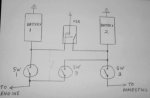
When I bought my boat it was wired with 3 ordinary vehicle type isolating switches, wired as in the diagram, but without the VSR.
I often forgot to throw the 3rd switch after starting the engine. So I fitted a VSR as shown.
I can now ignore the 3rd switch. But it's nice to know it's there if needed.
The system has been trouble free ever since. It's a very effective system for not a lot of money.
But I'm still agonising about, whether I should have connected the VSR before or after the SW number 1?
View attachment 45426
...........I fitted a VSR as shown.
I can now ignore the 3rd switch. But it's nice to know it's there if needed.
The system has been trouble free ever since. It's a very effective system for not a lot of money.
But I'm still agonising about, whether I should have connected the VSR before or after the SW number 1?
View attachment 45426

Starting an engine by connecting a good battery in parallel with a flat battery is not a problem, as anyone who has ever jump started a car knows.
Your options are a bit more limited in a car's systems.
True, but connecting a full battery to a flat battery doesn't cause the catastrophe that people assume would result in a boat.
This is exactly what I have just installed.......after much agonising and contemplation + help from this forum...please don't tell me now that I could/should have done it differently (lol!)
I can't get my head round that. Any chance of a sketch?
