Battery Isolation Switch - Yes or No

exapp

Well-Known Member
Joined
30 Mar 2006
Messages
79
Visit site
Howdy folks,

Buddy of mine has a Leisure 23 with a very old and unreliable electrical installation and the intention is to rip it out and start again.

The boat also has a battery isolation switch between the outboard and the battery and the owner has blown the rectifier (or whatever bit you blow on an alternator) by starting the engine with the isolation switch open.

Anyway we were thinking of rewiring the boat with the engine charging circuit directly connected to the battery and with the isolation switch between the battery and the rest of the electrical services. This way he doesen't have to remember to turn on the isolation switch before he starts the engine.

The engine is a 6hp manual start Mariner 2 stroke.

Is it OK to do this? If not why not? Or if it is OK is there anything we have to be careful about?

Thanks in advance,

Exapp
 
In a practical sense the switch is there to isolate the boat electrics from the battery to eliminate fire risk due to a short circuit when you are not aboard, and to eliminate leakage from the battery over long periods. There is a middle ground that you could consider with a single battery set up and that is to have a switch isolating all other circuits on the boat and leaving the engine connected.
 
Linking the charging circuit directly to the battery is pretty common, if paranoid you might wish to think about putting a fuse in the line. Normally it is the feed to the starter motor that has the breaker fitted, not applicable in your case. I would fit a breaker between the battery and the remaining electrical circuits and possibly a megafuse between the battery and the distribution panel
 
So the current plan is as follows...

Engine - Battery - Isolation Switch - Main Fuseboard

Any danger of electrolytic corrosion? or something else that could bite us on the bum???
 
Hi. I have a YAMAHA 8hp electric start. I have this connected to the battery via an isolation switch while it is on the boat, but during the winter lay-up I start the engine (with muffs) to keep it sweet and wash it out. When I do this the (is it an alternator or a magneto??) engine electrics are not connected to anything. Am I risking burning something out?

Sparkie
 
G'day Exapp,

<<Engine - Battery - Isolation Switch - Main Fuseboard>>

Sounds fine to me, as the only heavy current is all under the outboard cover. Also has the advantage of not blowing the charge system again.

Avagoodweekend......
 
I'm a little confused here ... starting the engine with switch off ...
If an engine - outboard is opn a boat and not connected to charging circuit 0 it has no problem ... so why should this one blow the rectifier ?

Are you sure that he didn't switch off the battery isolator while engine running ? that would blow something maybe.

I have feeling that something is not quite right here and made the system blow ..............


My set-up would be a plug and socket between engine and battery .... and then isolator from battery to boat systems.
 
In the interest of removing confusion there is no difference between hand starting an outboard with the battery not in circuit ond disconnecting it when running.
 
As others have already started to note Hand starting the outboard with the battery disconnected will not harm the rectifier!

I assume this is a hand start only engine anyway.

I also assume this is just a charging/lighting coil built into the flywheel plus rectifier not a proper alternator on an engine this size and I doubt very much if opening the isolator switch with the engine running will harm the rectifier either but I am prepared to be corrected on that point (I know it will with a proper alternator).

The easiest way of blowing the rectifier is to connect the battery the wrong way round. Near instant death as far as the rectifier is concerned. Don't even think of challenging that point, it is!

When designing a circuit it is well worth avoiding the situation in which the engine can be connected to all the boats circuits except the battery. That's because the no load output voltage from this type of non-regulated generator can be high enough to fry some electronic equipment. I fried the voltage regulator circuit in my Autohelm by doing just that!

Why bother with an isolating switch. My battery is connected up with some decent alligator clips and has been for almost thirty years. When I leave the boat I just remove the +ve clip. I do have main switch on the switch panel though.

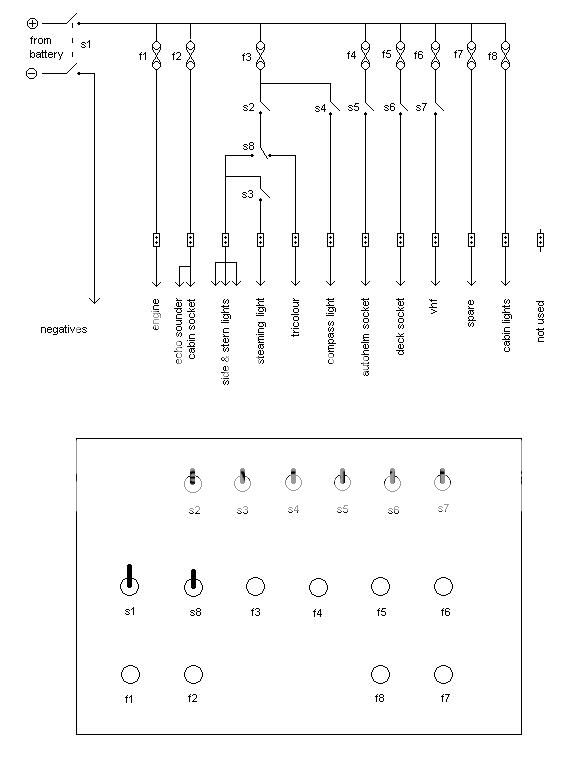
Below is the wiring diaram for my switch panel. It may provide you with a useful stating point even if you don't adopt it entirely. You will notice that I used a double pole switch as the main switch but that is because the nice heavy switch that I aquired was a double pole one. I have often thought about altering the wiring to use what is at present the negative half as the means of connecting the outboard to the system in order to avoid the aforementioned problem. A fuse local to the battery would be a sensible addition.

The switching includes cunning use of a change over switch to prevent illegal combinations of lights but enables alternative use of side lights + stern light or the tricolour when sailing but I do not have a permanent anchor light.

Separate fuses for the various nav. light circuts would be a sensible modification.

I should mention that all this is for a 19ft Seawych and a 6hp outboard with rectified output. BUT the electrical output from this type of charging circuit is negligible unless the engine is running at high revs, and that is rare, for long periods which is also avoided whenever there is any wind. Hence the next paragraph.

I also have a small solar panel that is not shown on this diagram as it is connected permanently via an inline fuse directly to the battery (I screwed some some bits of brass studding into the battery posts to make terminal posts for it)

97a15036.jpg


I hope some of this will be of help and not confuse further and apologise if I have repeated too much of what others have said especially in any later posts that have appeared while I have been preparing this one and loading the diagram.

If you want any clarification please ask.
 
The basis of your question relates to the diodes being "blown" by running engine charger without a battery. While we don't know the system this is highly unlikely on common small o/b chargers. So I suggest you check out the old recifier. It may have died of corroded wires/plugs etc. Diodes themselves are very tough. I doubt even the reverse battery scenario would kill the diodes but rather melt the wiring (unless of course they may be smaller diodes which can be overloaded with excess current so lets not argue there)

As for battery switch. Available here and I imagine in UK is a battery terminal with a screw down know switch built in. This is a very elegant and safe swith although possibly not in a convenient location. From there all you need is a 10 amp fuse to cover everything. Make sure all wiring is OK for 10 amps (fuse rating not volt drop). This just leaves you with a switch panel. In my case just nav lights and cabin light. I also mounted 2 banana sockets so I can attach a solar panel or portable GPS.
As for switching all circuits off. I would say yes all. This is sometimes necessary if you are subject to fire and safety inspections by various authorities. In my case every 2 years by Yacht Club officials for club's protection.
good luck ......olewill
 
Top