Battery flat

petedg

Well-Known Member
Joined
13 Aug 2006
Messages
428
Visit site
Travelled to Germany to get the boat taken out of the water. Went to start the engine and...not a sound, battery was as flat! Last time we were there at the end of August we decided to take it off the land power, I guess that was the first mistake. I also noticed that the -ve terminal was really corroded and the clamp was loose. Put it back on the land power but even after 24 hours it was reading <12V.
One of our neighbours in the Marina reckoned our charger was just not up to the job (Bosch Battmax 6), I'm inclined to agree and am now considering a CTEK M200 as they seem to get lots of positive feedback on the forum. We have 3 batteries in total, 2 x 90AH and 1 x 88AH which in total capacity would be <300 which is the max. for the M200 or have I missed something!
 
Travelled to Germany to get the boat taken out of the water. Went to start the engine and...not a sound, battery was as flat! Last time we were there at the end of August we decided to take it off the land power, I guess that was the first mistake. I also noticed that the -ve terminal was really corroded and the clamp was loose. Put it back on the land power but even after 24 hours it was reading <12V.
One of our neighbours in the Marina reckoned our charger was just not up to the job (Bosch Battmax 6), I'm inclined to agree and am now considering a CTEK M200 as they seem to get lots of positive feedback on the forum. We have 3 batteries in total, 2 x 90AH and 1 x 88AH which in total capacity would be <300 which is the max. for the M200 or have I missed something!

I reckon your starter battery is shot. Buy a new one. An engine start battery is not going to be anywhere near as expensive as domestic batteries.

Even if your charger is close to the limit, if there is any value left in the battery it would be over 12V after 24 hours.

Are the domestic batteries OK?
 
I reckon your starter battery is shot. Buy a new one. An engine start battery is not going to be anywhere near as expensive as domestic batteries.

Even if your charger is close to the limit, if there is any value left in the battery it would be over 12V after 24 hours.

Are the domestic batteries OK?

I did'nt have a meter with me but lights, pump and instruments seemed to be working OK so I'm assuming they were OK. Unfortunately had to leave the boat today, have to fly back to Switzerland. Have purchased a meter to keep on the boat and will go back again in December. Next year I will have more time to look at the electrics and see what's connected to what...at first glance it looks like a maze! I think there's so much I need to learn about boat electrics!
 
Next year I will have more time to look at the electrics and see what's connected to what...at first glance it looks like a maze! I think there's so much I need to learn about boat electrics!

I reckon the first lesson is that it is much easier when everything is neatly laid out and easily identifiable. It's a long struggle to get from the copper spaghetti to that but it has to be done if you're to get anywhere in teh long term.
 
The first thing you need to do is circuit diagram of the battery/charging setup. Make sure your domestic and engine banks are separate. As previously said your engine battery needs replacing but hopefully domestics OK (at the mo). Look after them over winter and don't let them freeze.
 
I take it the 88Ah battery is the engine start battery.
It should have been possible to have recharged it from your charger but the fact that you could not make any impression on it in 24 hours you can I think conclude that it is dead.

The Battmax 6 appears to be a non automatic 6 amp charger although probably Ok for the 88Ah battery rather small for the 180 Ah bank. Also not being automatic it is not suitable to be left on all the time which your post implies you may have been doing.

Normally you would rely on the engine for keeping the starter battery charged and use a battery charger on shorepower for recharging/ maintaining the house battery

The Cetek M200 is an automatic multi-stage charger with a maximum output of 15 amps and would be a good choice for you battery banks. If you are planning any substantial increase in battery bank size consider the merits of the M300, the 25 amp version. As you say 300Ah is considered the maximum size of battery for which the M200 is suitable..... it would charge larger but take longer. You'd not normally charge the house battery bank and the starter battery together though.


A fully charged battery will not freeze in winter. A dead flat one might !
 
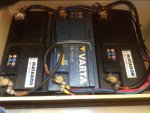
Clearly I have to spend time tracing all the wires from the battery, a job for next year. Surprising how having a problem focuses the mind! Below is a photo showing the 3 batteries, the one on the left had a heavily corroded -ve terminal.
image.jpg
 
Clearly I have to spend time tracing all the wires from the battery, a job for next year. Surprising how having a problem focuses the mind! Below is a photo showing the 3 batteries, the one on the left had a heavily corroded -ve terminal.
View attachment 46426

Well, the left-hand one isn't your engine start anyway.

Pity the installer decided to use black cable for the positive - the wraps of red tape are supposed to tell you that's what it is, but it certainly doesn't help.

Pete
 
If your battery was flat for a while it will most likely be a write off and will have to be replaced. The fact it will not take a charge is an indication it has come to the end of its life but it could be a failed charger. To check whether your battery or charger is at fault measure the voltage at the battery terminals whilst it is charging. If you don't read over 13V (it could be as high as 14.1V) then the charger is at fault. You should not parallel a new battery with an old one so make sure both parallel batteries are renewed at the same time and are identical (same make, model and capacity). Any 240V to 12V charger is man enough to charge your 3 batteries provided that there is no load connected. The lower the charger's rated max output the longer it will take to charge your batteries but the cheaper the charger. Take care charging 2 sets of batteries together; it is much safer to charge each bank separately unless you have circuitry in your boat to allow safe multi-bank charging. Also, take care to use only a marine charger with discontinuous earth link or you could risk problems with underwater erosion.
 
The battery on the right (90Ah Matador) I would assume to be your starter battery.

The 90Ah Matador on the left and the 88 Ah Varta are connected together in parallel and I would assume comprise your domestic battery bank.

Yes you certainly do need to spend some time getting to know what is what
 
The battery on the right (90Ah Matador) I would assume to be your starter battery.

The 90Ah Matador on the left and the 88 Ah Varta are connected together in parallel and I would assume comprise your domestic battery bank.

Yes you certainly do need to spend some time getting to know what is what

If the one on the right is the starter battery then I should be able to trace cables back to the Alternator, is that correct? As the one on the left had a corroded -ve terminal, it sounds like I could end up having to replace a couple of batteries.
 
Here's an old diagramme I did a while ago. It doesn't need to be done on CAD but it often means crawling all over your boat with a torch and notebook.
BOATWIRINGDIAGRAMNEWLAYOUT1.jpg
 
If the one on the right is the starter battery then I should be able to trace cables back to the Alternator, is that correct? As the one on the left had a corroded -ve terminal, it sounds like I could end up having to replace a couple of batteries.

I started trying to write a helpful reply but gave it up as impossible due to not knowing how the batteries are wired, what sort of switching arrangement you have and how they are charged from the alternator

You should be able to trace some wiring back to the starter motor solenoid. In a simple single battery system or even one with a 1,2, both switch the output from the alternator would probably meet up with it there.

Two things basically to do

Draw up a wiring diagram.

Separate and charge the batteries individually.

Then assess their condition. Dump any obviously dead.
Get potentially good ones properly tested.
Decide how best to use any that are serviceable.
Replace any that are unserviceable.

If you have one good one keep it as the starter battery. If you have two fairly good ones use them as the domestic bank .
 
Unless cash is really tight I would avoid using an old house battery as a starter battery (or vice versa). It will work for a while but if you put the wrong horse on the wrong course it won't last the race. Avoid compromising your safety at sea. You want that engine to start when your anchor's dragging on a lea shore! House batteries should be "leisure" or even better, "deep cycle" type. These are made with thick plates to supply their energy at low current (<20 A) over long periods (from 10 minutes to several hours say) depending on the capacity limitations of the battery. A starter battery is made with thinner plates and designed to produce high current (>90A) over a short period (<30s) for engine cranking.
Always keep lead acid batteries (wet, AGM or Gel) topped up to above 90% full and you'll get maybe 6 years or more life out of them. You can kill a lead acid battery by leaving it flat for any length of time which will cause sulphate crystals to foul its plates and shorten its life.
 
The battery on the right (90Ah Matador) I would assume to be your starter battery.

The 90Ah Matador on the left and the 88 Ah Varta are connected together in parallel and I would assume comprise your domestic battery bank.

Yes you certainly do need to spend some time getting to know what is what[/QUOTE]

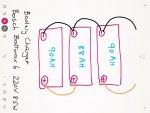
Based on how they are connected I see what you are saying, the battery on the right is the starter.

image.jpg
 
The battery on the right (90Ah Matador) I would assume to be your starter battery.

The 90Ah Matador on the left and the 88 Ah Varta are connected together in parallel and I would assume comprise your domestic battery bank.

Yes you certainly do need to spend some time getting to know what is what

While you are at that, I would spend some time taking apart and wire-brushing all the battery connectors to a spotlessly clean state. It will take time and effort, but I will be shocked if it does not reward the effort!
Been there- did the scrubbing :) - All much improved!
 
While you are at that, I would spend some time taking apart and wire-brushing all the battery connectors to a spotlessly clean state. It will take time and effort, but I will be shocked if it does not reward the effort!
Been there- did the scrubbing :) - All much improved!

One of those green Scotchbrite type of nylon pot scourers is good for cleaning battery posts, It will remove corrosion products without removing any metal.
 
Top