Battery Diode Splitter?

Tim Good

Well-Known Member
Joined
26 Feb 2010
Messages
2,888
Location
Bristol
Visit site
This Diode was installed in my boat before I bought it. I have 3 banks. House, now and engine and a selector switch.
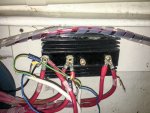
IMG_8910.JPG

The Diode from Left to right is:

1: House,
2: Select Switch no2 + engine
3: Nothing (should be alternator I believe)
4: Select switch no 1 + bow

The select switch then has:

Off / down position: house bank
1: bow + house
2: engine + house
Both: house, engine & bow

So I'm not entirely sure how a Diode works but in practice this seems to allow me to bring together bow, engine and house in different formats. If I want to charge the bow battery I have to link it with house.
My solar and alternator are connected directly to the house bank it seems so I need to use the switch in order to charge engine or bow.

Given my current setup can anyone pass judgement and recommend how it could be improved
Please?
 
A diode permits current to flow in one direction only !
Can't believe your alternator is only connected to your house batteries. Do you just have one alternator ?
I presume your bow battery is for your windlass.
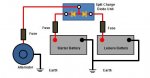
Complicated for nothing I think ! Your problem seems to be charging the batteries not how they are connected. The only time you need to connect batteries together is for starting purposes. A diode between your house and bow batteries should keep your bow battery charged (not forgetting the voltage drop of the diode about .5v . Its your alternator I would look at as it needs to charge the house and engine batteries. Look at a charge controller with dual output. If your splitter diode already has an alternator connection use that !
 
Last edited:
. Its your alternator I would look at as it needs to charge the house and engine batteries. Look at a charge controller with dual output. If your splitter diode already has an alternator connection use that !

If the alternator is fitted to the Diode input then would it just charge the bank which needs it most? I.e with less resistance?
 
I would replace the diode splitter with a volt sensing relay to avoid the 0.7v drop and allow full charging. You should wire this in accordance with the manufacturers diagram to give priority to the start battery and combining the house and bow batteries.
 
Assuming that what you have really is a 3-way charge splitter, i.e. 3 diodes with a common anode, then the unused terminal will be the anode.
You can use it to trickle charge all banks in winter.

There are dual charge splitters that look very similar to that, whee the fourth terminal is to go to the alternator/regulator, to provide compensation for the diode drop.

I would check that the alternator is not connected to the engine battery via the starter and alternator.

What you have is fine provided you switch to 1,2 or both often enough to keep the bow and engine batteries fully charged, it is a reasonable approach to avoiding overcharging these batteries when the house bank needs a lot more charger hours.
 
Assuming that what you have really is a 3-way charge splitter, i.e. 3 diodes with a common anode, then the unused terminal will be the anode.
You can use it to trickle charge all banks in winter.

There are dual charge splitters that look very similar to that, whee the fourth terminal is to go to the alternator/regulator, to provide compensation for the diode drop.

I would check that the alternator is not connected to the engine battery via the starter and alternator.

What you have is fine provided you switch to 1,2 or both often enough to keep the bow and engine batteries fully charged, it is a reasonable approach to avoiding overcharging these batteries when the house bank needs a lot more charger hours.

Thanks.

I can see that post one in the Diode has the alternator input. So this means that the house bank will get the alternator charge unless I switch to bow or engine.

You're spot on about the adverc. It was disconnected a while ago.

Question is... should I put the alternator lead to the input post in the Diode given I have 360w of solar now.

Also I've currently got the solar directly in the house bank. Should I also connect this to the input post of the Diode?
 
If you don't have something like an Adverc boosting your alternator volts, then a diode splitter is not nearly so useful.
These 'what is the perfect 12V system?' questions are impossible to answer, because every boat gets used differently.
If you have enough solar to keep everything charged and you are happy making a habit of using the 1B2 switch, then you don't have a problem.
If your solar trickle charges your engine and bow batteries, then you can leave the 1B2 switch 'off' unless they need a bit of a charge in winter.
A bit of voltage monitoring a couple of times a day will let you know if there's an issue.

I think it is far more important to understand the system you have, and how to live with it, than to worry about the exact optimum system.
 
Many thanks. Sounds fair. I've lived with this system
For a while now and do exactly that. Monitor the other batteries and switch it over when I feel they need more charge. I suppose whilst I was fitting a new bank of trojans I felt like I should review everything and understand it a little better.
 
Top