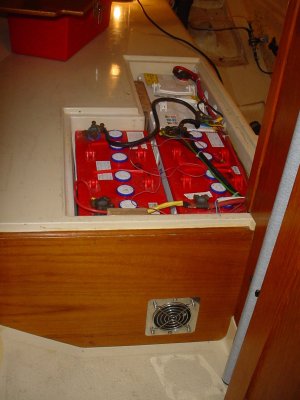
Battery compartment ventilation

hydrogen was particularly good at finding its way upward and outward via the smallest of openings
It’s the reason we don’t have hydrogen cars, storing tiny hydrogen atoms reliably is very hard as they get through most materials including solids like metals which to a hydrogen atom is quite gappy.
 
It’s the reason we don’t have hydrogen cars, storing tiny hydrogen atoms reliably is very hard as they get through most materials including solids like metals which to a hydrogen atom is quite gappy.
I used to work at a gas company and helium gas was used for leak testing and I believe Hydrogen molocules are half the size, so could easily find the smallest of gaps to leak through.
 
Last edited:
If a LA battery is gassing, you can vent it as much as you like, a spark close to the battery can cause the battery to explode. I've seen the result of this more than once, i actually had one explode in front of me when the battery was fitted to a car, with the bonnet up, in an open workshop.
 
The batteries on a Sadler are fitted in an insulated box with seat cushions on top. Hence they get warm on a long motoring passage, and possibly due to solar panel input. Over a season our domestic bank of three lead acid batteries takes between one and two litres of deionized water to top up. This water must be going somewhere, so ventilation/cooling seemed like a good idea. I fitted a computer-type fan low down on the forward face of the battery box with three exit holes drilled through into the engine compartment. The modification does seem to have helped.

(This setup was photographed when I increased the domestic bank from 2 to 3 by using the previous starter battery. Although obviously not all the same, this arrangement gave us a couple of years, after which I bought three identical LA types)
Battery box fan.JPG
 
I am shocked by the BSS requirements posted by Momac in post #13. If my calculation are correct, a pair of 100Ah unsealed batteries (pretty much the bare minimum for any but the smallest boats these days?) would, unless battery manufacturer's recommendations are different, require a 54.5mm (2.2") diameter vent from the top of the battery compartment (usually low down and enclosed by furniture etc.) to the outside world, while 6 X 100Ah would require a 92.5mm (3.7") diameter vent. Good luck installing that from scratch!
If I'm reading it correctly, ventilating it into the saloon or cabin is "OK" so long as that space also is ventilated.
I've not checked your arrithmetic.

But the BSS is full of things which "sea going" vessels seem to survive fine without!
 
Top