Battery charging help

Johnny5

Member
Joined
31 Mar 2012
Messages
41
Location
Kent
Visit site
I'm in the process of installing a 12v system to a widebeam barge
I already have the engine starter battery and I have now put in place two 110ah leisure battery's for the 12v circuits (lights radio etc) can I just use the existing engine alternator to charge these ?
If so how to wire them up ?
My other thought was to install a second alternator from the engine to charge my house battery's leaving the existing one to change the starter battery.
I would also like to install a battery charger for when I have access to 240v
Can this all be connected permanently or must it be isolated via a switch
 
You can charge both banks from the same alternator, but you will need either a 1,2, both isolator switch or better still through individual isolators and a VSR. There are in fact several different ways of wiring batteries and charging, so if you don't know already how to do it suggest you either get professional to advise or buy a book on the subject . Googling Boating Electrics books will give you a good selection to choose from.
 
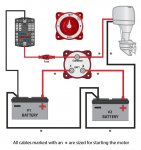
After looking at diagrams on the Internet the simplest one I found was this....
image.jpeg
And I understand a mains battery charger would just be permanently connected to the common and the neutral cables
Although I have a diesel inboard not a outboard
 
And I understand a mains battery charger would just be permanently connected to the common and the neutral cables

A charger could be connected by the positive/red lead to the terminal marked 1 on the switch and by the negative/black lead to any convenient terminal in the negative wiring. There should be an inline fuse in the positive lead that exceeds the charger rating. A switch in the lead might be needed to stop the back current when the charger is not in use, though for some chargers this back current is so small that it can be ignored. Check.
For a permanent charger installation you should also consider making a proper 240 v installation on board, with circuit breakers and RCD.
 
I have several friends who have river/canal boats which they live aboard. Most do run engines solely for charging as none are on mains power, so if you do that you will not be unusual (assuming you have a diesel engine). Only one alternator is needed for a mere 220Ah of capacity.

A good solution in my experience is an Adverc battery management system as it can help reduce the hours needed under charge to reach full charge. However other brands are available, and it's also true that modern alternators which are purpose designed for boat use now exist - but I've yet to meet one on a canal boat, 40 year old engines seem more common!

You need 'split charging'. A Voltage Sensing Relay or, imho simpler, cheaper and more reliable albeit a tad less efficient, diodes. See the diagrams in http://www.adverc.co.uk/cm/files/pdf/Adverc_Installation_Instructions.pdf for instance.

Most mains chargers which are suitable for boats, which you could use for the occasions you get shore power, will already have two outputs, one for engine starter and one for house bank. Don't expect a cheapo car charger to be a good investment as batteries cost a lot and so prolonging their life is financially worth-while.

Edit: How you manage batteries, wire them and charge them is slightly dependent on the battery type. A good solution I believe is to have as a starter battery an AGM battery with the service ones being wet lead-acid. This is because the maximum charging potential for the AGM is 14.8V whereas that for lead-acid is 14.4V (which is what a charge controller will produce). Any mis-match in the diodes due to different currents through them, or resistances in the system, are very unlikely to exceed 0.4V, so it means that only sensing the house bank - the normal configuration - will still not damage the starter battery. This also means that the 'isolator' shown in the Adverc diagrams is not required, simplifying day-to-day operation.
 
Last edited:
After looking at diagrams on the Internet the simplest one I found was this....
View attachment 57614
And I understand a mains battery charger would just be permanently connected to the common and the neutral cables
Although I have a diesel inboard not a outboard

That is a very simplistic arrangement and if you are doing an installation from scratch then it makes sense to do it properly to achieve an efficient charging and usage regime. The suggestions from jdc are one way of going about it, But if you are after serious mains charging capability then you need to instal a proper 240v system which is best left to a pro. A proper battery charger for your size bank needs to be a minimum of 20A to be of much use and have outputs to a least 2 separate banks which are simply not available from low powered car chargers.

Just picking a circuit from the internet is perhaps not the way to go about it - you have to understand the characteristics of the alternative arrangements so that you can choose one that meets your expected usage pattern.

I see your boat is a wide beam barge which suggests you will be looking to spend some time aboard and electricity will be important to you. A 220Ah house bank is not very big and would be typical of a weekend cruiser. For longer periods aboard you would probably need double that to avoid running them down too much. This means an efficient means of charging , hence the advice to consider a battery management system.
 
Top