Battery / Charger recommendations for an elctric toilet?

Karel

Well-Known Member
Joined
7 May 2006
Messages
125
Location
Behind you!
Visit site
For various reasons (see <u>this thread</u>) I'm rewiring my <u>Vetus WCS</u> toilet.

The best option (though not the cheapest) is to give the toilet it's own battery, and maybe even its own charger. These would be installed in a cupboard next to the loo - a damp place, but not 'wet'.

The toilet has a 400W motor and is rated at 35A @12V and runs for 6 seconds at a time. The high ampage rating is for a 'Dundee Cake Scenario'.

Any suggestions for a suitable battery that will handle half a dozen flushes between charges? The smaller, the better.
And a 230V trickle charger?
 
Don't worry it is not actually taking many amp hours. It is a very short time. Your usage is in seconds. Multiply the amps x the time in hours.

Any new battery installation will mean you would need larger cables to match the capacity of the charger output. Voltage drop is a far bigger problem charging than using batteries.
 
So a battery that can take short high ampage loads - like one for a starter motor?

I'm hoping someone can point me to something.
 
[ QUOTE ]
For various reasons (see <u>this thread</u>) I'm rewiring my <u>Vetus WCS</u> toilet.

The best option (though not the cheapest) is to give the toilet it's own battery, and maybe even its own charger. These would be installed in a cupboard next to the loo - a damp place, but not 'wet'.

The toilet has a 400W motor and is rated at 35A @12V and runs for 6 seconds at a time. The high ampage rating is for a 'Dundee Cake Scenario'.

Any suggestions for a suitable battery that will handle half a dozen flushes between charges? The smaller, the better.
And a 230V trickle charger?


[/ QUOTE ]

YOU DEFINITELY DONT NEED TO DO THIS!!!

I'm currently installing a Jabsco Electric Toilet conversion, and as long as you have got the correct thickness for the wires, (mine are 8mm sq'd each for a 5m run, or 10m both ways), the correct fuse, (the jabsco kit supplies a 25A fuse and connector), and a switch if you feel it necessary, all will be fine.

Given that a flush is 6 seconds, if it is used say twice an hour, it will only use a couple of Ah per day. One of my saloon lights uses almost that per hour.

Dont skimp on the wire thickness as too thin will run too hot, and this is where fires can start.

Cheers

Richard
 
"the jabsco kit supplies a 25A fuse"

Really? What do your 'installation instructions' say? Mine says 30A. The fuse that got fitted here though was 20A and blew. /forums/images/graemlins/confused.gif


I was wondering if a motor-cycle battery might do the job - they're only 6" long
Y50-N18L-A.jpg

http://www.batterycompany.co.uk/index.php?cc=1&page=shopping&shop_cat_id=412
 
In the responses to your previous thread, nobody seemed to suggest ASAP Supplies. They have always come up with the goods for me for electrical and other jobs. They sell lots of fuse-box options. They can also supply cable.

Their web site is www.asap-supplies.com
(I should really find out how to paste that as a link.) Oh it is!
 
<ul type="square">Thanks Ken, I've just ordered some fuses and a switch/breaker off them.

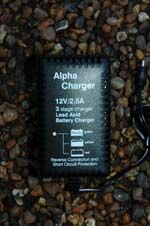
So... (a bit like thinking aloud this) if I used a motrobike battery like above and a charger like the one below plugged into a timer:

AC06025.jpg
(4th one down at <u>this</u> site)

I solve my problem for about £50...

Any observations?[/list]
 
Don't even think about this mad solution! Do a proper installation and forget about it. A separate battery is sometimes used for bowthrusters or windlasses, but it does not make a lot of sense even then. For an electric flush - crazy.

I would throw away the electric flush and fit a manual one long before fannying around with dedicated batteries.
 
Mad?

I wouldn't consider doing this for anything that was 'mission critical' but it's only the loo, will guarantee it works at minimal cost, is safe, and isolates the whole thing from all the other electrics, which can only be a good thing. My only concern is that the charger might just be a bit too mickey mouse... /forums/images/graemlins/shocked.gif
 
[ QUOTE ]
Mad?

[/ QUOTE ]


Mad as a very mad thing with a PhD in madness.

[ QUOTE ]
..... safe....

[/ QUOTE ]

I would say a lot less safe that properly sized, properly protected wire. If that battery shorts it will start a fire. How will you protect that wiring - with a fuse I suppose.

[ QUOTE ]
mission critical

[/ QUOTE ]

Well if your heads burst into flames, that may slow the mission down a bit.


Up to you of course! But I say its mad!!
 
The wiring will be 30A, and protected with both a fuse and a switch/breaker on the 12V side, and an RCD (I have a spare) on the 230V side.

When the boat is underway the 230V will of course not be connected. When the boat is unoccupied for any length of time I will switch off the mains supply.

Otherwise, where can the danger be? /forums/images/graemlins/confused.gif
 
Its just that I can't understand why it is any easier to make a safe and secure installation this way than it is to do it the usual way. You need to secure the battery carefully, fuse the 12v to the heads very close to the battery. You will also need to fuse the charger separately very close to the battery. You cannot rely on the 240V RCD for this, imagine a short across the output from the charger, that is a short straight across your heads battery. And your battery will not last very long being deeply discharged at regular intervals.

Help me out here someone....one of us is certainly mad.
 
It just happens to be easier on my boat at this point in time. There's a lot of room where I plan to mount it. The alternative is a minor nightmare!

"imagine a short across the output from the charger" Why should that happen? Everything will be properly insulated, and will be at the back of a cupboard, behind some drawers. Couldn't be safer.

"And your battery will not last very long being deeply discharged at regular intervals."
When will that happen? Richard calculated usage of 2Ah/day, and the battery I'm thinking of is rated at 8.
Meanwhile the charger can handle up to 12Ah, so that won't be anywhere near its limit either.

I know, i know, it all looks mickey mouse ay first sight, but I don't think it actually is.
 
<ul type="square">
Just had a thought:

If I'm installing a second seperate battery system on the boat, shouldn't I be thinking about how I earth it to avoid any unwanted corrosion?

BTW I hadn't mentioned, and perhaps i should, that I was already thinking about wiring in a computer and fitting a motorbike battery to act as a 'capacitor' to shield the PC from spikes when the engine was started. It so happens that the space I'll be using for the 'toilet battery' is exactly where I was going to put the PC battery, so why not fit both at the same time and kill two birds...?

I could then use the wiring that's now there for the toilet (and may not be of adequate capacity for that usage) instead for the PC. So everything gets used /forums/images/graemlins/smile.gif .My headache here is thinking about how to keep this all fully charged without undue voltage drops through a zillion diodes. One way is to completely isolate the toilet electrics as I've proposed above.

Is it all getting clearer?

yellowlaugh.gif

[/list]
 
[ QUOTE ]
"imagine a short across the output from the charger" Why should that happen?

[/ QUOTE ]

Well if you don't think wires in the back of a cupboard can short, you don't need to bother with any fuses. So that simplifies matters.
 
But you said it like it was somehow more likely to happen than with the first proposed installation.

Back of a cupboard, under the floor, accidents happen, so it will be fused wherever it is. Clearly you skipped over the post where I said that I'd just ordered 2 30A fuses and a breaker/switch. Or is that now too much protection. /forums/images/graemlins/grin.gif

Now, stop being pedantic and answer my earthing query. /forums/images/graemlins/wink.gif
 
[ QUOTE ]
Clearly you skipped over the post where I said that I'd just ordered 2 30A fuses and a breaker/switch.

[/ QUOTE ]


Whoa, ok, seriously. You said that you were planning to protect the charger with an RCD on the mains supply. That will not protect you from a short across the wires from the charger to the battery. You must do that and you must do it right at the battery. A 30A fuse will be too big unless you have wires from the charger also rated at 30A in which case why are you doing this?!

You would need 2 fuses at the battery, 1 rated to protect the pump and its wiring and 1 rated to protect the charger wiring.

As I may have mentioned, I would not do it that way!
 
<ul type="square">Just found this golf cart battery:
EVX12120.jpg

and at MDS battery only £20! 12Ah - that would keep my toilet going for a week!

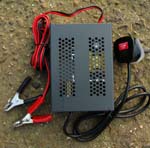
I could use this charger
AC1204.JPG

rated at 18Ah max for £26 from batterycomapanyco again, and the total is £46!

(or should i stick with a 12Ah charger to match the battery?)

Isn't the internet brilliant?[/list]
 
[ QUOTE ]
"the jabsco kit supplies a 25A fuse"

Really? What do your 'installation instructions' say? Mine says 30A. The fuse that got fitted here though was 20A and blew. /forums/images/graemlins/confused.gif


I was wondering if a motor-cycle battery might do the job - they're only 6" long


[/ QUOTE ]

My toilet is a Jabsco, and yours is a Vetus, so no reason why they should be the same. Yours needs a 30A fuse, mine needs a 25A fuse.

I cant understand why you persist with the separate battery idea. Just connect wires of the correct AWG, (thickness/guage?), to the existing battery bank, (domestic bank rather than engine if you have separate banks), with the fuse and switch somewhere between. It's not rocket science, whereas your idea is introducing complications.

The only reason I can think of is that it is difficult to feed the wires from battery to bog??

Cheers

Richard
 
<ul type="square">
It is a bit fiddly actually, and I think the solution I've arrived at (to simply isolate the WC and keep it all in one small space) is a good one. If it were another 12V device - like a TV - would you also feel that had to run off the house battery? I was planning to eventually wire in another battery anyway to act as a capacitor to smooth out spikes for a PC and I may as well do both jobs together now. That way I can use the wiring that's already there for the PC job.

I've done a search for golf cart batteries on ybw, and only found one passing reference. On the other hand golf batteries are mentioned quite often on US boaters' forums so I know they do work well. And if you think of the way golf carts (and lawn mowers) get treated they must be tough. And they're damn cheap! £20 for 12Ah - that's a third of the price I paid (per Ah) for the last battery I got from a chandlers. I wouldn't recommend them for starter motors (but who knows? They might be fine) but for this job they seem ideal.

Cheers

fritzthecat.gif

[/list]

Actually, now I'm curious! Once i've got a couple I'll pair them up and try them out on the starter (currently being rebuilt /forums/images/graemlins/frown.gif ) and see how they go...
 
Top