

superheat6k
Well-Known Member
With my boatyard introducing charges for electricity and because I don't need to continually cook the batteries I have come up with this idea for an automatic Battery Charger Demand Controller.
I am thinking of two primary control setpoints:
1 Falling Voltage to turn on - for now I have set this to 12.4 volts on the service / domestic battery bank.
I wil have to fine tune the Buck controller so the desired trigger is matched to the Turn On / Off level of the Sontay IO-RM1 module (~ 10 vdc)
2 Period to remain on for after the trigger voltage level is restored - for now I am thinking ~ 3 hours.
The battery charger is a Sterling 4 stage conected to two battery banks: Service & Port engine bank 2 x 110AH; Stbd engine & Windlass bank 1 x 110 AH.
Does any one know if 3 hours is OK for this charger to run through its normal cycle, or should I allow it to cycle longer, or indeed for less time. I expect the background demand to be very minimal, just a few LEDs on the distribution panel, unless a bilge pump kicks in.
I am also thinking of hooking up a run time counter to see how much it runs for over extended periods.
Thoughts please on this idea.
Diagram attached.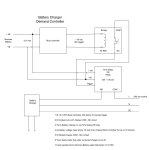
I am thinking of two primary control setpoints:
1 Falling Voltage to turn on - for now I have set this to 12.4 volts on the service / domestic battery bank.
I wil have to fine tune the Buck controller so the desired trigger is matched to the Turn On / Off level of the Sontay IO-RM1 module (~ 10 vdc)
2 Period to remain on for after the trigger voltage level is restored - for now I am thinking ~ 3 hours.
The battery charger is a Sterling 4 stage conected to two battery banks: Service & Port engine bank 2 x 110AH; Stbd engine & Windlass bank 1 x 110 AH.
Does any one know if 3 hours is OK for this charger to run through its normal cycle, or should I allow it to cycle longer, or indeed for less time. I expect the background demand to be very minimal, just a few LEDs on the distribution panel, unless a bilge pump kicks in.
I am also thinking of hooking up a run time counter to see how much it runs for over extended periods.
Thoughts please on this idea.
Diagram attached.


