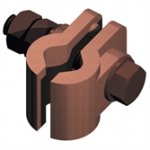
Battery cable mid-way clamp-on terminals?

prv

Well-Known Member
Joined
29 Nov 2009
Messages
37,358
Location
Southampton
Visit site
I have in mind a kind of terminal which could be fitted to the middle of a heavy battery cable, without cutting it. You'd run a knife round to remove a short length of insulation, then assemble the fitting around the exposed copper and do up a couple of bolts to clamp it in position. There would be a ring, stud, or similar terminal onto which you could then bolt another cable.

Obviously an alternative would be to cut the cable, crimp on two lugs, and put them with the new cable onto a stud. Or I could probably build something myself that would clamp on. But I'd like to know if anybody's come across such a thing off the shelf, and has a name to search for.

Cheers,

Pete
 
I have in mind a kind of terminal which could be fitted to the middle of a heavy battery cable, without cutting it. You'd run a knife round to remove a short length of insulation, then assemble the fitting around the exposed copper and do up a couple of bolts to clamp it in position. There would be a ring, stud, or similar terminal onto which you could then bolt another cable.

Obviously an alternative would be to cut the cable, crimp on two lugs, and put them with the new cable onto a stud. Or I could probably build something myself that would clamp on. But I'd like to know if anybody's come across such a thing off the shelf, and has a name to search for.

Cheers,

Pete

These might do you Pete but have to get the searchers out to find who is stocking them. I have got some from Holland for the rigs and may have found
some in Halfords or elswhere as have on the boat. Mind you these could be here from HK within a week.


http://www.ebay.com/itm/Auto-2-Pcs-...amp-Clips-Angle-Brass-Connector-/260984323701
 
Last edited:
I've never seen anything which matches your description. The easy solution, as you've suggested, is to use an insulated post and put lugs on the ends of the cables.
 
The easy solution, as you've suggested, is to use an insulated post and put lugs on the ends of the cables.

The reason I was reluctant to do that is that I have swallowed Gibbo's advice (of Smartgauge fame) about minimising connections in a charging circuit for best efficiency. Even a new, good connection will drop a fraction of a volt, and with the difference between charging voltages measured in tenths, it doesn't take many to start seeing a difference. However, since starting this thread I have realised that the cables I need to tap into are starter, not charging, cables so the point is moot :)

Pete
 
The reason I was reluctant to do that is that I have swallowed Gibbo's advice (of Smartgauge fame) about minimising connections in a charging circuit for best efficiency. Even a new, good connection will drop a fraction of a volt, and with the difference between charging voltages measured in tenths, it doesn't take many to start seeing a difference. However, since starting this thread I have realised that the cables I need to tap into are starter, not charging, cables so the point is moot :)

A properly made connection on a substantial post will have minimal resistance.
 
Last edited:
It might help to specfy why you want to tap off the cables and what loadings and therefore sizes are involved. E.g. if you are taking a low load feed from the cables or just sensing wires, then there may be an IDC connector which would suit (similar to Scotchlocks).

Rob.
 
... with a suitable die of course.

I have a hydraulic crimping machine with accompanying dies - but I suspect PCUK misread the question as I can't imagine any normal crimp being fitted to the middle of the cable. In any case, as I've already said, the whole requirement was based on a faulty assumption - I want to leave the charging cables unbroken, and it's the starting cables that I need to attach to.

Pete
 
Well, it's not my theory, so I'll link you to Gibbo on the matter: http://www.smartgauge.co.uk/alt_how.html

Ah, right! I reckon that Gibbo must be related to Mr Sterling, as they both have a habit of writing reams of stuff. Lots of people assume (with both of them) that they must know what they're talking about, because they write in such lengthy detail. The specific article you linked to probably isn't strictly relevant to many boatowners, as most people these days seem to have battery-sensed alternators (either directly or via "smart" regulators). However, Gibbo says that a typical connection has a resistance of 200 micro-ohms (0.0002 ohms). I think that's an exaggeration - commercial crimp connections should typically have a resistance of only 25-30 micro-ohms. So, straight away, there's a question mark over the calculations in the article. And, as I posted earlier, properly made connections on a substantial post will have minimal resistance.
 
The specific article you linked to probably isn't strictly relevant to many boatowners, as most people these days seem to have battery-sensed alternators (either directly or via "smart" regulators).

Really?

I don't know about the prevalence of external regulators, but I thought battery-sensed alternators were relatively rare.

Pete
 
Top