
Battery Advice For Overwinter

I was planning to leave my new sealed lead acid batteries in place over winter (a 270ah bank and a Red Flash 1100 with a 30 watt panel and regulator feeding both batteries) keeping them topped up, assuming that 13 volts would not cause water loss. It sounds like you think this is a bad idea ... I thought they were safe enough below 14 volts. No?

I find I need to add water to my bank of three 120Ah batteries about two or three times per season. This is with the fridge running full time. Some of this is no doubt due to gassing when the engine is charging via the Sterling unit, which their instructions warn about. However, we try to limit using the engine as much as possible, wheras the solar panels are charging whenever there is daylight. My motorhome has a large solar panel and the vehicle stands idle for much of the year and has a standard engine charging system, i.e. no Sterling. Its domestic batteries need topping up about once per year. So I don't really know the answer but it does seem that gassing occurs with solar charging.
 
it it does seem that gassing occurs with solar charging.

I think it very much depends on the regulator, Vyv, but from what I understand even 14V is well below the threshold for gassing. My solar regulator is custom-programmed for 14.8v for the final boost stage, as recommended by the battery manufacturer. That certainly causes gassing -- about 0.6 litre per month in top-up water. During the winter, when the batteries are normally maintained more-or-less fully charged by mains charger, they spend most of their time on float (13.4V) and use little or no water.

(For perhaps four months of the coming winter we won't be aboard, hence the dilemma about what to do. I suspect I'll just unbuckle them and leave them to it.)
 
I think it very much depends on the regulator, Vyv, but from what I understand even 14V is well below the threshold for gassing.....

I left a motorbike battery for 6 months at just under 14V once. At the end of that it was dry as a bonio.
I now use 13.3 on fully charged batteries.
 
Thanks for the collective wisdom to all that replied to my OP. I think that for this year at least, I shall disconnect and cover the 100w panel and use the 25w one via regulator to keep the batteries charged.
My initial dilemma was partly due to my confusion regarding charging cycles. I intend to read up on this as I am still not sure what constitutes a 'cycle'?. ie: how much does a battery have to discharge and charge to complete one cycle.
If it 100% then does each days percentage discharge and charge accumulate until the combined total reaches 100% to form one cycle or am I totally missing the point.
 
Further to my previous post I have just googled charging cycles and found an explanation I understand.

"A cycle is considered a full discharge/recharge, as the value is measuring how often the particles in the battery can be inflated before they die.

Consider a battery like a set of hundreds of balloons. Charging the battery is inflating those balloons, discharging is deflating them.
Each of these balloons can only sustain a certain amount of inflate/deflate cycles before it won't be able to inflate anymore (=cannot be charged with energy).

So if you charge your battery at 60% load, you are inflating 40% of those 'balloons', which means the wear effect applies mainly to 40% of the battery.

Also, it's worth to mention that the standard definition of a battery lifecycle is, how often a battery can be fully discharged/recharged until its capacity drops below 80% of the initial value."
 
The self discharge rate of a lead acid battery is affected by temperature, higher temperature results in faster discharge. I have repeatedly left my batteries disconnected over winter in Scotland with no obvious problems, but this does not mean I would be able to do the same in Greece.
 
The self discharge rate of a lead acid battery is affected by temperature, higher temperature results in faster discharge. I have repeatedly left my batteries disconnected over winter in Scotland with no obvious problems, but this does not mean I would be able to do the same in Greece.

That's rght, as the Exide information I gave in post #5 explains. The 'standard' temperature for which they give their six months advice is 25C. At 35C, that six months may be halved (not that Greece, or even Scotland ;), has winter temperatures that high). The difference in average January temperatures is significant, but maybe less than you'd imagine: 3C for Glasgow, 10C for Athens.
However, Exide and pretty well every other manufacturer are describing a storage regime in which the batteries are periodically monitored...and that's the rub.
 
Further to my previous post I have just googled charging cycles and found an explanation I understand.

"A cycle is considered a full discharge/recharge, as the value is measuring how often the particles in the battery can be inflated before they die.

Consider a battery like a set of hundreds of balloons. Charging the battery is inflating those balloons, discharging is deflating them.
Each of these balloons can only sustain a certain amount of inflate/deflate cycles before it won't be able to inflate anymore (=cannot be charged with energy).

So if you charge your battery at 60% load, you are inflating 40% of those 'balloons', which means the wear effect applies mainly to 40% of the battery.

Also, it's worth to mention that the standard definition of a battery lifecycle is, how often a battery can be fully discharged/recharged until its capacity drops below 80% of the initial value."

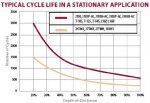
Trojan provide useful graphs for their batteries but I don't think that many other manufacturers are as open. You can easily see that the number of expected "cycles" is closely tied to the depth of discharge.

e.g.
100% > 80% > 100%
Approx. 3,000 cycles for T105 and only 1,000 cycles for 12V range (24TMX, 27TMX etc.)

100% > 60% > 100%
Approx. 1,000 cycles for T105 and only 480 cycles for 12V range (24TMX, 27TMX etc.)

Trojan obviously charge/discharge under closely controlled conditions and you might be lucky to get half in real life. However, they are useful as a guide.

Discharging by a only few % and then fully charging immediately would give a huge number of expected cycles before the battery expired.

TrojanDoD.jpg

So flooded type battery life shouldn't be adversely affected by trivial amount of "cycling" by self-discharge at night and modest solar charging by day.

Of course there are many other factors such as plate erosion, self-discharge rate, storage temperature and so on.

I have T-105s and cannot leave them disconnected over winter in Sardinia so leave some solar panels connected. Trojan quote a max. self-discharge rate of 4% per week so they'd get flat pretty quickly. I expect that's at 25C but the rate would still be too high at normal winter temps. here.

Different story with AGMs as they have very low self-discharge rates. Other battery types will be somewhere between these types.
 
Last edited:
I have T-105s and cannot leave them disconnected over winter in Sardinia so leave some solar panels connected. Trojan quote a max. self-discharge rate of 4% per week so they'd get flat pretty quickly. I expect that's at 25C but the rate would still be too high at normal winter temps. here.

Different story with AGMs as they have very low self-discharge rates. Other battery types will be somewhere between these types.

One reason Trojan T-105s achieve their excellent cycle life is because the grid alloy is about 5% antimony. This gives a much stronger grid than lead calcium and stands up to cycling better. The drawback is indeed substantially higher self discharge. The self discharge rate will increase over the life of the battery because the antimony tends to migrate from the pos plate and deposit in spots on the neg plate causing local cells that gas more. Known as antimony poisoning.

Ordinary lead antimony batteries are normally 1.5% Sb or less. They will still gas more than PbCa - maybe up to 2X - but less than T105s and not increasing over the life, antimony poisoning doesn't happen.

AGMs are never PbSb AFAIK, always PbCa or pure lead, usually with a trace of tin and/or silver. AGMs do usually self discharge even less than flooded PbCa.
 
Trojan provide useful graphs for their batteries but I don't think that many other manufacturers are as open. You can easily see that the number of expected "cycles" is closely tied to the depth of discharge.

e.g.
100% > 80% > 100%
Approx. 3,000 cycles for T105 and only 1,000 cycles for 12V range (24TMX, 27TMX etc.)

100% > 60% > 100%
Approx. 1,000 cycles for T105 and only 480 cycles for 12V range (24TMX, 27TMX etc.)

Discharging by a only few % and then fully charging immediately would give a huge number of expected cycles before the battery expired.

My first thought was "Who cares about cycles? Surely it's the lifetime Ah capacity which matters most?"
Then I noticed that you seem to be misreading your own graph at TrojanDoD.jpg, Mistroma.
It actually shows this for T105 (and others):

100% > 80% > 100%
Approx. 3,000 lifetime cycles.

100% > 60% > 100%
Approx. 1,500 lifetime cycles (not 1000, as you wrote).

100% > 40% > 100%
Approx. 1,000 lifetime cycles.

100% > 20% > 100%
Approx. 750 lifetime cycles.

100% > 0% > 100%
Approx. 600 lifetime cycles.

So let's call 1% of charge 1 unit, each of which equals 'x' Ah:
Repeated discharge to 80% for lifetime gives: 3000 x 20 = 60,000 units.
Repeated discharge to 60% for lifetime gives: 1500 x 40 = 60,000 units.
Repeated discharge to 40% for lifetime gives: 1000 x 60 = 60,000 units.
Repeated discharge to 20% for lifetime gives: 750 x 80 = 60,000 units.
Repeated discharge to 0% for lifetime gives: 600 x 100 = 60,000 units.

Are we perhaps seeing a pattern here?
In other words, the number of units (or Ah) stored and released in a T105's lifetime is unaltered by depth of cycle. And isn't the entire point of a battery precisely that: to store and release energy?

I've certainly read in the past evidence that this roughly the case with T105s, but with some modest losses for repeated deep discharge. In fact, I rather thought that you presented it, although I may be mistaken.

That said, our T105s very rarely get cycled below -20%, but that's just a function of the bank's size, our energy demands, and the transparency of the Mediterranean sky. Other charging regimes are available ;)

I have to say I'm somewhat sceptical of the graph's figures and would be most interested in Plevier's view on them. The figures for regular 100% discharge seem particularly hard to swallow, although golf carts seem to show that you can run traction batteries too flat to work and repeatedly bring them back to life. But I suppose very small loads will, paradoxically, eventually flatten batteries more comprehensively than 5kW motors.

Sorry, another one for Plevier:
Just a thought, but what does 40% discharged mean, anyway? Does it mean 60% of the original Ah are still available? Or that 60% of the battery's original energy is still available? Because surely they're not the same? As the volts drop, clearly so does the wattage, so the energy in each Ah must be less the lower the state of charge. But then shovelling energy back into a battery is easier at fairly high discharges, so maybe this is in some way self-compensating. And maybe Watt-hours would be a more revealing measure of capacity than Ah, anyway? Or are the electrons in my head just getting too feeble? G'night :sleeping:
 
Last edited:
My first thought was "Who cares about cycles? Surely it's the lifetime Ah capacity which matters most?"
Then I noticed that you seem to be misreading your own graph at TrojanDoD.jpg, Mistroma.
It actually shows this for T105 (and others):

100% > 80% > 100%
Approx. 3,000 lifetime cycles.

100% > 60% > 100%
Approx. 1,500 lifetime cycles (not 1000, as you wrote).

100% > 40% > 100%
Approx. 1,000 lifetime cycles.

100% > 20% > 100%
Approx. 750 lifetime cycles.

100% > 0% > 100%
Approx. 600 lifetime cycles.

So let's call 1% of charge 1 unit, each of which equals 'x' Ah:
Repeated discharge to 80% for lifetime gives: 3000 x 20 = 60,000 units.
Repeated discharge to 60% for lifetime gives: 1500 x 40 = 60,000 units.
Repeated discharge to 40% for lifetime gives: 1000 x 60 = 60,000 units.
Repeated discharge to 20% for lifetime gives: 750 x 80 = 60,000 units.
Repeated discharge to 0% for lifetime gives: 600 x 100 = 60,000 units.

Are we perhaps seeing a pattern here?
In other words, the number of units (or Ah) stored and released in a T105's lifetime is unaltered by depth of cycle. And isn't the entire point of a battery precisely that: to store and release energy?

I've certainly read in the past evidence that this roughly the case with T105s, but with some modest losses for repeated deep discharge. In fact, I rather thought that you presented it, although I may be mistaken.

That said, our T105s very rarely get cycled below -20%, but that's just a function of the bank's size, our energy demands, and the transparency of the Mediterranean sky. Other charging regimes are available ;)

I have to say I'm somewhat sceptical of the graph's figures and would be most interested in Plevier's view on them. The figures for regular 100% discharge seem particularly hard to swallow, although golf carts seem to show that you can run traction batteries too flat to work and repeatedly bring them back to life. But I suppose very small loads will, paradoxically, eventually flatten batteries more comprehensively than 5kW motors.

Sorry, another one for Plevier:
Just a thought, but what does 40% discharged mean, anyway? Does it mean 60% of the original Ah are still available? Or that 60% of the battery's original energy is still available? Because surely they're not the same? As the volts drop, clearly so does the wattage, so the energy in each Ah must be less the lower the state of charge. But then shovelling energy back into a battery is easier at fairly high discharges, so maybe this is in some way self-compensating. And maybe Watt-hours would be a more revealing measure of capacity than Ah, anyway? Or are the electrons in my head just getting too feeble? G'night :sleeping:

Thanks for pointing that out. I'd used cut and paste for the second line and altered the figures. I actually went back in to re-edit in a rush and altered 1,500 to 1,000 with my brain in neutral, obviously thinking I was on the next line. Obviously too many beers by then.

I thought about putting in more about the fact that there would be a sweet spot for capacity. It's well known that you get about the same total capacity over battery life but I didn't mention it as OP was only talking about cycling by a small amount in storage with solar panels. Good point though if sizing a battery bank and deciding on charging kit.
 
Sorry, another one for Plevier:
Just a thought, but what does 40% discharged mean, anyway? Does it mean 60% of the original Ah are still available? Or that 60% of the battery's original energy is still available? Because surely they're not the same? As the volts drop, clearly so does the wattage, so the energy in each Ah must be less the lower the state of charge. But then shovelling energy back into a battery is easier at fairly high discharges, so maybe this is in some way self-compensating. And maybe Watt-hours would be a more revealing measure of capacity than Ah, anyway? Or are the electrons in my head just getting too feeble? G'night :sleeping:

It's Ah not energy (Wh), and will be expressed as a %age of the nominal Ah capacity, not as a %age of the usable capacity at your discharge rate.
You're quite right that the energy per Ah drops as you discharge. You will find constant power - as opposed to constant current - discharge curves for some batteries when they are aiming at the UPS market. If you're sizing for say a 10 minute duty down to maybe 1.75 V per cell it's a significant difference. This would o fcourse be the correct way to size for an inverter on a boat too.
In terms of cycle life, the figures are so variable and approximate that I'm sure you wouldn't know the difference.

Why? LA batteries do not store electricity like capacitors. They are chemical devices. During discharge the + plate changes from lead dioxide to lead sulphate and the -ve from metallic lead to lead sulphate and the reverse when you recharge. Both these reactions produce a change in volume of the active material and that's what does the major damage to the plates, mainly the positive plates, it's physical rather than chemical. The deeper you discharge and the more material you convert, the worse the damage. During discharge the acid electrolyte is used up in the reactions and its concentration (specific gravity) reduces, hence the reducing voltage. However it still takes the same amount of plate active material conversion to liberate 1Ah, even though the actual energy delivered is less. So the damage is Ah related not Wh related. Yes I've ignored the effect of losses due to increasing internal resistance during discharge, please don't ask me to go there!
 
Last edited:
I have for the last few winters kept a single solar panel connected (1 of 2 85watt panels). They are connected to the batteries through a STECO 30 amp controller to 4 x 110 sealed boshe, 1 110 engine and a bow (winch and thruster) AGM battery - now 12 years old, connected to the engine battery by a Sterling Battery to Battery charger. The 2 banks, House and engine will then be connected together by heavy jump leads. The 1 2 both Battery switch will be OFF.

I fitted 4 new house batteries last year as the others had died prematurely - they were always kept as above. I have never taken my batteries below 12.6V as my fridge set up uses bugger all electric running only 20% of the time in the hottest of weather. So I was suspicious of why they had died prematurely after 2.5 years (9 weeks or so on board)

So this summer I came to the boat in Turkey and set off on the first cruise. Within days I was finding that the batteries although up to static voltage of 12.8, when the fridge was running (3-4 amps) the battery voltages came down to 11.9V. It seems that there was plenty of power in them but they could not deliver. I checked all the contacts etc - no problem.

I then plugged the mains charger in (Sterling 80amps) and found that the initial charge - which does an equalization of 15V for 10 minutes, did not raise the voltage above 14V. Repeated resettings finally achieved a rapid rise to 15V as should happen. The batteries started behaving normally again.

The battery guys in Yat Marine Marmaris said that this was a common problem when sun panels were left on for a full winter. They say that batteries dont like constant charge with no discharge at all. They fit to all the boats they manage a small strip of LEDs (about .4W)which come on with the controller dusk to dawn switch facility. This causes the batteries to marginally discharge over night - say max 8 amps at the shortest of days, and allows the chargers to work correctly putting a base charge in at 14.2V before floating to 13.8V. The STeco is adjustable so you can lower the voltages if you want to, but I haven't.

Independently, I wrote to Boshe who replied back with exactly the same solution and explanation to the problem. So this winter if you walk by my boat at dusk you will see the light suddenly switch on. I have left both panels up as they are badly shaded by other boats.

Lets see if it works better.
 
The battery guys in Yat Marine Marmaris said that this was a common problem when sun panels were left on for a full winter. They say that batteries dont like constant charge with no discharge at all. They fit to all the boats they manage a small strip of LEDs (about .4W)which come on with the controller dusk to dawn switch facility. This causes the batteries to marginally discharge over night - say max 8 amps at the shortest of days, and allows the chargers to work correctly putting a base charge in at 14.2V before floating to 13.8V. The STeco is adjustable so you can lower the voltages if you want to, but I haven't.

It's the old "batteries need to be exercised" maxim. It's not true for lead-acid batteries.

Richard
 
That was my view but not Boshes view. What do you think caused the problem?

It sounds like you might be connecting different batteries together in a parallel format using jump leads and then leaving the whole lot on permanent charge from a single channel controller. This is definitely not advisable other than for short periods to give a "boost" to the batteries.

You should only do this with very similar batteries and ideally identical ones of the same age.

Richard
 
It sounds like you might be connecting different batteries together in a parallel format using jump leads and then leaving the whole lot on permanent charge from a single channel controller.

Don't think he is Richard. Looks to me like he's leaving 5x 110ah batteries in parallel (in part by using jump leads) and the AGM is getting it's charge via the Sterling battery to battery charger.

As is my usual stance, i would seriously question his use of a 1-2-both switch though. IMO he would be better off all around with 2 separate circuits, 2 switches (preferably a 3rd for emergency starting) and a dual sensing VSR. Solar panels connected to the domestic bank, alternator to the engine bank and leave the Sterling unit as is.

Edit : I assume his engine battery to be the same as the domestics.
 
Don't think he is Richard. Looks to me like he's leaving 5x 110ah batteries in parallel (in part by using jump leads) and the AGM is getting it's charge via the Sterling battery to battery charger.

As is my usual stance, i would seriously question his use of a 1-2-both switch though. IMO he would be better off all around with 2 separate circuits, 2 switches (preferably a 3rd for emergency starting) and a dual sensing VSR. Solar panels connected to the domestic bank, alternator to the engine bank and leave the Sterling unit as is.

Edit : I assume his engine battery to be the same as the domestics.

All identical. I find that I have no draw backs with 1.2 both switch. I am in the habit of remembering to change settings.
 
Top