Batteries - how low can they go?

Tim Good

Well-Known Member
Joined
26 Feb 2010
Messages
2,888
Location
Bristol
Visit site
I’m trying to determine if I’m being too cautious with my batteries and if I should hammer them some more.

I have 4 x 6v Trojans in series for a 12v house bank. Together with 360w of solar this works well for charging our electric outboard boiling water in a kettle and cooking on an electric hob here and there. At this time of year we’re regularly putting in 2kwh according to our Victron controller and reach float every day or at worst every 3/4 days if bad weather.

However, I usually stop using the kettle and electric job when they get to a resting voltage of about 12.2v. So about 60% capacity.

On the assumption we’re getting enough sun every few days to top them back up again to float status, am I being too cautious and could I be using more of the capacity?

I’ve had these batteries since 2017 and always ensured they’re topped up and the specific gravity has never dropped below optimal in that time. We’re 65% liveaboards so they get used a lot.
 
The lower you discharge them, the more 'wear' on the battery.
Every cycle shortens the life of the battery, deeper cycles shorten it more.
Leaving the battery at a low state of charge also shortens its life.
There are no hard and fast limits, it's all grey scales and slippery slopes.
Bear in mind that batteries don't last forever even with zero use.

There's a cost to using them and presumably a benefit or a cost of not using them like using gas instead or running the engine.
Very hard to put numbers to it as we'd be guessing the inputs.
 
It depends upon whether you are measuring the 12.2V whilst the batteries are rested or whilst they are delivering current.

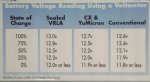
12.2V for a fully rested battery is down to around 40% whereas still at around 70% if the battery has been disconnected from charging and is not powering anything.

If the battery is still powering a fridge or similar, it could be at 80% or more.

I let my batteries go down to 12V whilst connected and powering stuff, which is probably around 50% or 60% remaining, My last set lasted 10 years.

I would only use 12.2V - 12.3V as a 50% guide if the battery was fully rested.

Richard
 
Last edited:
Yuasa state that 35% discharge is deep discharging.
 

Attachments

  • Studio_20210628_113450.jpg
    Studio_20210628_113450.jpg
    344.7 KB · Views: 33
MY PERSONAL LIMITS .....

A rule I keep to is not to go below 65 - 70% on a starter battery .... they really do not like being discharged at all ....

Not below 60% on a so-called leisure battery that they say can start an engine as well - these are compromise batterys and NOT true Deep Cycle.

For Deep Cycles to try not to go below 50% too often and IMHO I would not like to go below 45% at any time.

Something that I don't hear many say : When storing any of above - CHARGE IT FULLY .... and check it regularly. If the storage is likely to be cold and particularly drop below freezing - CHARGE FULLY. If the battery is discharged - the fluid is more likely to freeze and can split the case. Its happened to me and the mess to clean !!
 
35% discharge down to 65% capacity remaining is certainly not "deep discharging"
I posted that as i too was surprised it was considered deep discharging..
Another surprise was yuasa saying not to use a drop test on a battery as its dangerous due to sparking and makes no allowance at all for the size/capacity of the battery and gives very innacurate readings if the battery is in any state of discharge..
The 35% is nothing to do with the chart i posted. Thats a rough guide to how charged your batteries may be when left to settle for a period of time..
 
35% discharge down to 65% capacity remaining is certainly not "deep discharging

IMHO - if its a starter battery and you do it too often - then yes it is.

If its a leisure or Deep Cycle battery - then its not so deep.

But people seem to think that Deep Cycle means take battery right down ... No it does not. It just means the battery by way of the plates used is more tolerant of deeper discharge than a cranking battery. It is still good policy to not deep discharge and keep charged as much as possible.
 
I’m trying to determine if I’m being too cautious with my batteries and if I should hammer them some more.

I have 4 x 6v Trojans in series for a 12v house bank. Together with 360w of solar this works well for charging our electric outboard boiling water in a kettle and cooking on an electric hob here and there. At this time of year we’re regularly putting in 2kwh according to our Victron controller and reach float every day or at worst every 3/4 days if bad weather.

However, I usually stop using the kettle and electric job when they get to a resting voltage of about 12.2v. So about 60% capacity.

On the assumption we’re getting enough sun every few days to top them back up again to float status, am I being too cautious and could I be using more of the capacity?

I’ve had these batteries since 2017 and always ensured they’re topped up and the specific gravity has never dropped below optimal in that time. We’re 65% liveaboards so they get used a lot.

That all looks fine to me. 12.2V on batteries in use isn't hammering them, especially Trojans.
 
Top