Batteries and busbars

Parmesan

New Member
Joined
7 Feb 2024
Messages
11
Visit site
Hopefully a simple question.

I have a yacht with two house batteries and the usual rats nest of direct connections. These include direct loads (bilge pumps, radar, etc) and feeds from solar panels and a wind generator. These seem to be split somewhat randomly between the two batteries.

I would like to simplify these with busbar, but what is the ideal arrangement? I assume that I can rationalise everything to busbar(s) on the positive of battery A and the negative of battery B, but can I put loads and feeds on the same busbar or should they go on separate ones (with each connected directly to the battery or via another short busbar and a single cable to the battery?

Thanks in advance.
 
Hopefully a simple question.

I have a yacht with two house batteries and the usual rats nest of direct connections. These include direct loads (bilge pumps, radar, etc) and feeds from solar panels and a wind generator. These seem to be split somewhat randomly between the two batteries.

I would like to simplify these with busbar, but what is the ideal arrangement? I assume that I can rationalise everything to busbar(s) on the positive of battery A and the negative of battery B, but can I put loads and feeds on the same busbar or should they go on separate ones (with each connected directly to the battery or via another short busbar and a single cable to the battery?

Thanks in advance.
It's good to have a single connection on the battery terminals (y)

Loads and charging can go on the same busbar. So go from the battery to the busbar, then connect anything permanently positive, usually only bilge pumps, certainly not radar, plus mains and solar charging, and the connection to the main isolator.
 
Normally 2 house batteries would be in parallel as one bank and all domestic loads taken via the DC switch panel although you may have some direct from the battery like bilge pumps. Solar and wind would normally feed into house bank. You don't say whether you have a dedicated start battery or how the house battery is charged from the alternator. TBH it sounds like you need to rethink the whole system and more information is needed to make sensible suggestions.
 
If you can achieve a maximum of 4 connections on every battery terminal there is no need for busbars which only introduce even more connections to drop voltage and go bad. They look pretty but not the best or most efficient way with low voltage battery connections.
 
If you can achieve a maximum of 4 connections on every battery terminal there is no need for busbars which only introduce even more connections to drop voltage and go bad. They look pretty but not the best or most efficient way with low voltage battery connections.
What a lot of absolute rubbish !!

All of the wires have to go somewhere, if they all went to the battery terminals it would save the wire from the battery to the busbar, at the expense of having multiple wire connected to the battery terminals.

For the OP, at a bare minimum he'll have bilge pump, shore charger, solar controller, wind controller and the main isolator switch, that's 5 wires.
 
The OP has of course 2 batteries so including the interconnect he has space on the terminals for 8 cables.
keeping as many connections direct onto the batteries is not a load of rubbish and don't be so insulting, everyone has their view that they are entitled to.
Paul you are too entitled! Precisely why I have you on ignore.
 
The OP has of course 2 batteries so including the interconnect he has space on the terminals for 8 cables.
keeping as many connections direct onto the batteries is not a load of rubbish and don't be so insulting, everyone has their view that they are entitled to.
Paul you are too entitled! Precisely why I have you on ignore.
His batteries will be in parallel, he should only connect positives to one battery and negatives to the other, as he correctly says in post #1

Even if he did incorrectly connect positives to both batteries, that's 6, not 8, there will be a parallel cable.

So, still nonsense!
 
His batteries will be in parallel, he should only connect positives to one battery and negatives to the other, as he correctly says in post #1

Even if he did incorrectly connect positives to both batteries, that's 6, not 8, there will be a parallel cable.

So, still nonsense!
I did say including the interconnects..................... So 6 plus the interconnects = 8
More over entitlement Paul?
 
I did say including the interconnects..................... So 6 plus the interconnects = 8
More over entitlement Paul?
Still wrong, the positives do not connect to each of the batteries, positives to one battery, negatives to the other.

Nothing to do with entitlement, whatever that is supposed to mean, it's simply about doing the job correctly.
 
What a load of rubbish, the rule is no more than 4 connections on any battery connection, positive or negative.

I am not going to argue with someone who is ALLWAYS right because he is perfect and it would be me that he gets banned from the forum. His self-important and dogmatic attitude is well documented on the forum so I am bowing out of this childish discussion.
But I am correct.
 
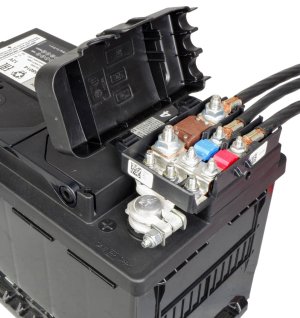
Those connections will need to be fused at the battery end, so instead of a busbar you could use a four-way fusebox like this from Blue Sea.
That is not perhaps appropriate for what he wants to do. There should indeed be a fuse from the +ve to the busbar and maybe a shunt from the -ve for a battery monitor. All loads then come off the busbars, either through the switch panel (with its fuses or breakers for individual circuits) or direct with their own fuse for example for an automatic bilge pump
 
That is not perhaps appropriate for what he wants to do. There should indeed be a fuse from the +ve to the busbar and maybe a shunt from the -ve for a battery monitor. All loads then come off the busbars, either through the switch panel (with its fuses or breakers for individual circuits) or direct with their own fuse for example for an automatic bilge pump
It depends. Good automotive practice has the high current feed to the busbar or other distribution point unfused. Then the feeds taken from the busbar go to a fusebox first and then to the loads. I can see no reason why marine would be any different as the last thing you need in a high current feed is a poor or underrated connection.

I feed my busbars with 25mm2, neatly routed and insulated. That also keeps the battery installation neat and compliant, with only one cable each side exiting the battery box.
 
What a load of rubbish, the rule is no more than 4 connections on any battery connection, positive or negative.

I am not going to argue with someone who is ALLWAYS right because he is perfect and it would be me that he gets banned from the forum. His self-important and dogmatic attitude is well documented on the forum so I am bowing out of this childish discussion.
But I am correct.
I think you have forgotten that best practice is that on any string of batteries to ensure an even draw from all batteries in that parallel string , you connect the main positive to one end of the string and negative to the other . Whilst best practice is no more than 4 terminals on a battery post it has to be taken alongside all other "rules" so Paul is correct that to do it properly you run only from the two furthest ends in a string and not every terminal.
 
I think you have forgotten that best practice is that on any string of batteries to ensure an even draw from all batteries in that parallel string , you connect the main positive to one end of the string and negative to the other . Whilst best practice is no more than 4 terminals on a battery post it has to be taken alongside all other "rules" so Paul is correct that to do it properly you run only from the two furthest ends in a string and not every terminal.
With just 2 batteries which end would you prefer?
 
With just 2 batteries which end would you prefer?

You are likely correct that in the real world there will be so little resistance in the wires that for small loads, which battery terminals you use will make little difference.

But if you are bothering to sort the wiring out on a boat, why would you set out with the intention of doing a shitty job?

Just do it properly ffs.

Or are you just here to wind people up and provoke a reaction?
 
It depends. Good automotive practice has the high current feed to the busbar or other distribution point unfused. Then the feeds taken from the busbar go to a fusebox first and then to the loads.
That's probably true of older cars, but has not been the case for many, many years. Modern cars are fused something like;

s-l1200.jpg

I can see no reason why marine would be any different as the last thing you need in a high current feed is a poor or underrated connection.
Leaving fuses out isn't the best way to prevent poor or underrated connections.
I feed my busbars with 25mm2, neatly routed and insulated.
Neat routing and good insulation is a must.

Boat wiring varies considerably from boat to boat though, it might be acceptable to have a short cable from the battery to a busbar or the main fuse, depending on the length of the cable and the possibility of it shorting. Cable sizing varies a lot too, 25mm cable is fine for a small boat with a small engine that can be started from 25mm cable, some will need much bigger cable and leaving main supply cables unfused could be disastrous.

In a lot of ways, comparing marine electrical systems to automotive ones doesn't exactly work, although basic principals are the same.
That also keeps the battery installation neat and compliant, with only one cable each side exiting the battery box.
That's one good point of using busbars, you don't have copper spaghetti hanging out of the battery boxes. (y)
 
Last edited:
What a load of rubbish, the rule is no more than 4 connections on any battery connection, positive or negative.
I doubt there’s anyone on here who after rewiring hasn’t then added further electronics within a few years. So if you’ve used all the connections in your rules of thumb you then have two choices - bodge one more connection or rip out at least some of what you’ve just done and put a busbar in! The reality is most people bodge at that point, sometimes with grand plans to “do it properly” when they have more time but often that time never comes.
 
Top