Battens in head sail

If the distance aft that the leech can go is restricted by the spreader then the overlap will be the same at that point whether rounded or hollow. ( provided the leech is cut to reach that point). If it is hollow it will allow the clew to extend further aft thus increasing overlap. So what is said above does not stand up to scrutiny.

If you are saying that the sail on the right, below, would be a better sail than the one on the left then I do not agree with you.
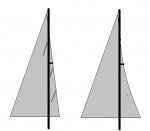
jibs.jpg

From the Elvstrom website again, good photo of a battened jib:

FurlingHeadSail_Faurby363.jpg
 
Last edited:
We have vertical battens on a circa 106% tall narrow furling jib.
The sail does set very well, and give a bit more sail area. As others have said, they are a major hassle when fitting or removing the sail - albeit generally only done twice a year.
But other factors to be aware,
- they can prevent fitting of things like radar scanners or reflectirs on the front of the mast. our radar is on the side of the mast.
- the batten pockets can be tne subject of more wear and tear than the rest of the sails. We are having repairs to stitching for second time in 5 years (unlike mainsail batten pockets all pristine in same period)

Worth considering for a performance cruiser - but only if on a quality laminate sail and matched to a fully battened (not furler) mainsail
 
I have 3 vertical battens on my 106% jib, they are a meter or so long so I haven't managed to work out a way of fitting it in the 'sausage' bag without taking them out.
With vertical battens I understand what you mean. I can see that would be difficult to find a way to fold or roll without taking them out.
 
If you look at this photo you'll see that the upper, full length batten on the jib has flipped over and is hanging out in front of the forestay. This was a constant problem when I was raising my chute. And once sailing downwind, there was no way I could correct it. It happened often so eventually I removed the batten all together. A real pain in the butt.

56 too much wind (479x640).jpg
 
If you look at this photo you'll see that the upper, full length batten on the jib has flipped over and is hanging out in front of the forestay. This was a constant problem when I was raising my chute. And once sailing downwind, there was no way I could correct it. It happened often so eventually I removed the batten all together. A real pain in the butt.

View attachment 66461

Too much sheet ease without moving the car forward. Pretty common issue and you soon get used to how much you can ease the jib before you risk this.
 
A previous boat had two fully battened jibs (no. 1 and no.2). Marvellous thinks, easy to set, lasted well and assuming you aren’t using roller furling, I’d happily recommend them.

Changing them at sea was no problem: just keep the battens pointing in roughly the same direction and stuff them down the he hatch.
 
If you are saying that the sail on the right, below, would be a better sail than the one on the left then I do not agree with you.

Fair enough but the leech should not flutter & the assertion that battens on the first picture are giving more sail area can be proven wrong. The amount of hollow does not have to be as large as shown but it demonstrates that battens are not needed to get the sail area & overlap.

Incidentally my old Hood jib was deliberately made with a "question mark" in the leech claiming that it gave a better release off the edge.
Does anyone still know if they do that anymore
 
Too much sheet ease without moving the car forward. Pretty common issue and you soon get used to how much you can ease the jib before you risk this.

This is correct, but you have to remember that I had eased the jib sheet because I was sailing at a broad reach in high winds (you can see that I have 2 reefs in the main and my storm jib is lashed to the port rail just in case I needed it later) and I wanted the maximum speed as I crossed the starting line of the race. (This was a pursuit race with each boat starting individually based on its handicap rating) Having the sheet trimmed tighter would not have given me max speed. It was just as I crossed the line that I raised the spinnaker. I love this photo because it shows how busy things can get when singlehanding. When you are singlehanding you give up a lot of second to second controls (like adjusting the cars) just to keep sailing at max speed.

The spinnaker originally went up in an hour glass and I had to drop the halyard by 3' to straighten it out. Here is another photo from 5 seconds earlier. You can see that the batten has not popped around yet.
54 Hour Glass (479x640).jpg
 
Last edited:
This is correct, but you have to remember that I had eased the jib sheet because I was sailing at a broad reach in high winds (you can see that I have 2 reefs in the main and my storm jib is lashed to the port rail just in case I needed it later) and I wanted the maximum speed as I crossed the starting line of the race. (This was a pursuit race with each boat starting individually based on its handicap rating) Having the sheet trimmed tighter would not have given me max speed. It was just as I crossed the line that I raised the spinnaker. I love this photo because it shows how busy things can get when singlehanding. When you are singlehanding you give up a lot of second to second controls (like adjusting the cars) just to keep sailing at max speed.

The spinnaker originally went up in an hour glass and I had to drop the halyard by 3' to straighten it out. Here is another photo from 5 seconds earlier. You can see that the batten has not popped around yet.
View attachment 66462

Sometimes hour glasses are the result of the jib being eased too much, and disturbed air coming off the leach and twisting the head of the sail as it is raised. It is generally advisable to keep the Jib sheeted harder than you would normally for the angle, as this makes a more efficient wind block to hoist the kite in.

Compromise between fastest sailing and best hoist. I'd take best hoist...
Getting the kite up clean 1 st time is always going to be faster overall.
 
Sometimes hour glasses are the result of the jib being eased too much, and disturbed air coming off the leach and twisting the head of the sail as it is raised. It is generally advisable to keep the Jib sheeted harder than you would normally for the angle, as this makes a more efficient wind block to hoist the kite in.

Correct. Remember that the photo was taken 12 years ago. Long before I learned how to properly raise a spinnaker singlehanded. Another problem with that raise was the spinnaker sheet being way too tight. So once the hourglass was eliminated then the boat started to round up and I had to ease the sheet a long way to regain control. Here is the complete set of 4 photos of the adventure. Lots of fun. (And make special note of the tiller under my knee)
The hour glass
54 Hour Glass (479x640).jpg
Ease the halyard.
55 sheet too tight (479x640).jpg
Sheet too tight.
56 too much wind (479x640).jpg
Too much wind
57 release the sheet (479x640).jpg
Ease the sheet
 
Last edited:
Top