Basic Charging Circuit with 1-2-All Switch (with diagram)

A penny has dropped overnight. I believe you are making a wrong assumption that I missed and that is colouring everything. Can we check through this please, make sure I have understood what you are doing?

1 The alternator is totally standard with its internal regulator.
2 The output goes to a diode splitter and thence to one or two battery banks.
3 You are measuring "output" voltage somewhere between the alternator and the diode splitter. Engine off this should be 0.
4 When you energise the engine circuits the warning light lights up.
5 You start the engine somehow (and it still bugs me that the two problems may be linked by funny wiring).
6 You now measure about 10V output.
7 You connect a wire from somewhere live in the engine circuits, maybe the solenoid terminal, to B+. Your measured output now goes to about 13V.
8 You assume the alternator is now operating and giving 13V because you have given it more excitation.

That's where it goes wrong. Your assumption is invalid.
All you are now measuring is the voltage of the engine battery. (You said yourself that this connection bypasses the diodes; I missed the significance because I have no experience of using a splitter.) You have not affected the alternator at all. If you put an ammeter between the alternator and the splitter I wager you will see no current. It is still not charging.

Further questions:
9 Is the alternator turning fast enough? How did you select the drive pulley? Have you tried speeding up the engine or only run it at idle?
10 When you start the engine does the WL go out (or at least go very dim)?
11 Is the WL connected directly to the alternator terminal?
12 Is anything else attached to the alternator terminal or to the alternator side of the WL?
13 Can you measure the voltage at the WL terminal on the alternator? Engine off but circuits energised it should be small, maybe around 1-2V. Engine running with 10V alternator output, it should be probably 9-10V. If you speed the engine up it should rise to around 12V.

Your alt is clearly starting to work, proving the start up excitation via the WL is sufficient. Once it has started, external excitation plays no part. You could disconnect the WL and it would make no difference.

The problem now in my view must be either the alt is not producing enough excitation voltage internally - low speed, faulty regulator, faulty diodes, faulty field coil - or something external is bleeding the excitation off and dragging the voltage down, hence my question is anything else attached to WL?

Edit - another post on the forum has just pointed someone to this website that you may find helpful
http://www.tb-training.co.uk/MarineE08.html#CHARGING SYSTEM – ALTERNATOR
and this too http://www.tb-training.co.uk/MarineE09.html about split charging. They are very good.
 
Last edited:
Sorry, Troubadour, we are so busy with preparations I've only just read this.

The alternator is reading 13.8v. That can't be the engine battery because it has just started the engine and went down to 12.5v.

What I am not understanding is this:

After starting the alternator reads 13.8
House batteries read 13.5 or 13.6, thereabouts
At the diode for the engine battery it reads 13.8 at one end and 13.4 at the other, as expected
However at the other end of the same cable, the one that goes to COM and eventually to starter battery, it is only reading the same voltage as the starter battery. As the engine runs this slowly creeps up from 12.5 to 12.6.

It appears as if my house batteries are getting the charge they are expecting off the alternator, and the alternator wants to put out the same to the engine battery, but somewhere there is resistance. I have even doubled up the offending cable to ensure there is no resistance in it, but I am still only reading 12.something and the engine battery does not appear to be getting any kind of boost. I am unsure if what I am reading is a very slow charge coming from the alternator, or just the engine battery resuming normal voltage having started the engine.
 
. . . . . What I am not understanding is this:

After starting the alternator reads 13.8
House batteries read 13.5 or 13.6, thereabouts
At the diode for the engine battery it reads 13.8 at one end and 13.4 at the other, as expected
However at the other end of the same cable, the one that goes to COM and eventually to starter battery, it is only reading the same voltage as the starter battery. As the engine runs this slowly creeps up from 12.5 to 12.6. . . . . . .

You have an HR junction on that cable and once the engine is running this junction gets warm and possibly changes state slightly creating less resistance.

Disconnect this cable at both ends, clean thoroughly with wire wool, wet & dry, Vaseline copiously and replace. Do this for the other end and re-check voltages. ;)


.
 
What lenseman is saying is that you've got a high resistance at a joint somewhere ( a bad connection in layman terms), but this may be due to a faulty blocking diode also.
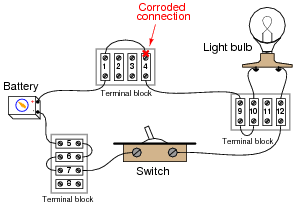
I don't think the block diode is the problem as there is only ½ volt drop across it according to Jamie and unless it is a Schottky diode, I would expect 0.7 volt drop so his readings are OK?

03303x01.png


In the above diagram assuming the battery (left) is 12 volts and the bulb glows or does not light when the switch is closed, then a test with a multimeter around the circuit as Jamie did will show where there is a sudden change in expected readings.

If you were to use the multimeter in its voltage mode (15volts FSD) and you placed one probe on terminal block 4 and the other meter probe on terminal block 1, if the circuit was good then there should be no reading on the meter. It might flicker between 0.001 and 0.00 volts but clearly, as the diagram shows a corroded terminal, then I would expect to see anything between 0.10 volts and 12.00 volts on the voltmeter depending on the severity of the corrosion.

To narrow the problem down even further, you place one probe on the top of the terminal marked as 4 and the other probe on the very wire end that is connected to this number 4 terminal, about an eighth of an inch away and this should prove which part of the wiring is HR. ;)

I hope this helps. Call me on Skype Jamie if you are really stuck? ;)


.
 
Is this still your wiring? https://dl.dropbox.com/u/25233603/ybw/ESPER-STARTER-CHARGING-SCHEMATIC-MAR-2013.jpg

While you are running with the Lucas alternator with the internal single voltage regulator you don't need that diode in, you only need it for the Balmar or Sterling smart regulators, the Lucas is never going to give more than about 14V anyway and in fact it's probably set at the 13.8V you're seeing now. Most of them used to be although new ones now tend to be 14-14.2V or even 14.4V. Your starter battery will be happy at 13.8-14V.

It does sound as though you have a complete discontinuity never mind HR - but you say you've doubled the wire with no difference. Very hard to understand. You can only measure at every point possible to find where the volts disappear, depending what's accessible - the terminal on the diode, then the lug on the cable, then the cable itself where it goes into the lug, etc.
You could take the cable from the diode straight to the engine battery isolator couldn't you? Indeed until you have your smart reg back on you could go straight from the alt to the isolator.

You say the alt is giving 13.8V now - is that with your "funny" connection? Is it still 10V without that? Something still doesn't make sense. B+ connections do not affect the excitation, and your house battery is already solidly connected to B+ anyway.

When you have time, do read the last two links I gave you they are very good and should make things clearer.

Anyway bon voyage and hope it all works however you solve it!
 
Hi all, thanks for the responses. It's late here so tomorrow morning (when you're all safely tucked up in bed) I shall test and clean each connection. Since your post, Troubadour, and this reply, I have been out (last supper) so I've not run the check without the excitation. I did run some jump cables from the diode terminal to the terminal at the other end, so not only did I double the cable but had extra cable too, but still low voltage. Logic would suggest that it has something to do with the point at which I am putting the voltmeter. Next test will be to run the same cable from the diode straight to the battery itself, and then all the terminals in between.

Just to confuse things, because I'm making do with the cables already installed, the point at which I am testing the voltage happens to be a fuse terminal, but I don't see that this should make any difference. I'm pretty sure the fuse has not blown (there's continuity between the terminals on the fuse) and even if it had, that still doesn't explain a voltage drop/resistance before it goes through the fuse.

I'll sleep on it, get up early and run the tests you suggest. We depart at 3pm local time and then I'll have three days for a shake down and further checks. Weather here is fair with little wind so it'll give me the opportunity to look into this further. Let's hope the engine battery is charged enough to drop and weigh anchor ;)
 
If you're using the engine battery for the windlass - I thought it was for engine starting only - I would take the diode out of circuit while you're using the Lucas regulator as you'll be discharging it a bit more.
You've enough on your plate at the moment without doing lots of tests. Why not just do what's easiest - can you move the cable from the input to the diode onto one side of the isolator switch perhaps? I don't know your layout except that the engine battery is a bit away.
 
Is this still your wiring? https://dl.dropbox.com/u/25233603/ybw/ESPER-STARTER-CHARGING-SCHEMATIC-MAR-2013.jpg

While you are running with the Lucas alternator with the internal single voltage regulator you don't need that diode in, you only need it for the Balmar or Sterling smart regulators, the Lucas is never going to give more than about 14V anyway and in fact it's probably set at the 13.8V you're seeing now. Most of them used to be although new ones now tend to be 14-14.2V or even 14.4V. Your starter battery will be happy at 13.8-14V.

I think you'll find most of these regulators are set at 14.4v or 14.8v. The voltage will only increase to it's set point as the batteries become charged, while it's pumping amperage the voltage set point won't be reached. The most important is the differential between the voltages and at 13.8 we can all assume the alternator is charging. To start with I would use a common negative, (even if you have to extend the test lead cable neg-) for the volt meter and start your positve readings from this point ( extend this also if need be), and we'll cross bridges as we hear your latest findings.
I know I'm late picking this post up and I apologise if this has been covered in any earlier posts but there are so many I just can't be arsed ploughing through them all.
 
Is this still your wiring? https://dl.dropbox.com/u/25233603/ybw/ESPER-STARTER-CHARGING-SCHEMATIC-MAR-2013.jpg

While you are running with the Lucas alternator with the internal single voltage regulator you don't need that diode in, you only need it for the Balmar or Sterling smart regulators, the Lucas is never going to give more than about 14V anyway and in fact it's probably set at the 13.8V you're seeing now. Most of them used to be although new ones now tend to be 14-14.2V or even 14.4V. Your starter battery will be happy at 13.8-14V.

I think you'll find most of these regulators are set at 14.4v or 14.8v. The voltage will only increase to it's set point as the batteries become charged, while it's pumping amperage the voltage set point won't be reached. The most important is the differential between the voltages and at 13.8 we can all assume the alternator is charging. To start with I would use a common negative, (even if you have to extend the test lead cable neg-) for the volt meter and start your positve readings from this point ( extend this also if need be), and we'll cross bridges as we hear your latest findings.
I know I'm late picking this post up and I apologise if this has been covered in any earlier posts but there are so many I just can't be arsed ploughing through them all.

I would agree with you now but this is an old Lucas design manufactured under license by Lucas-TVS in India. I visited them on business many years ago....
I haven't personally encountered any single rate alternators set at more than 14.4V, I believe a few cars have 2 rate internal regulators but i haven't handled one.
The number of posts might suggest to you that this isn't just a simple case of a bad joint.
 
Last edited:
I would agree with you now but this is an old Lucas design manufactured under license by Lucas-TVS in India. I visited them on business many years ago....
I haven't personally encountered any single rate alternators set at more than 14.4V, I believe a few cars have 2 rate internal regulators but i haven't handled one.
The number of posts might suggest to you that this isn't just a simple case of a bad joint.

India in my experience are one of the best producers of spurious units/components to the EU and for me up to retirement 4/5 years ago they were well ahead of the Chinese in product and quality control. Lucas had a factory in India so I would think the technoligy just carried on.
I am not suggesting it's just a simple case of a bad joint, Demonboy asked what lenseman meant by HR. I presumed he meant high resistance, even though it's not an Americanism that I would ever use. This is why we'll look at his next readings, he could have a problem on the neg side some where as well as a pos fault, if a job is a basket case as it seems to be it usually means there's more than one fault . . . . .I know it's all very difficult without a crysal ball but as I said we can cross that bridge with more up to date info.
 
Anyone up?

This problem just gets weirder. I have now connected the alternator directly to the starter battery, disconnected the house, isolated everything else (except the common negative), the alternator is putting out over 13v and STILL the starter battery appears to not be accepting a charge. When I connect the Mastervolt and charge via the mains, it is fine and shows over 14v across the terminals. I even isolated the starter circuit just in case there was a short or drain there, but no change. Even if it was floating or trickling, which it can't because the only regulator in action is the one inside the alternator, I would expect it to hit 13v, wouldn't it? Is it reasonable to expect the alternator to show 13v and the same on the starter, or would I expect the starter to show low voltage even whilst receiving a charge simply because it has just cranked the engine and dropped to 12.5? Either way, at least this rules out a dodgy diode or dodgy cables, which is some blessing.

One possible answer is that the starter circuit does not have a complete negative, but there is a direct negative coming from the starter negative.

The other consideration is that the official circuit diagram for the starter circuit shows a direct feed from B+ to the starter +ve, but if I do that I end up paralleling my starter and house since both will be connected to B+.

[edit] Sorry, I didn't read the last few posts. What I haven't done is disconnect the common negatives, so perhaps I'll take one of those out of the equation. However, that wouldn't explain why the house batteries are accepting the charge and the starter isn't.
 
Last edited:
With your test of the alternator connected direct to the starter circuit. Is your charge warning light in circuit with your starter battery? Is the voltage at the alternator the same as what's at the starter battery? When you measure the voltage at the alternator use the alternator casing as your test lead negative, I'm assuming it's not an insulated return alternator. The voltage I would expect after start up would be, lets say up to 13.5v and build to regulator set point of 14v plus after a running at fast idle for 5-10 mins. As a quick test, remove the alternator B+ and attach your Mastervolt to the B+ cable and see what voltage you have at your starter battery. If your getting 14v at the starter battery you can assume the wiring is good. As mentioned, it's not what the voltage is especially but the differential between test points. Hope this helps and good luck.
 
Between exactly which 2 points are you measuring when you say "the alternator is putting out over 13V"? The actual figure would be useful too.
What do you mean when you say "the battery appears not to be accepting a charge"? That's not clear. Are you saying "If I measure from battery -ve post to battery +ve post I only have 12.xV?" or what? Do you have the facility to measure current (my impression is not)?

I would suggest the following procedure (similar to what grumpygit suggests, just laying it out step by step as it has all got so confused.)

1 You have a direct connection from B+ to battery +ve terminal?
2 You have a direct connection from battery _ve terminal to alternator -ve? This may be a terminal post on the alternator or just the frame of it as discussed before.
3 Where are you connecting your meter -ve probe? Suggest use the alternator -ve terminal.
4 Work your way round systematically with the meter +ve probe. make no assumptions. Put the history out of your mind. Check at as many points as you can, so
alt +ve post
cable lug
wire where it goes into cable lug
other end of wire
cable lug
(the same for any intermediate connection points)
+ve battery post
-ve battery post
cable lug
wire
other end of wire
cable lug
(the same for any intermediate connection points)
and you're back to the terminal post your -ve probe is on

EDIT - write down all the measurements in sequence and it should be clear where voltage is being lost. Publish the figures here.

and humour me, measure from -ve to terminal WL please, and check if anything else as well as the light is connected to this terminal or to any point between it and the light.
 
Last edited:
Between exactly which 2 points are you measuring when you say "the alternator is putting out over 13V"? The actual figure would be useful too.
What do you mean when you say "the battery appears not to be accepting a charge"? That's not clear. Are you saying "If I measure from battery -ve post to battery +ve post I only have 12.xV?" or what? Do you have the facility to measure current (my impression is not)?.

Have we not had this problem the other month ?

One simple test I have not seen, what is the voltage between alternator positive output terminal ( battery connected and engine running ) and alternator case, just in case the output is only 13 volt.

Brian
 
SUCCESS!

Having made the crossing from Cochin to Uligamu (Maldives, 270nm, all motor sailing, not without its dramas) we dropped anchor, knackered. Had one of the best night's sleep in weeks so today started from scratch. I wanted to begin with just a simple engine battery circuit so I isolated everything. Dismantled the lot. Took the circuit diagram in one hand, starter motor in the other... lo and behold my alternator 'expert' from India had disconnected the alternator negative to starter negative. I think he may have done this because the original cable had a fast-fuse between the two which had blown, so thinking the alternator case was enough he took this out of the circuit. Putting it back in has solved the problem. It may sound obvious to you but remember I was getting positive readings from B+ and the alternator casing so it was never immediately obvious, at least to a non-expert like me. Perhaps someone could explain WHY this has solved the problem. Also, is the fuse to protect the alternator from spikes and how important is it to replace it? If it's blown once already...

Funnily enough I was reading through Payne's Marine Electrical Bible on the crossing and he suggests that the casing itself is not always adequate and so recommends a direct connection too. Now I can wire up either the engine battery, the domestic battery, or both, and they both receive a healthy charge (13.4v), which will at least keep us going until Male when I can sort out a proper charging system. If any one has any suggestions I'm open to them as we pay no import duty for a yacht in transit. Since I have the Balmar ARS-5 I'm thinking of keeping it simple and buying a Balmar 100amp alternator.

Thank you to everyone who perservered with this problem, in particular Troubadour of late who provided some great links. Not everything is solved but this is a positive step in the right direction.

For those who are interested I knocked up a quick blog post on our departure and crossing, which included an incident with the engine blower, plus a few pics including our current anchorage. http://www.followtheboat.com/2013/03/05/from-india-to-the-maldives/
 
Well done on getting a working system! It was really necessary to go through it calmly, I think you were getting a bit stressed! Understandably.
I'm not quite sure of the details from your account, unless you mean that the alternator (or the starter) did turn out to have an isolated negative terminal after all rather than using its frame.

Now a couple of cautions.
No a fuse will not "protect the alternator from spikes". Semiconductor components e.g. diodes blow much quicker than fuses. Fuses are to protect wiring from short circuits that could melt it or even start a fire. Pretty important! You certainly need some fuses (or cct breakers) but I'm not sure how common it is to have the -ve fused. I'm sure mine isn't. Others may have more to say on that.
Alternators are pretty robust - but don't like being disconnected under load.
13.4V is not a healthy charge. It's enough to maintain a charged battery, but to charge one you need at least 13.8V for a slow charge (24hrs or so). Have you only got 13.4V because of loss in the wiring? What do you get between B+ and - at the alternator?

You're building up a good collection of alternators - 3 so far isn't it? I'm not sure why you want another. There is no reason why you shouldn't adapt your Lucas (90 amps isn't it?) to work with a smart regulator. Just think carefully and read up on how you do it, bearing in mind that the internal Lucas reg is negative regulation and the Balmar reg is positive regulation, so you can't just use the same connections. The -ve end of the field coil will need to go to -ve instead of to the Lucas regulator output, and the +ve to the Balmar regulator output instead of to +ve. I don't know how the Sterling connects should you choose to use that one. Anyway we covered this before.

It must have been a wrench leaving but the next stage looks great!
 
Top
