Plevier
Well-Known Member
.
Last edited:



. . . . . What I am not understanding is this:
After starting the alternator reads 13.8
House batteries read 13.5 or 13.6, thereabouts
At the diode for the engine battery it reads 13.8 at one end and 13.4 at the other, as expected
However at the other end of the same cable, the one that goes to COM and eventually to starter battery, it is only reading the same voltage as the starter battery. As the engine runs this slowly creeps up from 12.5 to 12.6. . . . . . .

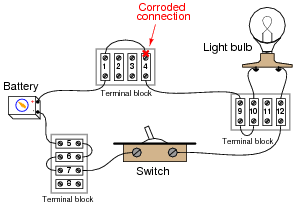
What lenseman is saying is that you've got a high resistance at a joint somewhere ( a bad connection in layman terms), but this may be due to a faulty blocking diode also.
Is this still your wiring? https://dl.dropbox.com/u/25233603/ybw/ESPER-STARTER-CHARGING-SCHEMATIC-MAR-2013.jpg
While you are running with the Lucas alternator with the internal single voltage regulator you don't need that diode in, you only need it for the Balmar or Sterling smart regulators, the Lucas is never going to give more than about 14V anyway and in fact it's probably set at the 13.8V you're seeing now. Most of them used to be although new ones now tend to be 14-14.2V or even 14.4V. Your starter battery will be happy at 13.8-14V.
I think you'll find most of these regulators are set at 14.4v or 14.8v. The voltage will only increase to it's set point as the batteries become charged, while it's pumping amperage the voltage set point won't be reached. The most important is the differential between the voltages and at 13.8 we can all assume the alternator is charging. To start with I would use a common negative, (even if you have to extend the test lead cable neg-) for the volt meter and start your positve readings from this point ( extend this also if need be), and we'll cross bridges as we hear your latest findings.
I know I'm late picking this post up and I apologise if this has been covered in any earlier posts but there are so many I just can't be arsed ploughing through them all.
Is this still your wiring? https://dl.dropbox.com/u/25233603/ybw/ESPER-STARTER-CHARGING-SCHEMATIC-MAR-2013.jpg
While you are running with the Lucas alternator with the internal single voltage regulator you don't need that diode in, you only need it for the Balmar or Sterling smart regulators, the Lucas is never going to give more than about 14V anyway and in fact it's probably set at the 13.8V you're seeing now. Most of them used to be although new ones now tend to be 14-14.2V or even 14.4V. Your starter battery will be happy at 13.8-14V.
I think you'll find most of these regulators are set at 14.4v or 14.8v. The voltage will only increase to it's set point as the batteries become charged, while it's pumping amperage the voltage set point won't be reached. The most important is the differential between the voltages and at 13.8 we can all assume the alternator is charging. To start with I would use a common negative, (even if you have to extend the test lead cable neg-) for the volt meter and start your positve readings from this point ( extend this also if need be), and we'll cross bridges as we hear your latest findings.
I know I'm late picking this post up and I apologise if this has been covered in any earlier posts but there are so many I just can't be arsed ploughing through them all.
I would agree with you now but this is an old Lucas design manufactured under license by Lucas-TVS in India. I visited them on business many years ago....
I haven't personally encountered any single rate alternators set at more than 14.4V, I believe a few cars have 2 rate internal regulators but i haven't handled one.
The number of posts might suggest to you that this isn't just a simple case of a bad joint.
I would agree with you now but this is an old Lucas design manufactured under license by Lucas-TVS in India. I visited them on business many years ago....
I haven't personally encountered any single rate alternators set at more than 14.4V, I believe a few cars have 2 rate internal regulators but i haven't handled one.
The number of posts might suggest to you that this isn't just a simple case of a bad joint.
India in my experience are one of the best producers of spurious units/components to the EU and for me up to retirement 4/5 years ago they were well ahead of the Chinese in product and quality control. Lucas had a factory in India so I would think the technoligy just carried on.
I am not suggesting it's just a simple case of a bad joint, Demonboy asked what lenseman meant by HR. I presumed he meant high resistance, even though it's not an Americanism that I would ever use. This is why we'll look at his next readings, he could have a problem on the neg side some where as well as a pos fault, if a job is a basket case as it seems to be it usually means there's more than one fault . . . . .I know it's all very difficult without a crysal ball but as I said we can cross that bridge with more up to date info.

Between exactly which 2 points are you measuring when you say "the alternator is putting out over 13V"? The actual figure would be useful too.
What do you mean when you say "the battery appears not to be accepting a charge"? That's not clear. Are you saying "If I measure from battery -ve post to battery +ve post I only have 12.xV?" or what? Do you have the facility to measure current (my impression is not)?.