Ballpark cost of professionally applied Coppercoat?

As you're talking about me Ill reply to you, I go get it and my maths are correct but if you're someone that likes to copper coat his boat then good for you, but financially it makes no sense. And BTW if you you think that people on this forum believe that you use 20 quid of juice a year then I think you're deluded or just being silly.
I have a lightweight high performance trimaran with an outboard auxiliary, its used only for going into and out of marinas, we sail everywhere else, so £20 is entirely realistic. Cost wise, everyone but you thinks it’s cheaper. Several have provided the evidence. For us, we’d use about £300 of antifoul every year. Then there’s the cost of having it done, if it’s not your thing. But even DIY, over the 10 year life of coppercoat, it adds up. You seem to have forgotten it’s once every 10 years minimum, it can last longer. Our copper coat materials would be about £1000. That is 1/3 the cost of 10 years of conventional. So forget the fuel saving.
 
30 litres an hour 😳

This is a Mobo q. My old lady uses about 200 / hour at planing cruising speed. Less at tickover obviously.

Also I disagree with your 20% figure, but that’s not the point. It’s not really where the savings are. They lie in elimination of annual antifoul and lift costs. In my own case I reckon the break even is less than 4 years.

The Coppercoat can be de-slimed by a diver for a few hundred quid. A lift for me is £1200. Antifoul (professional application not DIY) is at least another £1500.
200 litres per hour??? Volvo Pentas own figures say that a D13 900 horse power engine only needs 162 litres per hour, and this discussion is for a 10 meter boat requiring about 300 hp which is rated at 54.7 litres per hour. No need for us to argue, but, I'm right.
 
We’re discussing copper coat. The type of boat is irrelevant really. But the photo is my avatar, I’m not exactly hiding it🤣
It makes all the difference. We are discussing a 10 meter motorboat are we not? That is what ss2016 started this thread talking about, it pays to pay attention to the matter in hand.
 
It makes all the difference. We are discussing a 10 meter motorboat are we not? That is what ss2016 started this thread talking about, it pays to pay attention to the matter in hand.
It makes even more sense on a motorboat, yes. As you say, you save money on fuel as well as on the costs over 10 years. Not often you can say win win these days, with a week today looming in all our minds.
 
200 litres per hour??? Volvo Pentas own figures say that a D13 900 horse power engine only needs 162 litres per hour, and this discussion is for a 10 meter boat requiring about 300 hp which is rated at 54.7 litres per hour. No need for us to argue, but, I'm right.
I’m out. Argue yourself into any corner you prefer.
 
To answer my own question I accepted the quote of just less than £5K inc VAT today for 10m Sargo. The boat is ashore already but all the other costs are in there.
All the best with it. A boat like that, you can probably do quite a lot of what we do. A gently shelving beach, tin of beer, and a brush. Anchor in a metre of water.
 
It makes all the difference. We are discussing a 10 meter motorboat are we not? That is what ss2016 started this thread talking about, it pays to pay attention to the matter in hand.
As I said earlier your "calculations" are nonsense. you are assuming no antifouling and a fouled bottom whereas the comparison is between different types of antifouling which are broadly equal in preventing fouling. The purpose of antifouling is to keep the bottom clean and is the same whatever the boat. If you don't keep your MOBO hull clean you will burn extra fuel. Coppercoat does not necessarily keep it any cleaner than other treatments so the "cost" of a dirty bottom is the same.

The saving is as I and everybody else says in not having to replace the coating annually for typically 10 years. The larger the boat the shorter the return on the investment as the annual labour cost for recoating conventional antifouling is size related. On my 10m sailing boat it was 6 years. Stickyfingers 14mMOBO is shorter even though the original application of Coppercoat cost more.
 
To answer my own question I accepted the quote of just less than £5K inc VAT today for 10m Sargo. The boat is ashore already but all the other costs are in there.
I could get mine transported down south and back and I reckon it would still be just cheaper than getting it done here!
 
As you're talking about me Ill reply to you, I go get it and my maths are correct but if you're someone that likes to copper coat his boat then good for you, but financially it makes no sense. And BTW if you you think that people on this forum believe that you use 20 quid of juice a year then I think you're deluded or just being silly.
I don't think he is deluded or silly. I used 1/2 of a ten gallon tank of diesel in my old mgc27 last year despite sailing here every weekend.

I have the same experience as chiara, coppercoat gives you a perfect smooth surface for racing with just a lift and jetwash.
MIne cost about 1k in labour to do in summer and about 1k in materials.
 
I don't think he is deluded or silly. I used 1/2 of a ten gallon tank of diesel in my old mgc27 last year despite sailing here every weekend.

I have the same experience as chiara, coppercoat gives you a perfect smooth surface for racing with just a lift and jetwash.
MIne cost about 1k in labour to do in summer and about 1k in materials.
Mine was £2.7k total. But I have those stabilisers to paint as well, so really a very similar cost for size. Similar bottom area but more fiddly. Fuel wise, if you have a boat that can actually sail, then you don’t use much fuel. MGs certainly fit that description. We can delude ourselves we are saving money, but we simply spend it on sails instead🤣
 
OK so practical brain, click on. A 10 meter boat will lose say no more than 20% fuel efficiency when it's hull has a coral reef growing on it. So at say 30 litres per hour cruising speed that is 6 litres per hour wasted, or about 8 quid an hour, the average boater does 50 hours a year thats £400 per year wasted...at most, does that warrant 7 grands worth of copper coat, AND you will still have to pay for a lift out once a year to "hose off" the hull. Not for me, the maths doesn't add up.
put the cost of doing the antifoul route year in / year out and if you are going to do it yourself think of the time and cost each year then we come to the task of the prep / removal of the old antifoul if this is required in a 10 years and then painting it on vs copper coat - requires a rub down once in a while with a scouring pad - no brainer for me but everyone has their own set of circumstances
 
put the cost of doing the antifoul route year in / year out and if you are going to do it yourself think of the time and cost each year then we come to the task of the prep / removal of the old antifoul if this is required in a 10 years and then painting it on vs copper coat - requires a rub down once in a while with a scouring pad - no brainer for me but everyone has their own set of circumstances
I think that I didn’t coppercoat any of my boats because I wasn’t expecting to keep any of them long enough to put me ahead on the original application cost.

Of course, I could have factored in the possibility that someone might pay more for a coppercoated boat, but I was still learning manmaths back then. :)
 
You have to be a bit dedicated to the concept of Coppercoat to use it over a period. I know a few people who have gone back to conventional antifoul after a few years of Coppercoat. Personally, I like the protection that it gives the hull but Coppercoat isn't a "silver bullet" - you still have to work at it. As @jon and michie says, you really need to "reactivate it every year by rubbing it down so it isn't completely maintenance free.

Our Coppercoat was originally applied in 2012 after soda blasting (I don't like sand blasting - too aggressive).
I topped it up again with a full covering of 2 more coats in 2019.
And this year, we "patched up" (mainly the water line) which I hope will last another few years.

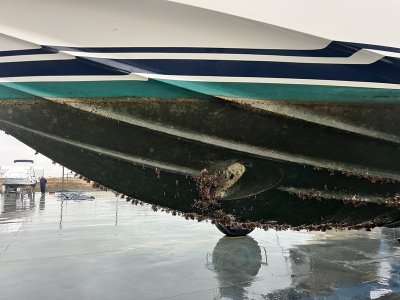
This photo was taken just after the lift this year
IMG_1136.resized.JPG

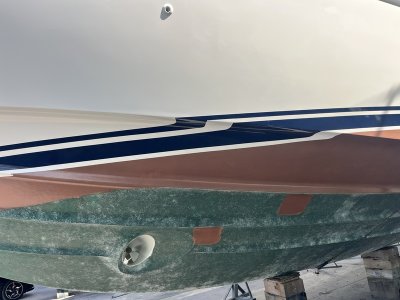
And this photo was taken just before relaunch
IMG_2966.resized.JPG

Note that I now paint the thruster tunnels and thruster props with Trilux (or equivalent) - we think that the white colour works better that other colours.

So, to recap, JW has been Coppercoated for 13 years and in that time, we have carefully maintained the Coppercoat.
As to the costs - a 20m boat is a struggle to paint on your own so there would have been professional costs involved with conventional antifoul.
But, all considered, Coppercoat has been a significant saving over those 13 years - with a few more years to go yet.
 
Last edited:
When I antifouled my last boat - I had to factor in hotel costs (at first before she was more secured on blocks before staying onboard gingerly) weather conditions and timing with work.
Then the lovely task of laying on your back sometimes in puddles to get the job done x2 as I always applied 2 coats.
Factor in the cost of the antifoul paint, consumables, time, Hotel costs if needed x a 10yr period it wont be far off the cost of Coppercoat getting done its just the initial outlay that I think puts people off
 
Top