balast ratio....

Not reading what's above, but "ballast ratio" is often confused or used in advertising. Taken aside of boat configuration it has no meaning. 55% ratio boat capsized in 8B (one victim) and been on Colin Archer type rescue ship (THE most unturnable) - it has 0% ballast. None. :p

For me high ballast ratio is indication of lightly constructed boat with no provision (in 'designed displacement') for stores and such. Simply a boat must have some weight to carry sail - stability is weight times RL - so lightly made boats nead more ballast. Light racer would be 40-50%, for cruiser of classic shape 20-30 is quite a lot.

Interesting thing - 'yacht producers' often say what ballast ratio or weight is, but to get stability characteristics from them requires legal investigation sometimes. In good auld times it was duty of a skipper to know them... www.maib.gov.uk/cms_resources/Ocean Madam.pdf
 
Last edited:
Thanks people.
So, if the boat balast is above 45% then this allows you options with the sail plan. What difference then is the keel on a boat that has 'good balast'?

For example,given a boat with something like 45% balast of its overall weight would a fin keel perform better or a twin bilge keel?

You are perhaps mixing things up here. Just trying to define performance is a problem. Keel shape and type has an impact on performance almost irrespective of ballast ratio.

All you can really say is that for boats of similar design a higher ballast ratio can give greater sail carrying ability. However boats of different designs with lower ballast ratio can perform better in terms of speed and passage times. An HR 412 with a ratio of 36 against an old style 42 with a ratio of 44 would be a good example. No prizes for guessing which is the better performing boat. Some might prefer the old to the new though.
 
Anyway.... ballast ratio is only one measure... you need to look at a suite of measures to get anything even approaching useful... and even then practical evidence can defy logic...

You might have a car that does 200 miles per gallon, but until you know whether it has headlights, does more than 10mph and more than 2" ground clearance, it would be pretty daft to describe it as the perfect commute vehicle...
 
been on original Colin Archer rescue ship (THE most unturnable) - it has 0% ballast. None. :p

If you are referring to Collin Archer RS 1, your memory is wrong..
This boat had a 5.5 ton external iron ballast keel + 4.5 internal ballast
Displacement 30 ton

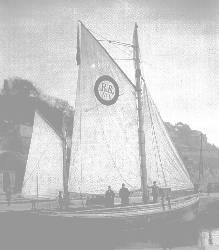
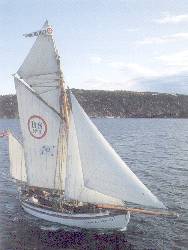
240px-RS_1_Colin_Archer.jpg

RS!b.jpg

By the way - she is painted white now

RS!a.jpg
 
Best safety ratio is number of accidents on a given boat type divided by the amount that type of boat is used, expressed as a percentage.

Ballast ratio depends on the intended use of the boat, it's size etc. An old clipper probably carried little if any ballast when loaded and she would sail the seven seas. A 22 footer with 50% ballast ratio would be a less popular choice for a world girdler.
 
If you are referring to Collin Archer RS 1
No, have seen a few Redningsskoite :) but know closer only this one - she is modified, must say. https://fbcdn-sphotos-e-a.akamaihd.net/hphotos-ak-prn1/560329_329395470449060_1678207494_n.jpg
Strictly speaking she is not Colin Archer per se - only same type but constructed by Hjalmar Johansson, on order for Polish rescue service (PRO).
After being converted to yacht she made extensive voyages, from Spitzbergen to Antarctic, Horn included, a very safe, seaworthy boat not having ballast ;)
 
Last edited:
No, have seen a few Redningsskoite :) but know closer only this one - she is modified, must say. https://fbcdn-sphotos-e-a.akamaihd.net/hphotos-ak-prn1/560329_329395470449060_1678207494_n.jpg
Strictly speaking she is not Colin Archer per se - only same type but constructed by Hjalmar Johansson, on order for Polish rescue service (PRO).
After being converted to yacht she made extensive voyages, from Spitzbergen to Antarctic, Horn included, a very safe, seaworthy boat not having ballast ;)

Interestingly enough all the Norwegian "redningsskøyter" with sail built for NSSR http://www.redningsselskapet.no/Om+oss/English had external ballast in an iron keel.

It's a common misconception that the Norwegian designer/builder Colin Archer invented the decked double-ender (skøyte).
He improved a traditional design by
1) Add external ballast
2) Build the boats with carvel planking instead of clinker (this was necessary to get a stronger construction so the boat could carry all the external/internal ballast)
 
You are perhaps mixing things up here. Just trying to define performance is a problem. Keel shape and type has an impact on performance almost irrespective of ballast ratio.

All you can really say is that for boats of similar design a higher ballast ratio can give greater sail carrying ability. However boats of different designs with lower ballast ratio can perform better in terms of speed and passage times. An HR 412 with a ratio of 36 against an old style 42 with a ratio of 44 would be a good example. No prizes for guessing which is the better performing boat. Some might prefer the old to the new though.

Thanks, Tranona. Simply put so that even I could get it!
 
No, have seen a few Redningsskoite :) but know closer only this one - she is modified, must say. https://fbcdn-sphotos-e-a.akamaihd.net/hphotos-ak-prn1/560329_329395470449060_1678207494_n.jpg
Strictly speaking she is not Colin Archer per se - only same type but constructed by Hjalmar Johansson, on order for Polish rescue service (PRO).
After being converted to yacht she made extensive voyages, from Spitzbergen to Antarctic, Horn included, a very safe, seaworthy boat not having ballast ;)

I struggle to believe that. If that was a motor vessel, converted into a sailing yacht, part of the conversion would have to be to add substantial ballast.

As Boomerangben said, a clipper ship did not have fixed ballast. The cargo was the ballast, and great care had to be taken to distribute its weight correctly. If a clipper had no economic cargo to carry when changing ports, they had to use stone, bricks or any other cheap weighty commodity to keep the ship upright and with enough draught to grip the water in order to sail at all.
 
I struggle to believe that. If that was a motor vessel, converted into a sailing yacht, part of the conversion would have to be to add substantial ballast.
Point to make here is - once again - stability (static) = weight x righting arm (or GM). Can anybody show me 'ballast' in the equation? :confused:
But too much of stability factors and calculations would be off topic here. http://pl.scribd.com/doc/15257464/ship-stability-formulae

As for 'Zjawa' - That was original set-up (when rebuilt), on rescue service she was a Gaff rigged sailing ship with engine - something like motor-sailer - had big engine and sails were meant mainly for storm conditions. For yacht she was given bigger rig, but bermudian sails.
Her construction is massive, engine, tanks etc, all are far down as there is space in there - traditional V hull shape; the oak keel alone would make a ballast for modern yacht - or even sink some :D
So it's all about distribution of weights, this boat displaces 60 tons at least and majority of this is deep down. Very different form AWB's, which are so lightly made that it's necessary to ballast them so they can carry sails - and float above water so need something to be put below...
It's often forgotten also that some hull shapes are just less prone to be turned over in waves, so can do with less ballast (and even would be too stiff for seaway if given more), simply as nowadays almost every boat is made to same concept. And same computer program for calculations ;)
 
Last edited:
This is not 'Yacht Design 101'. ;)
.........

So perhaps JPCarter30 needs to do Yacht design 101. That is, get an understanding of all the basics, rather than just one or a few.

Tranona posted, and I agree, (my emphasis added)
All you can really say is that for boats of similar design a higher ballast ratio can give greater sail carrying ability
and
While a single ratio tells you something it usually prompts more questions rather than providing an unambiguous answer.

If the OP doesn't want to do YD101, then they should stick to conventional designs that other people have found to be safe enough (there being no absolute safe). This is what the accidents/ days sailed ratio amounts to.

I thoroughly recommend "Cruising Sailboat Kinetics" by Danny Greene, NA. Published by Seven Seas Press in 1984. It is clearly written and shows many examples of very different boats.

He does not mention Ballast Ratio as such. Therefore I would say he did not think it a very useful figure.
 
Thanks Rosynant.

It sounds like the engines and other fixed loads are enough to keep it upright if the sail area is moderate as you say.

I have just checked Cruising Sailboat Kinetics on Amazon. It has been revised twice so I would say that indicates market acceptance.

I looked at the table of contents and the list of boats is the same as the first edition so I would say there are no huge changes.

Get a hard cover if you can, you will be reading it over and over.
 
He does not mention Ballast Ratio as such. Therefore I would say he did not think it a very useful figure.

Like many things, ballast ratio has taken on a status out of proportion to its real value. I think it dates from 60's and 70's when desirable offshore cruising boats often had high ballast ratios - even though equally successful boats of an earlier era did not. The ratio then became synonymous with "good" boats. However, the high ballast ratio was required because they were either narrow heavy displacement boats with low form stability or had keel shapes that meant the ballast was high up, so more was needed to carry large rigs.

Developments in all areas of design and construction mean that it is possible to build boats that perform well and safely without having such high ballast ratios. Just as in the past some designs are better than others and looking at one ratio tells you little. Different design styles, and therefore ratios give different characteristics to the final boat so the choice is to try and choose a boat that matches your preferences.
 
Interestingly enough all the Norwegian "redningsskøyter" had external ballast in an iron keel.

It's a common misconception that the Norwegian designer/builder Colin Archer invented the decked double-ender (skøyte).
He improved a traditional design by
1) Add external ballast
2) Build the boats with carvel planking instead of clinker (this was necessary to get a stronger construction so the boat could carry all the external/internal ballast)
He has done much more in shipdesign, for one - devised a theory of wave-resistance calculation for hull, which is not so scientifically accurate now, but displacement distribution along the hull calculated as he did gives nice clean water-flow and good behaviour at big sea. Still not much to be improved upon :)

And his rescue boats were specially made for purpose: they were able to tow another one (or even several at the same time) from lee shore - against the norther storms. Show me another sailboat capable of doing so :confused:
So they need enormous sail carrying capability and must weight a lot - simple mass is needed to go against huge breaking swell.
No wonder quite a bit of ballast is necessary for this... but also they had substantial beam, carried over whole length of hull. There are more factors, working together, to stability; ballast is only one aspect.

Some say such boats are slow, difficult to handle, inefficient and archaic. But see them run, with the proper sail area set, at high seas :D
Great admirer myself.
https://www.youtube.com/watch?v=vA7zZQVPayY
 
Last edited:
He has done much more in shipdesign, for one - devised a theory of wave-resistance calculation for hull, which is not so scientifically accurate now, but displacement distribution along the hull calculated as he did gives nice clean water-flow and good behaviour at big sea. Still not much to be improved upon :)
You have read about Colin Archer :)
Another thing he did was to make drawings for his designs, most boat builders in his time used half models.

He also built the polar ship Fram

And his rescue boats were specially made for purpose: they were able to tow another one (or even several at the same time) from lee shore - against the norther storms. Show me another sailboat capable of doing so :confused:
So they need enormous sail carrying capability and must weight a lot - simple mass is needed to go against huge breaking swell.
No wonder quite a bit of ballast is necessary for this... but also they had substantial beam, carried over whole length of hull. There are more factors, working together, to stability; ballast is only one aspect.
These boats where designed with a small sail area, compared with other boats of the same size. The reason where that these boats where designed to go out when other boats stayed in harbor.

Some say such boats are slow, difficult to handle, inefficient and archaic. But see them run, with the proper sail area set, at high seas :D
Great admirer myself.
https://www.youtube.com/watch?v=vA7zZQVPayY
The original rigging on these boats had lots of small details making them easier to handle.
Many of the "copies" made have left out some of these details because the copycats didn't understand the reason for this stuff.

Just look at how they reduce sail by scandalizing it:)

The film is from the last sail of RS 14 Stavanger still without an engine they completed a trip along the Norwegian coast to document how these boats where sailed.
The boat is now hauled out for the last time - going to be displayed at a museum
 
A simple explanation of righting moments here http://www.sailboat-cruising.com/gz-curves.html. Initial stability isn't the strong point of ballast as it gets more effective the more the yacht heels. Think of a trapdoor - the nearer it is to vertical the less effort required to lift it. It's only when it's horizontal you're lifting the maximum weight. In the same way fixed ballast is most effective when the yacht's laid flat or been knocked down.

By contrast hull stiffness tends to be most effective when the boat is not far heeled - the extreme example of hull stiffness is a beamy cruising catamaran which probably won't heel much at all. It has no ballast and the righting moment doesn't increase at all as she heels, in fact the opposite beyond a certain point though a range of other factors designed in make them very safe. A beamy hull, taken to monohull extremes in things like the open 60's and 70's, has other issues if it's not kept upright though (including not going as fast as she could if more upright) and, at best, will tend to round up unless she has been very carefully designed. In itself that's harmless on close reach but the loss of steering isn't so clever downwind or on a reach with a big asymmetric flying. Not all boats with massive transoms are like that but it's an indication of why it's very difficult to say whether ballast ratio or hull stiffness/shape make a boat safer.
 
Yes, that's a fairly comprehensive explanation. Ballast ratio is a fairly meaningless factor on its own. It's only useful when comparing boats of very similar form - ie those that have almost identical draft, beam, freeboards, LOAs, cabinhouse arrangements, cross sectional area, etc.

Stability is often conveniently divided into three 'zones': There is the sail carrying range of stability from upright to about 60 degrees that is often called 'stiffness'. There is then the recovery from a 'knockdown', which can be thought of as the about to recover from about 70 degrees to about 120 degrees (or when the masthead is 30 degrees under!), and finally there is the boats ability to right itself from a total immersion.

Stiffness, or sail carrying ability doesn't really depend on ballast ratio at all. Boats like Folkboats with their high ballast ratios have little stiffness, because of their slack bilges and narrow beams. Multihulls are the stiffest and they have no ballast. Racing rules that allow a trade off against beam, it's the widest beam that is frequently the fasted option. 'Rail stacking' of crew is also effective because having ballast on the rail at these angles of heel, is about 8 times more effective than having on the bottom of the keel. Hence the use of water ballast, or even better, swing the whole keel up from where it's doing almost nothing to be outboard of the rail, and you have a winner.

Recovery from a total inversion is also not strictly dependent on a high ballast ratio. Lifeboats (and theoretically the Moody 45DS) rely on the buoyancy of their huge cabin houses to ensure there is a large enough 'lever' between their immersed centres of buoyancy and their centres of gravity.

Which just leaves recovery from a knockdown where a high ballast ratio (or more accurately - a long ballast lever) is useful.

However as with most things with boats, there are compromises to be made. Some of the qualities that make for a stiff boat (wide beam and firm bilges) may work against it righting from an immersion. Some things like huge self righting cabinhouses might decrease it's stiffness and have too much upwind windage. So the ballast keel is a useful factor to add to the design mix to provide a range of qualities throughout the 180 degrees of a boat's behaviour that are best suited to that boat's intended use.

So if you have a wide beamed boat, with shallow draught, and a low profile cabin house, you might want to have a very high ballast ratio. Unfortunately, this is exactly the sort of boat that frequently doesn't!
 
I don't disagree with anything that's been said here (much, anyway) but would just like to add one thing. All aspects of boat design must be considered together. 'Stiffness', the ability of a boat to stand up to her canvas, is a result of the combination of ballast ratio and waterline length/beam ratio as well as centre of gravity and centre of effort. But all these things relate to the performance and handling of the boat. The safety of the boat with regard to ballast lies in its ability to stop the boat capsizing and right it if it does, and to understand this you need to look at and understand the boat's GZ curve and angle of vanishing stability. These used to be published regularly in YM boat tests. Although the curve and figures could sometimes be misleading they gave a reasonable indication of a boat's ability to stand up to its sail and, most importantly, its ability to self-right in the event of a knock-down.
 
"Our example shows a Gz curve for a typical monohull ballasted sailing yacht." Now that's a dramatic statement. But then again - it's wrong. Typical 'charter boat' today has this angle around 110.

:D
That is simply not true. If the boat is Cat A as most charter boats will be its AVS will be above 120.

You would really struggle to find many examples (if any) of a modern charter boat that has capsized - or indeed been lost for any reason in European waters.
 
Nevertheless this discussion on ballast ratio got me a bit shaken :) This is kindergarten knowlege.

I think that's a little bit harsh - understanding why is always a bonus but it isn't essential in order to sail a yacht safely as long as you know what's going to happen and when and can stay within your limitations. In practice most people seem to stay way inside the boat's limits, to the extent that there's plenty of cases of people abandoning boats that have been found comparatively unscathed later just floating around. Let's keep this in perspective. Even an AVS of 110 (which is the very bottom end of acceptable to me for a cruising boat, if only because I know my limitations as a heavy weather sailor) means that the mast has to be 20 degrees below the waterline before she'll keep going. Most people won't even experience a full knock-down in their sailing careers, never mind a knock-down of enough force and with the sea state and wind so high that it actually forces the mast head 10 foot or so underwater.

Re: upending a Carter 30, if it's the same as the one I sailed on a couple of times that must have been a hell of sea and wind and you would need to be pretty over-canvassed too (I'm assuming you weren't in a Force 10 mid-Atlantic or something). I think there may have been a racing version though?? Interestingly many Polish yachts seem to be quite lively and well-canvassed. Not sure if this is influenced by the number of lakes you have there.

One last general comment about size - yes, the bigger the boat the more stable and seaworthy it is, AOTBE, but do remember that bigger boats have bigger rigs and bigger sail area so there's a need for that greater stability. The end margin may not be any bigger than with a smaller boat.
 
Top