
Bag in mainsail when reefed

Sjk1000

Well-Known Member
Joined
22 May 2016
Messages
93
Location
Suffolk / Craobh
Visit site
Hi all
I've noticed that when the mainsail is reefed that it bags in the middle of the foot where the redundant flaked sail is blown outwards. Should I move the clew further back, or should I be tying the middle of the foot down to the grommets. I've read this from bvisailing32 on Cruisers Forum suggesting that's not the best idea:

"One major tip, those small lines ( small gomets ) that run horizontally between main sail reef cringles and are designed for holding the fall of the sail loosely below and along the boom. If those puppies that are securing the fall of the main sail are pulled tight, the wind pressure in the sail will be so strong it can rip out the stitching around those tiny gromets, and next thing the main sail itself rips and tears."

Here's an image of the reefing system we have
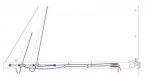
Block-Systems-Slab-reef.jpg

Any suggestions?
Thanks, Steve
 
DO NOT use the holes and ties to take the bag out, you will rip the sail.

The strong point is the reefing point in the leech of the sail. To tighten the foot, you need to somehow pull that reefing point further backwards.

How you do it depends on the reefing system you have. If your aft reefing line ties to the boom then goes up through the sail and back down to the boom, you can sometimes move its position on the boom backwards. If not, you may be able to move the turning block on the boom backwards. Basically, you need to put some backwards pull into the reefing line so as to stretch the foot of the sail a bit more wen reefed.

If you have a track on the boom (as in the picure), more the block back a bit, and also make sure you pull the reefing line b*stard tight.
 
Last edited:
If you have a track on the boom (as in the picure), move the block back a bit, and also make sure you pull the reefing line b*stard tight.

Thanks for the quick reply. I'll give that a whirl. We made some new webbing and rings for attaching to the rams horns at the tack and I have a feeling the webbing straps are too long, stopping us pulling the sail down as far as necessary. Something to do in a windy Whitby for the next few days!
Thanks again, Steve
 
As bobc says, the clew tension and turning block needs to be used to control the depth (bag) along the Foot of the sail. Usually (maybe always) the depth of the sail along the foot can be varied by adjusting the clew position along the line of the boom, adjusted to suit the course, sea state and the wind strength. In varying wind conditions on cruise trip of a few hours I seem to end up having the Foot completely flat (when full of wind because the reef line stretches) when the reef first goes in, then ease in a little more depth to suit how the yachts settles into a course. If The wind is at the top end range for the reefed sail area then with depth left in the foot I end up on my yacht with weather helm and too much heel.

Those little light lines along the foot of the reefed sail are Reef Points, are just to tidy up the bag of a reefed sail, then need to be loose enough so as to not tension the set sail shape. I sometimes uses then to: help with forward visibility, stop the the bag of sail flogging about in the wind, reduced windage, looks tidier.

When I use the Reefing Points I always tie what I call a Safety line of a short length of spare light Sheet through the mainsail reefed clew and around the boom twice then secured with a reef knot. This reminds me and crew when shaking out a reef to undo the reefing points before letting go on the Reefing Penant, avoiding ripping the mainsail by mistake. This also: helps keep the reefed clew of the sail close to the boom leaving the Reefing Pennant and its turning block positions to do the main job of stretching/controlling the Foot of the sail and it helps tidy up the loose bag of the sail at the aft end.
 
Agree that the clew reefing line needs to pull further back, also don't tighten the small reefing grommet lines - they are only tidy-up lines used if you don't have a stackpack, and will tear the sail if any load comes on them. The classic way to do this is to unreef without undoing the small grommet lines.

If your main leech or luff reef point has a block attached rather than just an eye ultra-hard tightening can distort the cheeks of the block against the boom and break the block, so use some caution in winching tight. A few inches or even 6 inches above the boom is OK if the reefing lines are led correctly.
 
Hi all
I've noticed that when the mainsail is reefed that it bags in the middle of the foot where the redundant flaked sail is blown outwards. Should I move the clew further back, or should I be tying the middle of the foot down to the grommets. I've read this from bvisailing32 on Cruisers Forum suggesting that's not the best idea:

"One major tip, those small lines ( small gomets ) that run horizontally between main sail reef cringles and are designed for holding the fall of the sail loosely below and along the boom. If those puppies that are securing the fall of the main sail are pulled tight, the wind pressure in the sail will be so strong it can rip out the stitching around those tiny gromets, and next thing the main sail itself rips and tears."

Here's an image of the reefing system we have
View attachment 65582

Any suggestions?
Thanks, Steve

Ideally the "D2-ring to which the end of each reefing line is attached should be a little bit aft of a point vertically below their respective cringle in the sail ,and the car on the track should be more towards the end of the boom, so that the d-ring end is providing a downward force on the sail and the other part of the line is pulling the foot towards the boom-end, so as to flatten it, becoming the new outhaul, so to speak. The relative positions will only be found by experimentation.
Generally, reefing grommets are found only on boats with a loose-footed sail, and are intended to tie up the loose bunt of sail directly underneath the sail itself, above the boom, and should never be put underneath it as damage could result, if the tack slips off the ram's horn.
 
Last edited:
Essentially when you reef a sail you must ignore all the bunt of unused sail and regard the main sail foot as between the clew eyelet and the tack eyelet. You need lots of tension between the 2. Firstly I think the tack eyelet should be sufficiently far forward on the boom (with outhaul load on) to keep the luff in line up the mast track. ie no aft pull loads on slugs or bolt rope. I use a tack down haul line that also pulls the tack eyelet forward to tuck tightly into the corner near the mast by pulling forward. It is likely that using rams horn and the webbing straps that are too long you are not getting the foot forward enough. From there it is a question of getting enough outhaul. So you need to get reefing line pulling from further aft. The whole foot should be bow string tight. As said the eyelets along above the foot are only to facilitate tidying up the bunt of unused sail. Also an excellent idea to add a few wraps of rope around clew eyelet to boom as this takes all the main sheet loads.
I sailed on a bigger ex ocean racer once and asked what the steel wires were for that emerged from the boom out towards the boom end. Skipper explained that when they reef they transfer the load from reefing ropes to these wires to take the load of outhaul and boom pulling down on sail. Mind you I knew it was a big boat when a crew climbed up the mast to the gooseneck then walked along the boom pulling the cover zip.
On a smaller boat do get the stretch on the foot right when reefed. It is a time when you want to be able to sail to windward with best efficiency. olewill
 
Thanks for the quick reply. I'll give that a whirl. We made some new webbing and rings for attaching to the rams horns at the tack and I have a feeling the webbing straps are too long, stopping us pulling the sail down as far as necessary. Something to do in a windy Whitby for the next few days!
Thanks again, Steve

Your new webbing may actually be the problem , but not because the sail isn't coming down far enough. They are probably not holding the luff cringle near enough to the mast, which means that the original foot tension has evaporated. Long strap/loops are obviously nice and easy to use when reefing, but they don't really locate the tack very well at all.
 
I've seen boats where replacement mainsails have had two reefs sewn in at manufacture but that the reefs have been smaller than the original reefs...

This leads to the reef 1 and reef 2 clew eyelets being further from the mast than they would have been on the original mainsail. No amount of tightening in the clew reefing lines could tension the foot when reefed.

So - As others have said.. perhaps look into where the clew pulleys are on the boom.. Could your perhaps add another further towards the aft end of the boom for reef 1 and then repurpose the original reef one pulley to become reef 2 outhaul.
 
The title of this thread reminds me of the days when roller reefing was commonplace.
One trick was to throw your woolly jumper into the mainsail to take up tbe bagginess.
Roller reefing and woolly jumpers are seldom seen nowadays.
 
Last edited:
There is a very simple form of reefing which if OP tries might just give a guide to a fix for his baggy sail. Firstly after dropping the main sail down far enough you put a few turns of light rope around the mast and through the tack eyelet. This means you cna pull the tack right up to the mast. Do the same with the rope around the boom and through the tack eyelet pulling sail right down onto the boom.
Then you do similar with the clew.Lashing the eyelet to the boom then lashing out pulling hard to the end of the boom or outhaul. Just how hard you pull sets the foot stretch. This method is only useable before you depart (to hard to reef when under way) but will give a good sail shape. olewill
 
Thanks for all the replies. Really appreciate it.
From what I've read, the reefed tack eyelet should be as close to the boom as possible, with the shortest practical reefing straps. Once this has been set, the clew pulley would be positioned to give a 45 degree angle in the reefing line with the clew eyelet at the same height above the boom as the tack eyelet, the tension at the clew being equally downward and outward. Does that make sense?
 
Thanks for all the replies. Really appreciate it.
From what I've read, the reefed tack eyelet should be as close to the boom as possible, with the shortest practical reefing straps. Once this has been set, the clew pulley would be positioned to give a 45 degree angle in the reefing line with the clew eyelet at the same height above the boom as the tack eyelet, the tension at the clew being equally downward and outward. Does that make sense?

You will find it just works better with one side of the reef pennant pulling the clew down, and the other side pulling it as near as possible back.
Just move the boom blocks as far back as possible.
Having the line at 45 degrees both sides sounds like it ought to come to the same thing, but in reality, I've seen it tried several times and it does not work at all well. I'd guess it's to do with a lot of friction in bending the line 180deg through the cringle, but whatever the theory, leading the line back to the block as close as poss to horizontal just seems to work ten times better.
 
Thanks for all the replies. Really appreciate it.
From what I've read, the reefed tack eyelet should be as close to the boom as possible, with the shortest practical reefing straps. Once this has been set, the clew pulley would be positioned to give a 45 degree angle in the reefing line with the clew eyelet at the same height above the boom as the tack eyelet, the tension at the clew being equally downward and outward. Does that make sense?

The clew pendant should be secured to the boom roughly below the clew reefing cringle - and erring towards aft of the cringle rather than forward of it. The pendant should go through the cringle and then run well aft - this will be to the boom end casting if you have the normal "modern" arrangement of lines running through the boom. If you have a retrofit with cheek blocks on the sides of the boom and lines running along the outside (same as solid wooden booms used to use) then the blocks want to be as far aft as you can get them.

The part of the pendant going down to the boom then provides the downwards component, and the part running aft provides the all-important tension across the foot of the sail needed to get it nice and flat in a strong wind.

Pete
 
The title of this thread reminds me of the days when roller reefing was commonplace.
One trick was to throw your woolly jumper into the mainsail to take up tbe bagginess.
Roller reefing and woolly jumpers are seldom seen nowadays.

No, no the recommendation was to throw in, not a wooly jumper, but a sail bag, hence the thread title:)
 
DO NOT use the holes and ties to take the bag out, you will rip the sail.

The strong point is the reefing point in the leech of the sail. To tighten the foot, you need to somehow pull that reefing point further backwards.
This.

Remember to attack the tack first. Then tighten the clew. The clew reefing pennant needs to hold the clew both down and aft, so it acts as an outhaul.
 
To the OP,
Agree with lw395's comments with the caveat that the system depicted is somewhat unusual. The normal way to do this is to tie a reefing line to the boom (threaded through a D ring), then up to the reef cringle, back to a pully at the end of the boom and forward from there.

Attaching reef lines to the sides of the boom is however not ideal. The danger is that big rotational forces can be set up, which can easily bust the gooseneck.

From your pic it would seem that each reef line has one termination either side of the boom, which should be fine as long as you're careful to load up both sides evenly as you pull in the reef and most importantly when you re-tighten the vang and main sheet.
 
Top