
Baffled

K-ron

Well-Known Member
Joined
1 Mar 2014
Messages
221
Visit site
Hi,

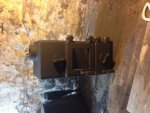
I have recently installed my home made wood burner on my boat. Unfortunately the stove is not drawing as well as I would like. After lighting some small pieces of kindling with a fire lighter the wood started to just smoulder rather than burn. It doesn't really change much when I open the ash door at the bottom. This leads me to believe that it's simply not drawing properly. The stove is made from 8 mm steel box section with top and bottom plates of 12mm there are two air vents one on the ash door at the bottom and one at the top of the fire box. I have also installed a 12mm baffle plate 2 inches from the top plate, welded on 3 edges with a gap of about 1.5 inches for the smoke/fumes. The baffle is welded horizontally not on an angel. Could I have made the baffle to big? Could this be stopping the flow of air, pushing it back down into the fire box? The flue is 2 inch thick walled stainless and the length is 1 meter. Any suggestions as to the problem before I resort to chopping the top off to change the baffle design?

Cheers

Kieran
 

Attachments

  • image.jpg
    image.jpg
    43.8 KB · Views: 0
First, dont panic!

It could be a number of things. Did you light it and let it get up to heat? Was the boat cold? What is the chimney like, near other objects etc? In general the baffle plates are put at an angle which helps to increase the draw due to a kind of venturi effect. The chimney and how hot things have managed to get to are very important in the draw. For instance, an insulated chimney will draw better because the heat will not be lost and can continue to drive the air up the chimney. Then you have weather conditions, somethimes you get atmospheric conditions that simple do not encourage draw. Try a few times before you start hacking it apart. It does look like wuite a lot of metal though for quite a small fire so it might just take a bit of time to get going. Try some coal to get it up to heat.
 
Hi,

I have recently installed my home made wood burner on my boat. Unfortunately the stove is not drawing as well as I would like. After lighting some small pieces of kindling with a fire lighter the wood started to just smoulder rather than burn. It doesn't really change much when I open the ash door at the bottom. This leads me to believe that it's simply not drawing properly. The stove is made from 8 mm steel box section with top and bottom plates of 12mm there are two air vents one on the ash door at the bottom and one at the top of the fire box. I have also installed a 12mm baffle plate 2 inches from the top plate, welded on 3 edges with a gap of about 1.5 inches for the smoke/fumes. The baffle is welded horizontally not on an angel. Could I have made the baffle to big? Could this be stopping the flow of air, pushing it back down into the fire box? The flue is 2 inch thick walled stainless and the length is 1 meter. Any suggestions as to the problem before I resort to chopping the top off to change the baffle design?

Cheers

Kieran

Id say your baffle is restricting the flow up the chimney too much.

What are you basing the design on or are you just making it up as you go ?
 
It is my own design but I have lived with morso squirrels for many years and I think the design plays homage to them.

Many thanks pmagowan for your thoughts. I will try some charcoal today and see how that performs.

Thanks
 
First, dont panic!

It could be a number of things. Did you light it and let it get up to heat? Was the boat cold? What is the chimney like, near other objects etc? In general the baffle plates are put at an angle which helps to increase the draw due to a kind of venturi effect. The chimney and how hot things have managed to get to are very important in the draw. For instance, an insulated chimney will draw better because the heat will not be lost and can continue to drive the air up the chimney. Then you have weather conditions, somethimes you get atmospheric conditions that simple do not encourage draw. Try a few times before you start hacking it apart. It does look like wuite a lot of metal though for quite a small fire so it might just take a bit of time to get going. Try some coal to get it up to heat.

Agree with all that above. Very nice job you made of the heater! We heat our hose with a wood burner stove and know that the initial draw is tricky to establish untill you get used to the stove. However, i have a taylors diesel heater on my boat and i know it is not the same but i did have a problem at first in getting it to draw. The solution was a longer length of chimney. I increased it from 4ft 6" to 6ft by adding an extra length outside above deck and now it draws first time every time even in strong winds.

Www.solocoastalsailing.co.uk
 
I'm no expert but, off-hand, I would suggest that the flue is too small to be effective.
On my previous boat the first thing that I removed was the Refleks diesel heater that had been installed for Scottish weather and it had a stainless flue that was around 4" diameter (from memory). I don't think that wood can burn efficiently with less cross-sectional area.
 
Last edited:
Also, when I close the bottom vent, smoke will come out of the top vent. Suggesting lack of draw. Extend flue pipe or reduce baffle size?
 
Try lighting it with the box lined with cardboard and a good bit of scrunched up news paper. If smoke comes back from a 1m flue then the smoke has lost all its heat before it leaves the box.
 
I had a small woodburner (ashore) some years ago and I could never get it to draw.
The chimney, I discovered, had a spark guard in it which had become tarred up. Once I removed that it roared away.
Just a thought.
 
I think you'll find that all that's wrong is that the flue is cold. Certainly the baffle might have been better angled up a bit. Try setting your fire, the putting some scrunched up newspaper on top, and lighting that, just to get an airflow up the flue, then light the fire.
 
Only ever deal with chimneys ashore lol, It could well be that your chimney is too short, how far does the top clear the deck? and is there anything within 2'-3' radius of the chimney? (the turbulence from the wind could disrupt the draw) For the chimney to work it needs to heat up which greatly assists the draw.

It may be that you will need a flue extension you can slot on when you light up.
Just make sure you have sufficient fresh inflow into the boat and a CO2 alarm.

Would be interested to hear how you get on
 
I would suggest before you rip it out to remove or modify the baffle you temporarily increase the length of the flue. Also try a bend on top opening facing down wind or even try to fabricate a venturi for the top of the flue. It may be that as said once it is lit and hot it works OK.
I am not sure why you would have an air vent at the top of the firebox.
I also wonder what the baffle is for. If it has the gap at the front or away from the flue outlet then that would direct hot air past the top hot plate before exiting. If not it will direct the hot air away from the top hot plate. Perhaps you should think of an axle on the baffle so it can for start up not impede air flow to the flue but later when hot rotate to direct the hot air flow past the hot plate. Just remembering old Australian wood fire cookers had a hole at the back of the fire going straight to the chimney. It had a sliding plate to close this off so all hot air was directed down and around the oven mounted underneath once fire was established. Also allowed some adjustment of oven temp. good luck olewill
 
Hi,

I have recently installed my home made wood burner on my boat. Unfortunately the stove is not drawing as well as I would like. After lighting some small pieces of kindling with a fire lighter the wood started to just smoulder rather than burn. It doesn't really change much when I open the ash door at the bottom. This leads me to believe that it's simply not drawing properly. The stove is made from 8 mm steel box section with top and bottom plates of 12mm there are two air vents one on the ash door at the bottom and one at the top of the fire box. I have also installed a 12mm baffle plate 2 inches from the top plate, welded on 3 edges with a gap of about 1.5 inches for the smoke/fumes. The baffle is welded horizontally not on an angel. Could I have made the baffle to big? Could this be stopping the flow of air, pushing it back down into the fire box? The flue is 2 inch thick walled stainless and the length is 1 meter. Any suggestions as to the problem before I resort to chopping the top off to change the baffle design?

Cheers

Kieran

Hi I have burned wood most of my life in everything from homemade 20ltr metal oil cans to factory wood furnace.

To burn wood (or any solid or liquid fuel) you need a hot flue to draw the smoke away from fire,or smoke will kill fire due to lack of air(oxygen). Air will not be drawn in thru the bottom draft to supply burning if there is insufficient "suction" of smoke up the flue.

1. your flue is large enough but is made of heavy slow to heat pipe. That will make stove difficult & smoky to get going. I suggest you cut it off 2 inches above stove top & replace with thin wall stainless. Also,you could set a length of larger thin wall on over the flue but not touching it to make an insulated flue which will heat even faster & draw better. Study REFLEKS catalogue for help with flue. When you get it aboard your boat,follow REFLEKS instructions re-flue height above deck & nearby objects as well as insulation & proper down draft preventer cap.
2. the "draft" in top front of stove will draw the smoke out at that point-I don't know your theory-but I suggest sealing it tightly & trying again. I don't understand the purpose of it.
3. the flue appears to be in the back corner of top which is OK. Baffle should be welded to back wall & both side walls with the gap along front wall. Baffle's only purpose is to extract more heat by getting hot enough to vapourize & burn smoke by-products when fire gets going well. Also better for environment. Two inches sounds sufficient for gap & baffle drop.As long as baffle's cross sectional openings are as large or larger than flue it should work.


4. I don't know what the bottom area of firebox looks like,but you must have some type of raised grate to place wood on & allow air to get underneath fire. Rebar works well. It will not light or burn well if wood is lying on flat plate bottom & air is only available above the fire.

Hope this helps- Very nice workmanship!
Cheers/ Len
 
Hi I have burned wood most of my life in everything from homemade 20ltr metal oil cans to factory wood furnace.

To burn wood (or any solid or liquid fuel) you need a hot flue to draw the smoke away from fire,or smoke will kill fire due to lack of air(oxygen). Air will not be drawn in thru the bottom draft to supply burning if there is insufficient "suction" of smoke up the flue.

1. your flue is large enough but is made of heavy slow to heat pipe. That will make stove difficult & smoky to get going. I suggest you cut it off 2 inches above stove top & replace with thin wall stainless. Also,you could set a length of larger thin wall on over the flue but not touching it to make an insulated flue which will heat even faster & draw better. Study REFLEKS catalogue for help with flue. When you get it aboard your boat,follow REFLEKS instructions re-flue height above deck & nearby objects as well as insulation & proper down draft preventer cap.
2. the "draft" in top front of stove will draw the smoke out at that point-I don't know your theory-but I suggest sealing it tightly & trying again. I don't understand the purpose of it.
3. the flue appears to be in the back corner of top which is OK. Baffle should be welded to back wall & both side walls with the gap along front wall. Baffle's only purpose is to extract more heat by getting hot enough to vapourize & burn smoke by-products when fire gets going well. Also better for environment. Two inches sounds sufficient for gap & baffle drop.As long as baffle's cross sectional openings are as large or larger than flue it should work.


4. I don't know what the bottom area of firebox looks like,but you must have some type of raised grate to place wood on & allow air to get underneath fire. Rebar works well. It will not light or burn well if wood is lying on flat plate bottom & air is only available above the fire.

Hope this helps- Very nice workmanship!
Cheers/ Len

OK The upper draft is for combustion of gasses above baffle plate. May help but it must be closed tight until stove is burning well.
 
OK The upper draft is for combustion of gasses above baffle plate. May help but it must be closed tight until stove is burning well.

I always though (from experience of multi fuel stoves) that you want air entering at the bottom (below the grate) when burning coal, but want air entering from the top of the stove when burning wood.

apart from when lighting the stove, we only ever run ours with the top draw open and the bottom draw closed.

For lighting the stove we have everything open to encourage it to get going quick to heat the flue up.
 
I always though (from experience of multi fuel stoves) that you want air entering at the bottom (below the grate) when burning coal, but want air entering from the top of the stove when burning wood.

apart from when lighting the stove, we only ever run ours with the top draw open and the bottom draw closed.

I have never operated a stove designed that way. Does your stove have a closed channel to direct the upper draw air down to flame level? Some newer designs do this to pre-heat the incoming combustion air but OP's stove appears to have the upper draw very high above fire & he states smoke comes out upper draw.
Can't argue with your success-like to know more about your stove.
Cheers/ Len
 
Firstly, many thanks for all the informative replies. As prodave says, I thought it was good to have an air intake at the bottom for burning charcoal/coal etc and the top vent for burning wood. This is how a morso squirrel is set up and I have found to be excellent to control. Last night I lit a small amount of lump charcoal (with a fairly strong breeze, around 20 knots) and it drew beautifully, I then added some really small pieces of wood and it was great. Then I added some larger lumps of that compressed paper saw dust stuff and it was ok but often needed the bottom ash door open to help keep the wood lit and not smoulder. It certainly seems that lighting with a little charcoal to get the flue hot works wonders. Like all the stoves I have had in the past it seems to have its own character and I need to get to know it better before I start cutting it up! Please keep any other information coming and I will continue to experiment and feed back. Also the flue is centered and to the right as you look at it. The baffle is welded on the three edges, right side, front and back - hope that makes sense. I thought the baffle would help stop the heat going out the flue which I'm sure it does but makes it harder to start.

Once again, thank you everyone.
Kieran
 
I have never operated a stove designed that way. Does your stove have a closed channel to direct the upper draw air down to flame level? Some newer designs do this to pre-heat the incoming combustion air but OP's stove appears to have the upper draw very high above fire & he states smoke comes out upper draw.
Can't argue with your success-like to know more about your stove.
Cheers/ Len

Our stove is a Dunsley Highlander 5.

The idea of the top draw for burning wood is to create an air wash. Basically the top draw is in the top of the door above the glass so draws the combustion air down to the fire across the glass helping to keep the glass clear. The smoke tends to rise up at the back, wash over the baffle, then up into the flue.

The exact position of the air intake and it's size is very critical. Once we broke the glass. Only a little corner broke off right at the top. Now I would have thought that would have had the effect of allowing more air in and making it impossible to shut the fire down, resulting in it being over fired. But no, it had the opposite effect and the fire was almost impossible to light and get it to burn properly until we replaced the glass.

I suspect commercial stoves have gone through a long design / evolution process, probably a lot by trial and error, to arrive at a design that works. The OP has built a stove that does not work so well, and it probably only wants a small adjustment, but knowing what it needs is a bit of a black art.
 
Top