Avoiding thread galling on thru-hull/ball valve

coopec

N/A
Joined
23 Nov 2013
Messages
5,211
Visit site
I don't know whether galling it is a problem or not on thru-hull/ball valves. But I've already got anti-seize on the fittings and I am about to use Teflon tape as well when I fit them. Being a vital underwater fitting I thought I'd better check and I found the answer:

"When joining threaded pipe sections, it's a different story and all of the pipefitters claim to have their own combination of teflon tape, pipe dope and anti-seize in concert to prevent galling."

The whole thread can be read here :
Need solution to avoid thread galling - Mechanical engineering general discussion - Eng-Tips
 
Personally I have never had an issue with bronze or brass fittings.

I favour clesetite for thread sealing/lubrication
 
Galling is only a problem with stainless steel. Your link says their fittings are SS316L.

If your fitting for some reason are stainless steel, then never-sieze with molybdenum disulphide is your best choice to prevent galling.

Now I am confused.:(

SS316L is a grade of stainless steel. Are you saying SS316 doesn't gall?

"It should be noted that while using 304 bolts with 316 nuts is often quoted as a cure for galling, the hardness difference is not necessarily sufficient to prevent galling even with a cold rolled, harder 304 thread used against an annealed, softer 316 nut. There are reports that A2-80 and A4-80 bolts are more resistant to galling than 70 class bolts, but there are other reports that cold work increases risk. A substantial set of galling stress data is given in pages 61-65 of the 'Stainless Steel Blue Book' available from Carpenter Technology
FAQ 5: Galling and its Control
 
316 definitely is susceptible to galling along with most 300 series stainless steel. As said, MoS2 products have been shown to provide the best resistance to the problem although people will claim that Copaslip is equally good.
 
Now I am confused.:( SS316L is a grade of stainless steel. Are you saying SS316 doesn't gall?

You asked: "I don't know whether galling it is a problem or not on thru-hull/ball valves". Well the answer is it's only a problem if you were planning to use stainless steel thru-hull/ball valves. (If so, why?)

As your linked article discusses, galling with stainless steel fasteners, including 316L, is a problem in many industries, especially where high speed assembly of components is a requirement during manufacture. But you have to remember that stainless steel has lots of other issues in the marine environment, so any discussion of a 'solution' to galling may not be relevant to our use. For instance one suggestion is to use aluminium nuts, and that might be fine in the manufacture of stainless steel hospital equipment where use of Never-Sieze isn't acceptable, but doesn't really off a solution to your through hull.

Although molybdenum disulphide based pastes are thought to provide the best preventative help, it's really messy stuff. Therefore those people with all stainless rigging screws don't like it as it ends up on sheets and sails, so things like Tuff-Gel and Lanocote might offer a workable alternative without the cross contamination.

So check the threads aren't damaged, add the lubricant of your choice, take it slow and pray.
And still it will bite you at the most inopportune moment.
 
316 definitely is susceptible to galling along with most 300 series stainless steel. As said, MoS2 products have been shown to provide the best resistance to the problem although people will claim that Copaslip is equally good.

When I can fit my ball valve I will definitely use MoS2 as well as Teflon tape.

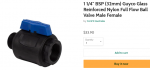
But I ran into a problem today as I found the thru-hull fitting is 41.9mm and the ball valve is 40mm despite being marked 1 ¼ inch. I'm now considering a nylon valve or SS. (It is for toilet waste discharge)

I think I'll go for SS as there is nothing in it cost-wise

Screenshot 2022-01-15 at 19-27-54 1 1 4 BSP (32mm) Guyco Glass Reinforced Nylon Full Flow Ball...png


Screenshot 2022-01-15 at 19-32-00 1 1 4 BSP 316 STAINLESS STEEL BALL VALVE FEMALE FEMALE 1 PIE...png
 
Last edited:
You asked: "I don't know whether galling it is a problem or not on thru-hull/ball valves". Well the answer is it's only a problem if you were planning to use stainless steel thru-hull/ball valves. (If so, why?)

As your linked article discusses, galling with stainless steel fasteners, including 316L, is a problem in many industries, especially where high speed assembly of components is a requirement during manufacture. But you have to remember that stainless steel has lots of other issues in the marine environment, so any discussion of a 'solution' to galling may not be relevant to our use. For instance one suggestion is to use aluminium nuts, and that might be fine in the manufacture of stainless steel hospital equipment where use of Never-Sieze isn't acceptable, but doesn't really off a solution to your through hull.

Although molybdenum disulphide based pastes are thought to provide the best preventative help, it's really messy stuff. Therefore those people with all stainless rigging screws don't like it as it ends up on sheets and sails, so things like Tuff-Gel and Lanocote might offer a workable alternative without the cross contamination.

So check the threads aren't damaged, add the lubricant of your choice, take it slow and pray.
And still it will bite you at the most inopportune moment.

Thanks for that.

Since the thru hull is below the waterline I prefer 316 SS.

The only other type of thru-hull/ball valve would be Marelon. (I would never consider PVC or ABS rigid plastic polymer for below waterline )
 
Here is an informative article on skin fittings. (TruDesign gets a tick)

Know how: Thru-hulls and Seacocks
We have Marelon valves and bronze through hulls with s/s valves. Both seem to stand the test of time. I striped the s/s valves off the bronze through hulls last year to inspect for corrosion. Everything was in perfect condition after 10 years
 
I'm not a fan of stainless in seawater, having needed to replace a couple of stainless valves doing duty as seacocks due to weeping through cracks in the body. The previous owner used proper industrial valves but nfg after a few years. I replaced them with marelon ones.
 
On which parts do you want to avoid galling?
If it is the threaded join between the through hull and valve, then I’d always add a thread seal / thread lock as others have mentioned. This should lubricate the thread during fitting until it sets, and once set I don't want them to come apart again.
 
Thanks for that.

Since the thru hull is below the waterline I prefer 316 SS.

The only other type of thru-hull/ball valve would be Marelon. (I would never consider PVC or ABS rigid plastic polymer for below waterline )
Why do you prefer stainless for underwater when bronze, DZR or composite are superior? The big unknown with using stainless (apart from galling of the threads) is crevice corrosion in the threads. The static seawater that sits on top of the exposed thread of the skin fitting creates perfect conditions for this type of corrosion. Better to use an alternative material that does not corrode in seawater.
 
Why do you prefer stainless for underwater when bronze, DZR or composite are superior? The big unknown with using stainless (apart from galling of the threads) is crevice corrosion in the threads. The static seawater that sits on top of the exposed thread of the skin fitting creates perfect conditions for this type of corrosion. Better to use an alternative material that does not corrode in seawater.
I'll probably use TruDesign when I build my next boat.:cool:

When I spoke to the chandlers they suggested SS for underwater fittings . I have the SS ball valves now so that'
the way I'll go this time. (But I am listening to you guys) (y)

Thanks
 
Apparently leaks from the thru hull/ball valves are fairly common so I'm taking time to find out how I should install them.

I had planned to use Teflon tape as well as anti-seize. (I wonder if Loctite have a product I should consider?)

But I came across this article which is quite relevant. (I have no commercial interest in Grays and I don't know how good their advice is)

How to Properly Seal Stainless Steel Fittings, Nipples & Well Supplies
 
Why do you prefer stainless for underwater when bronze, DZR or composite are superior? The big unknown with using stainless (apart from galling of the threads) is crevice corrosion in the threads. The static seawater that sits on top of the exposed thread of the skin fitting creates perfect conditions for this type of corrosion. Better to use an alternative material that does not corrode in seawater.
My experience last year when I removed a DZR valve was that it was in poor condition. It had been installed at the same time as 316 s/s valves that were in in far better condition. I posted about it at the time. I have not found any sign of crevice corrosion in the s/s valves after 10 years. Galling only seems to occur when you use s/s on s/s. s/s on bronze isn't an issue.
 
What do you mean by "poor condition - and are you sure it was DZR?

You can guard against crevice corrosion by fully sealing the threads, but as with dezincification in brass valves it occurs unseen in threads of fittings, rarely in the valves themselves as the bodies are not exposed to dead seawater.
 
What do you mean by "poor condition - and are you sure it was DZR?

You can guard against crevice corrosion by fully sealing the threads, but as with dezincification in brass valves it occurs unseen in threads of fittings, rarely in the valves themselves as the bodies are not exposed to dead seawater.
That's why I removed the valves to inspect them. Threads were perfect.
The DZR valve was dribbling from the stem. It was definitely DZR. As I understand it, even bronze valves often have brass balls in them
 
Yesterday I got down in the bilge and with my knees up near my ears I tried to fit the ball valve on to the thru-hull but I failed.

I checked the O/D of the thru-hull with the digital vernier gauge and found it was 41.9mm.
I then checked the I/D of the female thread opening of the ball valve and found it was 39.6mm

I'll try again today but has anyone got advice?:oops:
 
Top