Autopilot remote control - wifi & tablet / ipad

ianj99

Well-Known Member
Joined
11 Nov 2009
Messages
2,097
Location
UK
Visit site
Has anyone used an AP WRC3 or 3iF from Australian company
http://www.madmanmarine.com/

The cost is £177 including express shipping to the UK at current exchange rate (excl any vat or duties which may be charged), so it is a fair bit cheaper than the Raymarine S100 remote.

Connects via Seatalk like the S100 and is operated by a 4 button fob, or an Android or iPad app.
 
I have not used one but am interested in the technology and in any replies. It seems relatively cheap. If you had electronic throttle control with this you could have a remote controlled boat. You could have a lot of fun with that although practically it would be very useful for picking up a mooring buoy single handed.
 
I have not used one but am interested in the technology and in any replies. It seems relatively cheap. If you had electronic throttle control with this you could have a remote controlled boat. You could have a lot of fun with that although practically it would be very useful for picking up a mooring buoy single handed.

They've obviously decoded Raymarine's Seatalk autopilot sentences. Its not that difficult to capture the Seatalk or even STNG data stream and if you know what to look for, the rest is fairly easy with an Arduino etc.

I am thinking about using an off the shelf fob operated remote control off Ebay to start or stop my engine. It doesn't matter if its in gear at the time. However, so far I've not had a problem single handedly picking up my mooring though mainly due the heavy old girl (10t) losing headway so slowly out of gear, and the rudder not stalling until very low speed.
 
Last edited:
They've obviously decoded Raymarine's Seatalk autopilot sentences.

I am thinking about using an off the shelf fob operated remote control off Ebay to start or stop my engine. It doesn't matter if its in gear at the time. However, so far I've not had a problem single handedly picking up my mooring though mainly due the heavy old girl (10t) losing headway so slowly out of gear, and the rudder not stalling until very low speed.

Yes, it is rather a solution looking for a problem but it is an enticing idea. I have been looking at various types of monitoring and control systems based on arduino and rasp-pi or equivalent and it just seems like fun to join everything together. You can imagine someone stealing your boat and it activating the return to home function! The general automated steering that you are looking at also allows you to control things from the comfort of the sprayhood etc.
 
They've obviously decoded Raymarine's Seatalk autopilot sentences.

Using Thomas Knauf's well-known reference, more likely :) http://www.thomasknauf.de/seatalk.htm

Angus used to offer something very similar as a YAPP.

I have all the bits on my desk for a Seatalk Arduino project myself, when I find the time. I want a thingy that auto-cancels the depth alarm when I know the water is shallow.

Pete
 
Using Thomas Knauf's well-known reference, more likely :) http://www.thomasknauf.de/seatalk.htm

Angus used to offer something very similar as a YAPP.

I have all the bits on my desk for a Seatalk Arduino project myself, when I find the time. I want a thingy that auto-cancels the depth alarm when I know the water is shallow.

Pete

Yes I remember Angus' yapp which I think was a wired remote. Had I been able to get hold of one, it would be easy to wire up the buttons to the relay outputs of a remote control kit.
 
Yes I remember Angus' yapp which I think was a wired remote. Had I been able to get hold of one, it would be easy to wire up the buttons to the relay outputs of a remote control kit.

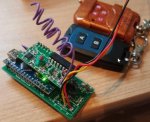
I have made a seatalk remote....wireless....if people are interested...I can make them available as a kit...I need to find time to put up some details.
 
Using Thomas Knauf's well-known reference, more likely :) http://www.thomasknauf.de/seatalk.htm

Angus used to offer something very similar as a YAPP.

I have all the bits on my desk for a Seatalk Arduino project myself, when I find the time. I want a thingy that auto-cancels the depth alarm when I know the water is shallow.

Pete

Like the idea....I'll add it to my code on the seatalk remote....a special key sequence shuts up the depth alarm.
 
I use the Madman Marine remote with my Raymarine autopilot every time I go out. I have it clipped to my harness, which I wear all the time. As you all know (from my book) I'm a singlehanded sailor and I've taken to using the remote to achieve maximum speed with the boat. I let Auto drive, and I sit up on the side and watch the knot meter and make little adjustments to heading using the Madman remote. 3 deg up, 2 deg down, etc, etc,. It is the fastest way to sail.
 
I have made a seatalk remote....wireless....if people are interested...I can make them available as a kit...I need to find time to put up some details.

Put me down for one please.

I think Iremote.jpg found a photo of yours below! :)

Ian
 
I would be very interested in that, the ability to tweak the tillerpilot from the companionway would be great

here is a pic of the first one...
Untitled.jpg

just connect the 3 wires to Seatalk,. im waiting on some new 4 button waterproof remotes to arrive, (the brown remotes are rubbish, but work) and I need to sort out a waterproof box, I'm holding off making these available as I haven't done a full sea trial yet....but the plan is to make them available....I had 30 PCBs made up,
 
Like the idea....I'll add it to my code on the seatalk remote....a special key sequence shuts up the depth alarm.

:encouragement:

The problem I have is that the alarm depth is set at 1.5m below the keel. For where I sail, that gives a reasonable compromise between long enough warning and too many nuisance alerts - but only when out and about. When coming into harbour there will often be less than 1.5m, which I know and accept and don't need warning about. The alarm going off and needing to be cancelled every twenty seconds while I'm trying to berth is an annoying distraction.

My plan is to have a module on the Seatalk bus which is inactive most of the time. After the first alarm (or in advance when I know I'm going into a shallow harbour) I'll press a button at the binnacle to turn it on. Thereafter, whenever Command 00 has the "Shallow Depth Alarm" flag set, it will immediately respond with 68 11 to cancel the alarm. I don't know whether the depth instrument will get any sound out before this process completes, but if it does it should only be a short "peep".

A second press of the button will turn the silencer off again, but there's an obvious danger that I forget and run into a mudbank without any warning. So I'll build in one or more of the following ideas:
  • Bright LED next to the binnacle activation button, flashing occasionally when the silencer is active (probably whenever the cancel operation happens).
  • When the instrument power is turned off after tying up, the system resets (will happen anyway unless I take special steps).
  • If the depth goes back up over a certain threshold and stays there for a while, turn off the silencer.
  • Overall timer - the silencer will never run for more than, say, an hour.

This is my first foray into Arduinos, triggered by another thread the other week in which someone pointed out just how amazingly cheap they are now (I bought three for £6.95 delivered). I've done the obligatory blinking of LEDs and I've received NMEA messages from a GPS module for a different project I have in mind (waiting on other components for that one now) but those are very well-documented things where one can mostly just smoosh together well-known libraries. Seatalk is a bit more niche and it has its funny 9-bit structure, and I'm a bit less confident in figuring that out (especially since I don't have a good source of Seatalk to experiment with at home, nor a laptop to take to the boat and work on it there). I've found a handful of blog posts etc, but they mostly rely on hand-patching the standard Serial library which has changed drastically since they were written.

I'm sure I'd manage it in the end, but any pointers (or even code examples, if you're willing) on how to send or receive Seatalk would be very welcome :)

Cheers,

Pete
 
:encouragement:

I'm sure I'd manage it in the end, but any pointers (or even code examples, if you're willing) on how to send or receive Seatalk would be very welcome :)

Cheers,

Pete

I'll see if I can get it working and send you some code to change.
 
I'll see if I can get it working and send you some code to change.

Thanks - I'm not asking you to write the silencer though, I can do that. I was just after an example of reading/writing Seatalk, which I assume you're already doing for the pilot controller.

Pete
 
I haven't priced it all up as still trying option on boxes and remotes....£40-£60 perhaps?

I made a Seatalk autopilot wireless remote. I used it all summer & it worked fine but in the end I went back to the wired one. The problem with the remote one was I kept on putting it down & losing it or sitting on it & doing unintentional tacks. It was PIC based & much smaller & cheaper than an Arduino one would be.
y4YwSyo.jpg

Base station on the left, handset on the right. Combined cost about £20. Batteries would last years as the remote handset went into sleep mode until a button pressed taking the current consumption from the batteries down tothe sub-microAmp range. Small RF daughter boards on each end, 60p each (15m range), 18F processor, proper Seatalk collision avoidance at the base station end.

An Arduino board isn't an ideal choice for the handset application - overkill, too big, too power hungry & much more expensive.

I only made the 1. Couldn't be bothered to make any more but I still have plenty of PCB's.
 
Last edited:
Top