Autopilot Actuator. How Much Force to Move the Ram?

DJE

Well-Known Member
Joined
21 Jun 2004
Messages
7,742
Location
Fareham
www.casl.uk.com
I'm new to wheel steering and I thought I had rudder bearing problems as the wheel felt a bit stiff and dead. Now traced the problem to the Autopilot actuator; it is a Navico self contained linear unit which I believe is electro-hydrulic. AFAIK it has been on the boat for 17 years - I bought the boat 8 months ago. The projecting piston was clean but bone dry and the resistance reduced a bit when I put some oil on it. But it still seems very stiff and putting it on the scales it needs 6 to 10 kg force to get it moving at any reasonable speed. Is this sort of resistance normal?

The autopilot tiller arm is I suppose about 200mm long and the wheel is someting like 750mm radius so there is no problem turning the steering. But with the actuator removed the wheel spins easily with one finger and with it attached it feels heavy and sluggish. Is this normal on a 39ft 7-tonne boat?
 
I'd expect it to have some small resistance, but 10kg force sounds a lot. When it's in standby, a by-pass valve should open to allow the fluid to flow freely. It could be that this valve isn't opening properly. Alternatively, the drive may have the wrong fluid in it - too viscous a fluid would increase resistance.

You should be able to find a manual online, which might help you to troubleshoot it.
 
I don't know that particular ram, but it definitely shouldn't be that stiff. The Raymarine one is free-moving enough to slide in and out under its own weight when you tilt it.

Pete
 
I don't know your actuator but my Simrad Robertson one also has some resistance, but less than yours. Mine is all electric and the movement felt a bit rough and like yours the projecting piston was bone dry. I asked Simrad how I could lubricate it and had an answer saying that they always feel a bit rough and that no lubrication was required!

When you tested the force needed to move the piston on yours was it switched off? A hydraulic ram type actuator normally has a bypass valve that opens to allow movement of fluid from one side of the piston to the other when the system is off, or the steering in manual mode. Strong resistance is likely if the valve is in the closed position. I suggest you ask the makers if the amount of force you needed is normal, as it does seem rather high. Is less force needed to move the acuator slowly, but heavy resistance felt to any attempt to move it quickly? That could indicate a bypass valve stuck shut or only partially opening.

My mechanical actuator
tn_DSCF2162.jpg
 
The measured resistance was with power off.

There is a solenoid which I assume operates the bypass. With the actuator installed the resistance was the same with the system powered off or powered on in Standby mode. But the wheel locks completely when switched to Auto mode. So I am assuming that the solenoid valve is normally open but closes under power when the system is switched to Auto.
 
Last edited:
That's correct. But it may not be opening fully.
Probably closed under power and opened with a spring. Might well be sticking - I'm very tempted to take the solenoid off and have a look inside. What's the worst that can happen! :eek:
 
Probably closed under power and opened with a spring. Might well be sticking - I'm very tempted to take the solenoid off and have a look inside. What's the worst that can happen! :eek:

You might find it's a sealed component, so you can't get inside it. Even worse would be getting inside it and not being able to put it back together!
 
Does your linear drive look anything like this?

hld2000L_md.jpg
 
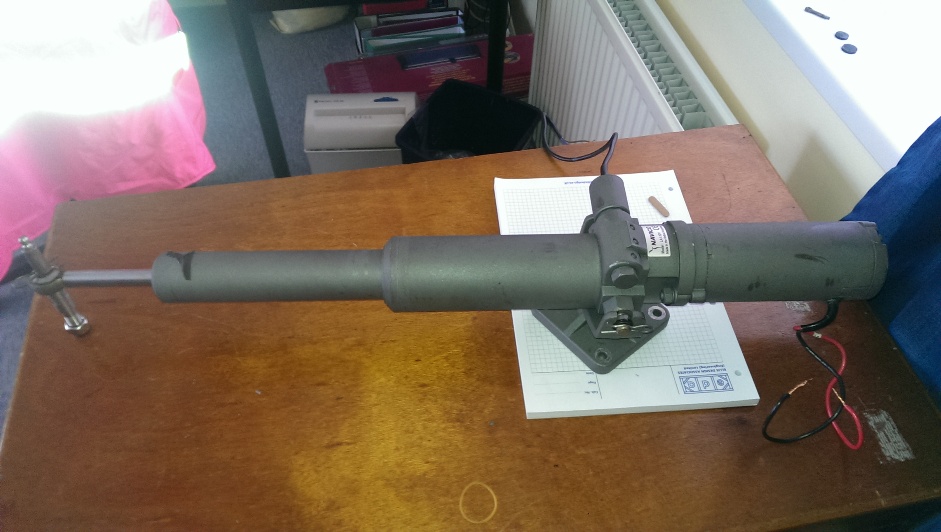
No - like this:-

Actuator1.jpg


The solenoid is the cylinder on top of the main unit directly above the pivot.
 
Last edited:
That's basically the same unit as the B&G RAM-T1, if that helps.

Hmm. Looked up the spec for the B&G unit and it says, "Back-drive at 12 sec hard-over: 7kg".

Does back-drive mean force to push the ram back? Maybe there's nothing wrong with it!
 
Hmm. Looked up the spec for the B&G unit and it says, "Back-drive at 12 sec hard-over: 7kg".

Does back-drive mean force to push the ram back? Maybe there's nothing wrong with it!

Yes, I noticed that in the spec. Seems high, doesn't it? Probably equates to about 3kg at the wheel rim.
 
I think what the specs say is that if you push the ram shaft back into zero position starting from full extended and you try do do it in 12 seconds, there is a back force of 7 kgf. If you do it slower, the force should decrease considerably. When you started this thread you wrote "get it moving at any reasonable speed". If you compare your (reasonable speed) with the (full extension)/(12 seconds) speed given by the specs you can decide if the force you experience is normal or not.

This is a feature of the ram only. The tonnage of the boat is not relevant.

Daniel
 
Last edited:
I think what the specs say is that if you push the ram shaft back into zero position starting from full extended and you try do do it in 12 seconds, there is a back force of 7 kgf. If you do it slower, the force should decrease considerably. When you started this thread you wrote "get it moving at any reasonable speed". If you compare your (reasonable speed) with the (full extension)/(12 seconds) speed given by the specs you can decide if the force you experience is normal or not.

This is a feature of the ram only. The tonnage of the boat is not relevant.

Daniel

For a more objective test I suspended the actuator from the end of the push rod so that it could extend under its own weight. It weighs 6.5 kg so the force acting is this less the weight of the push rod so I assume that it is about 6kg. Time to extend fully was more or less one minute. Time to hard over is presumably a bit less than half this so about 25 seconds. I suppose I could add a bag of sugar to get the weight up to 7 kg but on the face of it it is a bit stiffer than the B&G spec.
 
I tend to agree with you: it sounds stiffer than due.
There are several possibilities but the most likely are:
1) too dense fluid; if the fluid is contaminated it may happen. Change it.
2) partly obstructed by-pass conduit . Check the valve.
3) O-rings and/or seals of the piston. They may have swelled or stiffened due to age or contamination.

Daniel
 
Last edited:
From your description it certainly seems well on the stiff side to me. I agree with daniel's analysis that 7kg should achieve the rate of compression specified by B&G and with your's that an extra 1/2 kg is unlikely to make much difference.

I have a vague idea that Navico rebadged Lecomble & Schmitt gear, and if that's right this is really good kit. Does your look like this: https://www.dropbox.com/s/0irxpa3sbyi4pnh/Catalog_power-packs_linear-drives.pdf?dl=0 ??

If it does then give them a call to discuss and get service bits / instructions.
 
Top