Attaching washboard bottom edge

CloveHitch

New Member
Joined
8 Apr 2017
Messages
17
Visit site
I want to attach a hardwood edge to the bottom of a marine plyboard washboard.

The only advice I've found online concerns home applications (shelving mainly) and recommends simply glueing the edge on. Would this survive a marine environment? What suitable alternative methods are there? I'm assuming screws would ultimately compromise the integrity of the plywood.
 
If you make a good job of epoxying it, it should be fine.
You could use an L-section strip of wood to give more strength and more gluing area.
Even with a hard wood edge, it may be worth having a plastic buffer on the bottom so that the wood is not sat in a little pool of water?
 
I'm assuming the trim is to go on the bottom edge of the ply.

I'd want to do both, using fine screws; without knowing the thickness of the ply, I'd be thinking No 4s, if the ply's over about 7/16", no 6s (3mm).

Pre-drill holes in both & countersink the trim so the screw heads will be below the surface of the wood then glue and screw everything together. Gorilla wood glue claims to be waterproof and stronger than the wood. Alternatively, an epoxy would be fine.
 
I want to attach a hardwood edge to the bottom of a marine plyboard washboard.

The only advice I've found online concerns home applications (shelving mainly) and recommends simply glueing the edge on. Would this survive a marine environment? What suitable alternative methods are there? I'm assuming screws would ultimately compromise the integrity of the plywood.

You could try a tongue and groove method , or a loose tongue method depending on how much edge you are using.
Maybe better to remove more of the washboard and increase the amount of edge to facilitate the loose tongue?

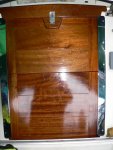
This is a set of wash boards I made using loose tongues all around using solid Iroko . Still good 9 years on.
 

Attachments

  • Boat in Primer, Winches, and joinery 014.jpg
    Boat in Primer, Winches, and joinery 014.jpg
    237.7 KB · Views: 1
Last edited:
My washboards are plywood with an oak edge along the bottom and the two vertical sides. They happen to be in my office right now (still waiting for a coat of paint) and by the look of it I used epoxy as there is also a fillet joint.

As washboards are not (hopefully) underwater, just exposed to weather, any waterproof (D4) wood adhesive should work. The hardwood edge will be a glue joint on the long grain of the wood, which is the strongest glue joint. The plywood will of course be a mix of long grain and end grain, I suspect that a polyurethane wood adhesive would work well with this.

So if you don't have epoxy I think polyurethane , eg gorilla glue would be good.
https://www.screwfix.com/p/gorilla-glue-115ml/54593

For reference, polyurethane wood adhesive is good with endgrain and as it is a moisture cure is waterproof once cured.
https://www.popularwoodworking.com/article/the_truth_about_polyurethane_glue/
 
You could try a tongue and groove method , or a loose tongue method depending on how much edge you are using.
Maybe better to remove more of the washboard and increase the amount of edge to facilitate the loose tongue?

This is a set of wash boards I made using loose tongues all around using solid Iroko . Still good 9 years on.

"Loose Tongues Cost Lives" :)
 
Traditionally the bottom is beveled so that the water drips off the outside edge and doesn't run underneath.

I think that all my boats have been like that. In spite of this, driving rain will always cause some water to get into the gap or it will get drawn in by capillary attraction, so it is necessary that the lower edge is proof against the wet. My current hatches are unvarnished teak and only need normal care but my last boat was always going manky until I covered the surface with epoxy and varnished over it.
 
Made a set of boards with 10mm marine ply and all round oak edges. PU (Gorilla type) glue used. No need for screws/tacks. Been good for the last 7 or 8 years. They are my 'summer' boards. Winter boards are plain, stained 'not-even-marine' ply.
 
Alohol, I'm glad you said "Gorilla type" I'm making a point of not using products made in the USA where possible as my small reaction to Trump's America First policy. I've always found Gorilla products over hyped anyway.
Made a set of boards with 10mm marine ply and all round oak edges. PU (Gorilla type) glue used. No need for screws/tacks. Been good for the last 7 or 8 years. They are my 'summer' boards. Winter boards are plain, stained 'not-even-marine' ply.
 
Many thanks to everyone for all the excellent advice. Very many years ago I opted for cookery at school, over woodwork, a decision I had recently begun to regret: but am glad to discover I can make a reasonable first effort just using the right kind of glue. I might later attempt some joinery for some 'summer' boards.
 
Top