
Attaching Mooring Strop to Foredeck

Houleaux

Well-Known Member
Joined
29 Nov 2009
Messages
342
Location
Solent
Visit site
My boat will be on a swinging mooring this season for the first time during my ownership.

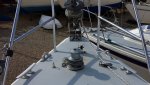
Her foredeck arrangement is shown in the photo below:
2018-02-27 11.36.15b.jpg

According to its instructions, the manual Simpson Lawrence winch is not designed to take a permanent mooring load - which is a pity as it's perfectly positioned to take the strop!

My plan is therefore to run the strop through the bow roller to the port cleat. This will not be a straight run so, to avoid chafe on the bow fitting, I intend to take a separate line from the starboard cleat around the strop (with a round turn) and back to the starboard cleat, such that the strop is guided straight fore and aft through the bow fitting before turning towards the port cleat where the second line is wrapped around it - I hope that makes sense!

Can anyone suggest a better alternative?
 
If a single rope strop what you suggest is probably sensible, just to one cleat would cause a lot of chafe on the bow roller sides. The other option is to have two rope strops, and use both fairleads and both cleats.

The more your boat swings around the more you have to worry about chafe at the front end of the bow roller. Heavy long-keelers end to sit still: light fin-keelers and lift-keelers (the worst) tend to sail around.
 
What you suggest would seem sensible, however I would not rely on a rope strop alone.

Our club moorings officer recommends taking the rising chain to one of the cleats which eliminates catastrophe due to a strop chafing through, so this is what I have done, but I have a strop attached to this chain which I hope has some give in it in poor weather and avoids some of the snatching. The strop takes all the tension but the chain is there as a backup in case of strop failure.

We have had failures on our moorings, and it is nearly always strop or shackle failure hence the officers recommendation.

When you see a boat on the rocks it concentrates the mind!
 
I've had my boats on swinging moorings for over 30 years and have always used at least two strops (often 3). On your arrangement I would lead one to each of the cleats and make sure that they are of unequal length. I would also suggest putting something on the strops to protect them from chafe at the rollers - polypipe works well held in place with tie wraps.
 
I would take 2 strops from the cleats straight over the sides. Do not go through the fairleads to avoid chaffe. Take each one to the buoy & fasten to a separate shackle to each one to the buoy. Then take a slack piece of chain with a shackled loop hooked over both cleats so it sits centrally through the anchor roller to the buoy with no tension as backup
 
Last edited:
I've had my boats on swinging moorings for over 30 years and have always used at least two strops (often 3). On your arrangement I would lead one to each of the cleats and make sure that they are of unequal length. I would also suggest putting something on the strops to protect them from chafe at the rollers - polypipe works well held in place with tie wraps.

We never had any problem with a Sadler 29 for twelve years just fastening to a cleat via a fairlead. We also used a tube against chafe and left the second line slack. This is to prevent the attachment from tightening up if the boat swings in a few circles. I always tied the lines on the cleat down with a light line as well.
 
W use 2 x 24mm polyprop strops. One over each roller and then to cleat. Have been based on moorings for 25 years now and have found polyprop will outlast nylon by several years.
 
My boat will be on a swinging mooring this season for the first time during my ownership.

Her foredeck arrangement is shown in the photo below:

View attachment 69892

According to its instructions, the manual Simpson Lawrence winch is not designed to take a permanent mooring load - which is a pity as it's perfectly positioned to take the strop!

My plan is therefore to run the strop through the bow roller to the port cleat. This will not be a straight run so, to avoid chafe on the bow fitting, I intend to take a separate line from the starboard cleat around the strop (with a round turn) and back to the starboard cleat, such that the strop is guided straight fore and aft through the bow fitting before turning towards the port cleat where the second line is wrapped around it - I hope that makes sense!

Can anyone suggest a better alternative?

I would investigate the wording of the windlass manufacturer about the permanent load. It is quite possible they mean the GEAR shouldn't be permanently loaded by leaving the chain in a positions used for lifting the anchor. I can see a possibility a loop over the gypsy that doesn't create any torque could be O.K.
 
On the Exe the tradition is that the chain comes over the bow roller then onto one of the cleats. Why faf about with wee bits of string?
 
I suspect the big question is whether your boat will turn the same way on every tide and be prone to winding up multiple strops.
Personally I tend to favour a single ropestrop that is as heavy as possible, with a swivel on top of the buoy.
My preference would be to put a big cleat close behind the bow roller, but clearly that's not going to be compatible with windlass and anchor on deck.

I doubt that using the windlass is advisable, as the mooring forces will fret the bearings.

Taking twin strops straight over the side to a swivel below the buoy might work well. But this may need a swivel which actually rortates more freely than many seem to after 6 months. It may also be prone to scuffing the bow in wind vs tide situations.

Those bow roller cheeks look like they will chafe rope led back to the cleats if it moves under load, so using strops of low stretch rope or even chain might be best. I've seen people using stainless chain to avoid rust on their deck. DYOR on the quality of what will go through the rollers?

Two strops direct to the cleats, joined jsut ahead of the bow by a third line which lifts them towards the rollers is another option.
 
As jiris says a couple of posts ago, there's a big difference between using your windlass to take the load through its mechanism, and simply treating it as a big bollard.
I moor my boat by throwing the big spliced eye in the mooring strop over the windlass. At 32mm, the strop is far too large to fit on a cleat, and the windlass is a bigger lump of metal, bolted down with bigger fixings via a sturdier backing plate. The strop goes around the base of the windlass and puts no load on the gypsy.
 
Don't you have a decent size mooring cleat - ideally two, one to each side, with substantial backing pads bolted underneath ?

I would always use chain not a rope strop, having tried both on exposed moorings.

A friend of mine had his boat written off when the rope strop chafed through in a series of gales; he knew she was at risk but simply couldn't get out to her.

Chain is chafe-proof, and you can put a padlock through it to prevent vandals setting your pride and joy adrift !
 
I have always used rope for the top part of my swing mooring. Now 32 years. However my boat being smaller has an eye for winching it onto trailer mounted about half way water line to top of bow. I use this to take the primary load of the mooring. The original eye bolt fatigued early on but a large saddle with 8mm bolts seems OK. The GRP is incredibly thick at this point so just washers under the nuts. I use a large snap shackle to attach the rope to the top of the mooring buoy. This has the advantage of no chafe places and below the bow so can't be chafed by another boat adrift. However the disadvantage is that it is difficult to reach from deck. I usually disconnect on arrival at the boat and reconnect from the dinghy before leaving the boat. There is of course a normal rope tether to the deck cleat for use when the main attach is disconnected. ie for mooring pick up and casting off. So 1 or 2 metres of rope then all chain down to the bottom. Works well for me but perhaps not for a bigger boat. olewill
 
It seems to be essential to have TWO boat ropes or strops, as a 'backstop' in event of failure through accelerated chafe - which can take but a half-hour to cut through a single loaded line. I'd bring a pair of boat ropes, of >20mm polysteel, over the bow rollers and each part-around the winch then onto one of those cleats.

I'd have anti-chafe tubing - of time-expired fire hose with securing cords - at the bow rollers and at the windlass. That's dirt-cheap and easy. Put a heavyweight swivel between the boat ropes' ends and the mooring buoy. Inspect frequently, then photograph for the insurance company.

Unless your cleats are held on by woodscrews ( worth a check! ) that should certainly suffice.
 
One other point- the strop must be secured in the roller so that it cannot jump out. Some boats have a drop nose stainless pin, otherwise you will need to lash it in place.
 
I would investigate the wording of the windlass manufacturer about the permanent load. It is quite possible they mean the GEAR shouldn't be permanently loaded by leaving the chain in a positions used for lifting the anchor. I can see a possibility a loop over the gypsy that doesn't create any torque could be O.K.

Some windlass mountings aren't designed for snatch loads which can be present on a mooring. A mate had the two rear bolts stripped out of an alloy windlass on anchor one night without a snubber.
 
If one were to take 2 lines direct from the cleats to a buoy they may rub the side of the boat a little but prevent the buoy from running back along the side of the boat, which would do more damage. The buoys I supply to our mooring holders have rotating eyes on the tops so it does not matter if the boat turns one way or the other
I understand why some might prefer to use chain as the main load bearing strop but these can play havoc with the bow rollers & the roller cheeks. That is why I suggested a chain laid as a slack emergency backup.
It is obvious from the OP's comments & the pictures that ropes lead straight from the anchor roller to the cleats would be cut through in days by the sharp edges of the roller cheeks even with protective sheathing. If the OP were to lead the lines through the fairleads it would wear through the lines & in some cases the fairlead may break . We have seen this happen in a number of cases even on pontoons in rolly conditions in harbours
Of course lines could go through the bow roller then round the winch then at right angles to the cleat but this would put the load on the cleat sideways which it is not designed for. Plus the OP says the winch is not designed for snatch load
 
I...
It is obvious from the OP's comments & the pictures that ropes lead straight from the anchor roller to the cleats would be cut through in days by the sharp edges of the roller cheeks even with protective sheathing. ...
It could be possible to add some half-round stainless to the edge?
Or even get the edges bent to a radius?
Mine were much thicker metal, I filed and polished them to a radius.
 
Thanks all for your thoughts and suggestions. Very useful.

When I next get down to the boat I'll re-read the windlass instructions to see exactly what they say. On reflection, I think the key point was that the the gypsy shouldn't be left to take all the forces from the anchor chain, so maybe placing the loop of the strop over the winch and treating it as a big bollard is acceptable. That would mean that the strop would run straight fore and aft through the bow fitting, so getting around the problem of chafe at that point (the forward end of the bow fitting has flared cheeks so, whilst chafe protection will be required, the problem isn't as acute there). Naturally I'll have a good look at the windlass fittings and backing plate if I decide to take this route!
 
Top