
Asymmetric setup

PhillM

Well-Known Member
Joined
15 Nov 2010
Messages
4,008
Location
Solent
Visit site
I am wondering about getting an Asymmetric for Paean and I am wondering how to rig it for easy handling.

Rig is 3/4 fractional. There is a spin halyard about 6 inches above the forestay. I also have a spare halyard at the top of the mast, forward facing.

The forestay connects to the bow roller under the pullpit. There is a spare hole slightly forward (about an inch) to which I could attach a block for the tack. I have a spare jammer to which this could run at the cockpit. I also have the ability to run sheet blocks near the stren.

Genoa is hanked on and I have a down-haul to make getting it down.

My questions are:

1) Do I need space forward of the halyard to gybe the sail?

2) Can I gybe from the cockpit or do I need a bow person?

3) Would you run from the same level as the Jib or from the top of the mast?

4) For the foreseeable, I shall be short handed (me + an inexperienced crew) any forseable problems?
 
When I bought a similar sail from Crusader they advised me to gibe by having extra long sheets so the sail can gibe as if it were tacking ie. by having the clew right downwind. Works fine but you end up with yards of spare sheet in the cockpit which needs some organising!
 
My previous boat was masthead rig so the spinnaker halyard came out just about level with the forestay - maybe a few inches in front by the time it came off the turning block. The tack was fixed on the bow roller a few inches in front of the forestay. Still managed to gybe it OK. The trick on that boat (with a fairly small mainsail) was to sheet the main in close to the centreline before the gybe which helped to keep the cruising chute full as we bore away for the gybe. Then ease the chute sheet to get the sail as far forward as possible before the gybe. Given the curve of the luff the sail is never too close to the forestay if you can keep it full.

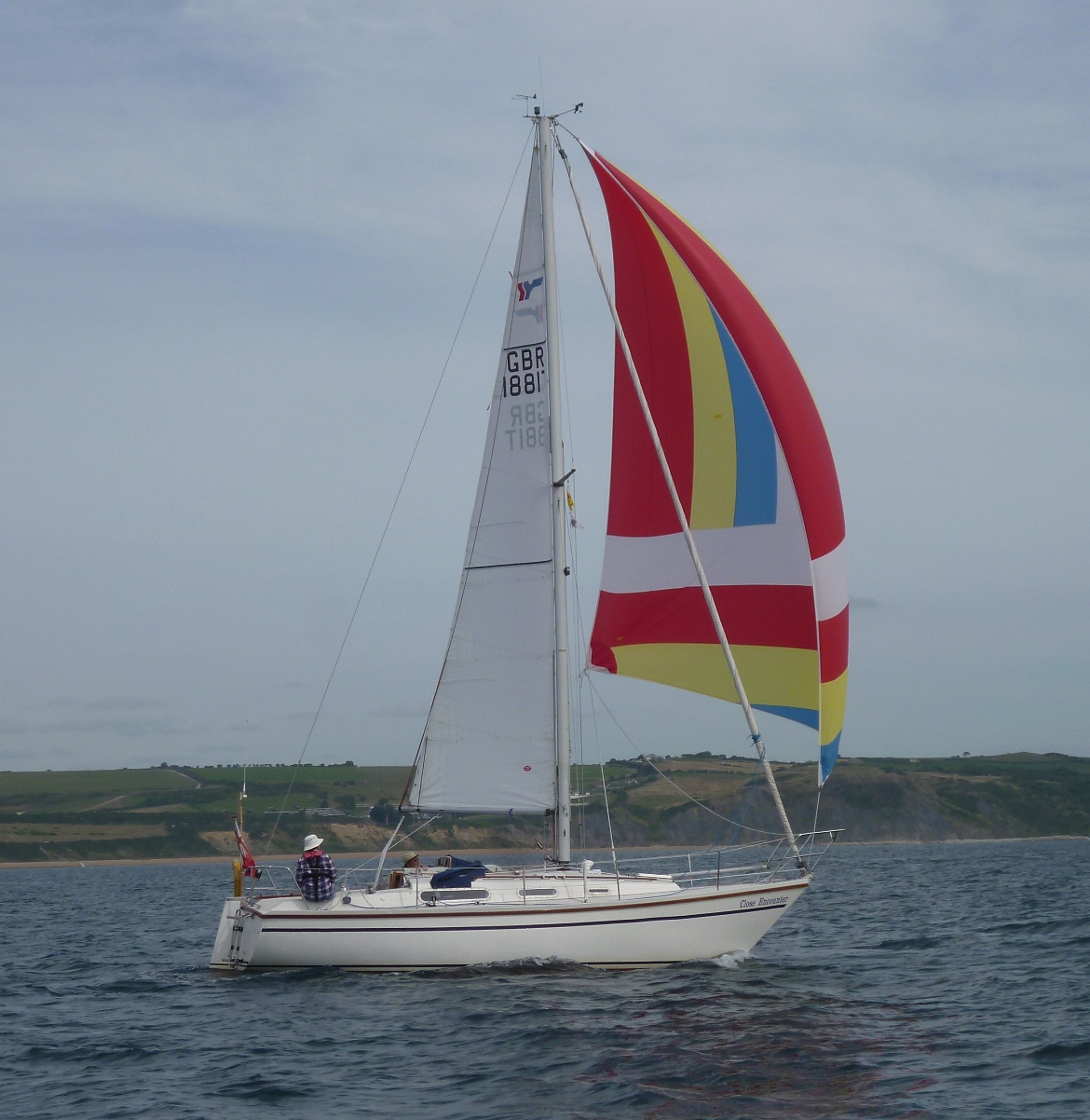
Kite%20Up.JPG
 
One option is to snuff the kite before gybing. This may sound silly, but if you are two up with a big kite, then putting it away for a minute or two every couple of hours, whiel you put a cross on the chart, make tea or whatever, is sometimes a good idea. It means you need only rig one sheet, which helps if the sheets are heavy and the wind is light.
Gybing the kite like a flag around the front may go pearshaped in light air, as the apparent wind mid gybe will be very low and the weight of the sheets will have them in the water.
But some people prefer it on some boats. Personally I prefer to rig it like a dinghy with the sheets inside the kite, if the kite is very close to the forestay, ease some halyard.

A masthead asy is a big temptation, for light air, if you already have the halyard and are sure the rig is good for it.
 
1) Do I need space forward of the halyard to gybe the sail?
No, but it helps. I made a bowsprit for my old Sabre and it made things easier.

2) Can I gybe from the cockpit or do I need a bow person?
Yes, from the cockpit no problem.

3) Would you run from the same level as the Jib or from the top of the mast?
Depends on the amount of wind you plan on using it in. Also, have you already got the kite or are you having one made?

4) For the foreseeable, I shall be short handed (me + an inexperienced crew) any forseable problems?
Not really, however a snuffer helps no end. I used to singlehand mine with no dramas.
 
1) Do I need space forward of the halyard to gybe the sail?
No.... But if you can fit a pole it makes everything better, downwind sailing and gybing

2) Can I gybe from the cockpit or do I need a bow person?
You can gybe from the cockpit easily, but I would setup for a outside gybe as this is easier and less prone to going wrong
Read: http://www.yachtingworld.com/featur...pip-hare-offers-tips-using-outside-gybe-71272

3) Would you run from the same level as the Jib or from the top of the mast?
If you can go masthead do so, it makes gybing and flying the sail better.

4) For the foreseeable, I shall be short handed (me + an inexperienced crew) any forseable problems?
Get a snuffer. Makes it easy to get the kite away shorthanded and rigging and hoisting is easier as much can be done and sorted with the kite up but snuffed.
Get a gybulator (a batten at tack of the spinnaker) fitted so that you can easily outside gybe without the lazy sheet falling in the water.
 
One option is to snuff the kite before gybing. This may sound silly, but if you are two up with a big kite, then putting it away for a minute or two every couple of hours, whiel you put a cross on the chart, make tea or whatever, is sometimes a good idea. It means you need only rig one sheet, which helps if the sheets are heavy and the wind is light.
Gybing the kite like a flag around the front may go pearshaped in light air, as the apparent wind mid gybe will be very low and the weight of the sheets will have them in the water.
But some people prefer it on some boats. Personally I prefer to rig it like a dinghy with the sheets inside the kite, if the kite is very close to the forestay, ease some halyard.

A masthead asy is a big temptation, for light air, if you already have the halyard and are sure the rig is good for it.

That's exactly what we do - go forward, snuff the kite, lead the single sheet round to the other side (which is easy as it goes straight back to a winch without blocks), gybe then unsnuff the kite. We tend to sail with just one of us on watch so all that is controllable and easy, but of course slower than if we had two or three people.
 
If short handed forget the snuffer. It can be dodgy standing on a rolling foredeck looking up trying to pull on a downhaul line that sod's law dictates is on the wrong side of the sail. If the crew goes overboard at that point you are in trouble. You can have a long tack line controlled from the cockpit & gather the sail from under the boom whilst still in the safety of the cockpit.

Re gybing. Keep the sheets inside the sail because you will find that the windward sheet will drop under the bow & become entangled around the keel.
 
That's exactly what we do - go forward, snuff the kite, lead the single sheet round to the other side (which is easy as it goes straight back to a winch without blocks), gybe then unsnuff the kite. We tend to sail with just one of us on watch so all that is controllable and easy, but of course slower than if we had two or three people.

I'm afraid I really really don't subscribe to this "Juan Sheet" idea (I'm sure he's the same guy from the "Plenty" advert). What happens if you need to gybe RIGHT NOW to avoid something, or if there's a huge shift and the boat gybes and now you've got the kite pinned against the rig? It seems like a solution looking for a problem, and to be honest laziness and questionable seamanship. Sorry to get on my soap-box on this, however I was once singlehanding my boat in the Solent with the kite up, on stbd, and on a converging course with another boat, with a number of crew on board, kite up, on port. Admittedly it was a calm day, I called stbd on them to be told that they only had one sheet rigged, and could not gybe easily, so could I? As I gybed away I'm afraid I sarcastically asked them if they bothered rigging both genoa sheets for upwind work or just expected the other boat to tack...
 
If short handed forget the snuffer. It can be dodgy standing on a rolling foredeck looking up trying to pull on a downhaul line that sod's law dictates is on the wrong side of the sail. If the crew goes overboard at that point you are in trouble. You can have a long tack line controlled from the cockpit & gather the sail from under the boom whilst still in the safety of the cockpit.

Re gybing. Keep the sheets inside the sail because you will find that the windward sheet will drop under the bow & become entangled around the keel.

Couldn't disagree more - the idea of gathering a wet sail under the boom and putting it into the cabin is horrible unless you are racing - sails stay on deck and cabins remain dry - I mean what if somebody is cooking or watching telly? But also the snuffer is perfect when you are alone on watch - pull it down controllably and quickly even in a gust and the sail is ready for use again in a few minutes or hours.
 
I am wondering about getting an Asymmetric for Paean and I am wondering how to rig it for easy handling.

Rig is 3/4 fractional. There is a spin halyard about 6 inches above the forestay. I also have a spare halyard at the top of the mast, forward facing.

The forestay connects to the bow roller under the pullpit. There is a spare hole slightly forward (about an inch) to which I could attach a block for the tack. I have a spare jammer to which this could run at the cockpit. I also have the ability to run sheet blocks near the stren.

Genoa is hanked on and I have a down-haul to make getting it down.

My questions are:

1) Do I need space forward of the halyard to gybe the sail?

2) Can I gybe from the cockpit or do I need a bow person?

3) Would you run from the same level as the Jib or from the top of the mast?

4) For the foreseeable, I shall be short handed (me + an inexperienced crew) any forseable problems?

I know it sounds contrary but my spinnakers on my old boats were much easier to manage than my asymmetric on my present one. Obviously pure spinnakers are only good for down wind but my asymmetric does not work well as a "super light genoa". No trouble in gybing a spinnaker, just move the spinnaker pole if used. Obviously if you can afford chute furling (I cant ) that changes everything as all much easier to put away and you could furl then gybe.

However if you do go with asymmetric then I prefer sheets between forestay and chute rather than trying to go round the front. If you go for chute furling thats the only way to run the sheets. However if you get extra long sheets for now you can try it in front to see if that's what you prefer

The further forward you mount the tack the better or it will tangle in the forestay, though that's less of an issue with hanked on genoa. And from top of mast - you are using it to catch light airs so maximise !
 
I'm afraid I really really don't subscribe to this "Juan Sheet" idea (I'm sure he's the same guy from the "Plenty" advert). What happens if you need to gybe RIGHT NOW to avoid something, or if there's a huge shift and the boat gybes and now you've got the kite pinned against the rig? It seems like a solution looking for a problem, and to be honest laziness and questionable seamanship. Sorry to get on my soap-box on this, however I was once singlehanding my boat in the Solent with the kite up, on stbd, and on a converging course with another boat, with a number of crew on board, kite up, on port. Admittedly it was a calm day, I called stbd on them to be told that they only had one sheet rigged, and could not gybe easily, so could I? As I gybed away I'm afraid I sarcastically asked them if they bothered rigging both genoa sheets for upwind work or just expected the other boat to tack...

I tend to keep shorthanded kite use for out of the Solent.
Whenever you have a kite up, you need to look ahead a bit more and plan to go around the things you need to give way to.
Sailing with a kite, you'd normally expect to be able to alter course over at least a 30 degree range without the kite collapsing or overpowering the boat. That should be enough to avoid what you need to avoid. If it's not, you are in a place too crowded for your kite skills. If your kite won't operate over that 30 degree range of course, maybe it's too windy and you'll make adequate progress with white sails?
Rigging a kite shorthanded can be a bit like poling out genoas. There is a time and a place. Crossing Lyme Bay with not another soul within 5 miles is different from Southampton Water on a Summer Saturday morning.
I race dinghies too. We expect to put the kite up for a few minutes and drop it within 50ft of the mark while interacting with ten other boats. Shorthanded cruiser sailing, you want a margin of a few minutes to prepare for any action. And a margin of space in case it goes a bit out of shape. A different world!
 
I'm afraid I really really don't subscribe to this "Juan Sheet" idea (I'm sure he's the same guy from the "Plenty" advert). What happens if you need to gybe RIGHT NOW to avoid something, or if there's a huge shift and the boat gybes and now you've got the kite pinned against the rig? It seems like a solution looking for a problem, and to be honest laziness and questionable seamanship. Sorry to get on my soap-box on this, however I was once singlehanding my boat in the Solent with the kite up, on stbd, and on a converging course with another boat, with a number of crew on board, kite up, on port. Admittedly it was a calm day, I called stbd on them to be told that they only had one sheet rigged, and could not gybe easily, so could I? As I gybed away I'm afraid I sarcastically asked them if they bothered rigging both genoa sheets for upwind work or just expected the other boat to tack...

That has certainly got me thinking but I can't envisage a gybe right now scenario and our option is always to simply snuff the sail - it's a fun sail for light winds and I've found it will still start snuffing when pinned backwards against the shrouds after a big wind shift but at that point we turn the boat around to free it and complete the manouvre. I can't see a gybe that will be quicker than the snuff.

We are never bothered about keeping up speed or momentum if things get tight - just stopping the asym use when it stops being easy and fun. We very rarely gybe at all - it's usually unsnuff it for a long broad reach then snuff it and often drop it when the course or wind changes and we don't think we'll use it again that day.

I wouldn't really like to handle a big sail by myself through a gybe but might give it a go as your post makes me wonder.
 
I certainly would not go charging past Cowes at rush hour screaming STARBOARD at everything but I see no reason why you can't fly a kite singlehanded in the Solent in lighter weather. I helm a 49er so I'm pretty used to big kites and the golden rule of keeping the boat under the rig! And in fairness, the kite on my Sabre really wasn't that big, and as I had my bowsprit setup, with an adjustable tack line back to the cockpit, I did have a bit of flexibility on the angles I could sail, adjusting the luff tension to suit. I could very easily gybe the boat with the tiller between my knees and a sheet in each hand, and the main was very handy too on the bridgedeck.

I am about to buy an asymm and snuffer for my new Bav32, although I'll certainly be a bit more nervous using the kite on that on my own. However the wheel pilot should make things a bit easier but I'll certainly be getting used to that one in more open water first. But I'll sure as hell rig both sheets!!!
 
A masthead asy is a big temptation, for light air, if you already have the halyard and are sure the rig is good for it.

I would strongly recommend you check with your mast manufacturer before using a masthead spinnaker with a fractional rig. They will almost certainly have recommendations for max halyard exit height for various sails (symmetric, assy & code zero). I know that Selden do for my mast and non of them are anywhere near mast head.
 
I certainly would not go charging past Cowes at rush hour screaming STARBOARD at everything but I see no reason why you can't fly a kite singlehanded in the Solent in lighter weather. I helm a 49er so I'm pretty used to big kites and the golden rule of keeping the boat under the rig! .......!
No reason at not to fly a kite in the Solent, within the limits of other traffic, wind conditions, the way you rig your kite, the crew you may or may not have, and one's experience and ability.
The Solent can be empty on a Tuesday morning, or it can suddenly fill up with racing boats on a Sunday.
It's all about knowing you have enough sea room to deal with any plausible mishap, like tangled sheets, windshifts etc.
People who are starting out with kites should find themselves plenty of sea room.
People who want to use kites when there is not much room (e.g. RTIR) should get their skills to a suitable level first.

A single sheet is only for when you have plenty of space. Which is when many of us would be considering a kite while shorthanded. It works for us in light air, we have one lightweight tapered spectra sheet (with plastic Spinlock snap shackle) for light air and two hefty ones normally.
I've been on 40ft boats with normal kites, in drifters it is not unusual to unclip the heavy sheet and lazy guy and use a light sheet. A few hurried moments to swap back when the wind fills in or to gybe....
 
I would strongly recommend you check with your mast manufacturer before using a masthead spinnaker with a fractional rig. They will almost certainly have recommendations for max halyard exit height for various sails (symmetric, assy & code zero). I know that Selden do for my mast and non of them are anywhere near mast head.

Ah that's a bugger, its an old aeroplane spar extrusion from 1961 and the designer passed away last year. I may err on the side of caution, which is a shame as there is a good sized Asym on ebay atm, but its for a mast head 24 footer and would have fitted nicely.
 
No reason at not to fly a kite in the Solent, within the limits of other traffic, wind conditions, the way you rig your kite, the crew you may or may not have, and one's experience and ability.
The Solent can be empty on a Tuesday morning, or it can suddenly fill up with racing boats on a Sunday.
It's all about knowing you have enough sea room to deal with any plausible mishap, like tangled sheets, windshifts etc.
People who are starting out with kites should find themselves plenty of sea room.
People who want to use kites when there is not much room (e.g. RTIR) should get their skills to a suitable level first.

A single sheet is only for when you have plenty of space. Which is when many of us would be considering a kite while shorthanded. It works for us in light air, we have one lightweight tapered spectra sheet (with plastic Spinlock snap shackle) for light air and two hefty ones normally.
I've been on 40ft boats with normal kites, in drifters it is not unusual to unclip the heavy sheet and lazy guy and use a light sheet. A few hurried moments to swap back when the wind fills in or to gybe....

Ooooo that's a good point...if it get's really light I'll tend to start the donkey...but I might now have a use for a set of old Fireball kite sheets that aren't any good on a Fireball any more but may well do as light wind sheets on a yacht...thanks for that!
 
Couldn't disagree more - the idea of gathering a wet sail under the boom and putting it into the cabin is horrible unless you are racing - sails stay on deck and cabins remain dry - I mean what if somebody is cooking or watching telly? But also the snuffer is perfect when you are alone on watch - pull it down controllably and quickly even in a gust and the sail is ready for use again in a few minutes or hours.

The only reason the sail would be wet is if was raining in which case a snuffer will stick. Who wants to go on the fordeck on their own to snuff the sail. Standing there trying to catch the down haul that will be on the wrong side of the sail. Trying to get it started as it is all wedged up at the top. trying to get it past a flapping sail out to leeward,
total joke
Just ease the halyard & feed it in under the boom. The bag can be hooked in the hatch if you want. Some have the bag by the shroud.
You still have to get the snuffed sail down & control the halyard whilst you do it which takes as long as dropping the sail anyway.
 
I know it sounds contrary but my spinnakers on my old boats were much easier to manage than my asymmetric on my present one. Obviously pure spinnakers are only good for down wind but my asymmetric does not work well as a "super light genoa". !

Plus one for the spinnaker but you can still reach with them. Depends how it is cut. . The trouble with asyms is that you cannot successfully run dead down wind as easily unless there is a lot of roach in the leach so if it is a big sail it soon over powers the boat.A big roach is also harder to keep set so not so good on a pure cruising sail. A spinnaker can be carried dead down wind so can be carried on that point in higher wind.
 
Last edited:
Top