Astro - navigation

Sybarite

Well-Known Member
Joined
7 Dec 2002
Messages
27,780
Location
France
Visit site
The US Naval Academy and the US Coast guard have reintroduced this on their training programmes after a 20 year absence, citing the risk to GPS of cyber attacks.

A message for yachtsmen?
 
Interesting, they have ICBMs with INS and automatic astro navigation but below clouds they want to practice with sextants. Do they allow their officers calculators for calculating a fix or is it back to pencil and paper for post EMP, when nothing electrical works any more?
Watch this space for the reintroduction of sails and capstans.
 
We carried a sextant when long distance sailing for fun taking occasional sites to see how accurate they were. If anybody here ever uses one it's much easier to find the sun and bring the horizon up to it which means turning the sextant upsidedown, make sure the shades are in the right place. We did carry tables but it's much easier to use Astrocalc software.
 
We carried a sextant when long distance sailing for fun taking occasional sites to see how accurate they were. If anybody here ever uses one it's much easier to find the sun and bring the horizon up to it which means turning the sextant upsidedown, make sure the shades are in the right place. We did carry tables but it's much easier to use Astrocalc software.

And I bet like us you used the GPS read out time as the 'standard' to input! I actually had a Casio programmable calcultor programmed with the program published over a few months issues many years ago in PBO. I added moon and star sight progs too ans several of my own little programs foraveraging tide rares/set, fuel consumption etc. That was in the days back when PBO had better articles than ' how to load a grease gun with grease'.:disgust:
 
Oh ! You all sound experts at this astro stuff.

So please be gentle with an old grandad who still has ambitions !

I would love to learn how to use a sextant - but my maths is some where near nil.

I did manage to cope with those sections of the RYA Yachmaster written (alright, I was one of 5 who had to go back for remedial coaching to get through those bits).

There used to be some chap who did courses in the winter on a ferry down to, I think, Santander, where you stood on the top deck and took sightings.

Suggestions please for the likes of me.
 
Yes a suggestion. There is a lovely little book by an author called Mary Blewitt re Celestial Navigation for yachtsmen. It's simply written and once you lay out a proforma a sheet with a place to put the variables of each sun/star sight, very easy to use.
You will be surprised at how accurate you can become on a small boat after some practice.
 
I would love to learn how to use a sextant - but my maths is some where near nil.

Believe me, if I could do it, you could do it.

I learned to use a sextant taking sun sights on a washing up bowl filled with water topped with vegetable oil in a back garden in Reigate. And I used astro quite successfully at sea for quite a few years. Never used electronic aids, but if you can add and subtract and read tables you can work out a sight, using the intercept method (otherwise known as the Marc St. Hilaire method) I imagine computers have automated all that stuff.

There are really four separate skills - correcting and caring for a sextant, identifying the relevant "heavenly bodies" (the sun and moon are fairly recognisable, but I don't recommend moon sights), using a sextant to take sights and and converting them to position lines on the chart.

I used to use the Nautical Almananc and Sight Reduction Tables for Air Navigation for working out sights. The best textbook I ever found (and I know Mary Blewitt's book well) was the Admiralty Manual of Navigation Volume 2. There was also an excellent slim volume called "The Sextant Simplified" by Captain O.M. Watts that gave very clear guidance on the care and correction of the sextant. Both probably long out of print......

The old sextant saved our bacon a few times in the days before GPS. I remember one occasion when we were hove to in a NW gale way out in the western approaches. No idea where we were until the clouds parted just before dawn and allowed us a glimpse of Venus. Got under way, crossed it with a sun sight a few hours later and got ourselves a good enough fix to steer for for a safe haven............. Those were the days!
 
Yes a suggestion. There is a lovely little book by an author called Mary Blewitt re Celestial Navigation for yachtsmen. It's simply written and once you lay out a proforma a sheet with a place to put the variables of each sun/star sight, very easy to use.
You will be surprised at how accurate you can become on a small boat after some practice.

+1 for Mary Blewitt. The real Eureka moment for me was creating my personal proforma sheet in my own words with added explanatory notations. I Only ever owned a plastic Ebbco sextant but got good results regardless whenever I tried and it also proved useful for vertical angles/distance off calcs for coastal work, especially for making certain of passing a headland, like Portland Bill at least 'n' miles off. I Sold my sextant to a fellow fellow forumite before we moved to the USA in 2012, hopefully he has made good use of it, I forget who(Duncan Mac)?
 
I still have my Ebbco and have so far resisted attempts by other parties to consign it to a dump. I once managd to get a position line within x miles but only really used it on lighthouses and the like. I used to work things out with the haversine tables in Reed's, but that would have been pretty frustrating if I had wanted to do it in earnest.

My favourite explanation, with the best diagrams, was in Eric Hiscock's's "Voyaging under Sail". I read it before I started to cruise but it wasn't a lot of help when going down the Blackwater.
 
Its not a skill that most Yachtsmen or Yachtswomen need.

I find it fascinating and enjoy the whole deal.

Been lucky enough to have been out and about enough to do the Ocean thing, and so has my Yachtmaster Ocean wife!

We get lots of interest in the Theory bit and I've got 2 courses to teach in the next few weeks. As its Ferburary and March when the weather is pants, Im gonna be inboard talking declination and hour angle whilst others are out there getting PWT (pi$$ed wet through) and trying very hard not to scratch gelcoat....

Disregard Ebco, for yer first one try Davies. Brill for sun, moon and Venus and mebbe Sirius. Good enough for nearly all sights.

If you want to get adept with the stars and not spend biggo, try Celestaire. My favourite. When the tables say you can get 6 stars and real world says get three, that one is top for dollar.

May the force be with you!!

:encouragement:
 
When starting learning I was frustrated that there didn't seem to be a few lines describing how it worked before getting all bogged down with geometry & maths. So here goes for anyone knowing nothing about the process.. Feel free to rip to shreds..

Imagine you are in a sports stadium with just one floodlight working. To find out where you are pretend that you know, pick a spot , luckily you have book which tells you the angle from the edge of the pitch to the light from spotlight every few feet on the pitch. You measure the actual angle from where you really are and the difference between the real angle and the angle where you pretended to be with tell you how far and what direction you are from the pretend position, you are somewhere on a line which is a radius around the spotlight.
In the real world it's similar, except now you need 3 more pieces of info, the difference in longitude between your pretend place & a place directly under the sun (or star) , your pretend latitude & the latitude directly under the sun. With these you can get what the angle & direction the sun will be from your pretend position out of a book then work out how far away you are from there using the real angle of the sun.

That's it. Plus you need to know what time it is and another book to find out where the sun actually is.

Easy :)
 
Oh yeah, Mary Blewitt, um, great in her day, but, cmon, more fun drinking sheep dip.

Go modern, Tom Cunliffe is very good, Tim Bartlett better by a smidge. My bibles.
 
When starting learning I was frustrated that there didn't seem to be a few lines describing how it worked before getting all bogged down with geometry & maths. So here goes for anyone knowing nothing about the process.. Feel free to rip to shreds..

Imagine you are in a sports stadium with just one floodlight working. To find out where you are pretend that you know, pick a spot , luckily you have book which tells you the angle from the edge of the pitch to the light from spotlight every few feet on the pitch. You measure the actual angle from where you really are and the difference between the real angle and the angle where you pretended to be with tell you how far and what direction you are from the pretend position, you are somewhere on a line which is a radius around the spotlight.
In the real world it's similar, except now you need 3 more pieces of info, the difference in longitude between your pretend place & a place directly under the sun (or star) , your pretend latitude & the latitude directly under the sun. With these you can get what the angle & direction the sun will be from your pretend position out of a book then work out how far away you are from there using the real angle of the sun.

That's it. Plus you need to know what time it is and another book to find out where the sun actually is.

Easy :)

The floodlight moves too......in a measured way!

;):encouragement:
 
+1 for Mary Blewitt. The real Eureka moment for me was creating my personal proforma sheet in my own words with added explanatory notations. I Only ever owned a plastic Ebbco sextant but got good results regardless whenever I tried and it also proved useful for vertical angles/distance off calcs for coastal work, especially for making certain of passing a headland, like Portland Bill at least 'n' miles off. I Sold my sextant to a fellow fellow forumite before we moved to the USA in 2012, hopefully he has made good use of it, I forget who(Duncan Mac)?

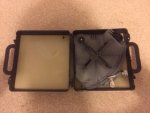
If your Ebbco had a slightly dodgy hinge on one side, then you may appreciate this nostalgic picture

IMG_1677.jpg
 
I'm going to pretend that one day I'll get my head properly around the theory, and pretend also that one day I'll take some proper sights at sea and crunch the numbers properly too!

Not knocking my fascination with astro but, for now its a case of needs must - and don't need to really.
 
Yes a suggestion. There is a lovely little book by an author called Mary Blewitt re Celestial Navigation for yachtsmen. It's simply written and once you lay out a proforma a sheet with a place to put the variables of each sun/star sight, very easy to use.
You will be surprised at how accurate you can become on a small boat after some practice.
If that is the red one I have? It is total gobbledygook to me and I have an "O" level in navigation!

There are far better books and YouTube is brilliant. I like https://www.youtube.com/watch?v=jUrZLv-sxxY
 
Top