Arthur Mitchell Ransome

All this, I think, is a direct result of my mother getting those books from the Library 40 years ago.
So I for one will be eternally grateful to Arthur as I firmly believe there is no better occupation for a family than "messin about in boats".
Well said. I wonder how many people Mr Winter's writing will be inspiring to take up sailing in seventy five years' time.
 
For example, Peter Duck gets a mention as a fictional character in Swallowdale before he actually appears in the eponymous story. I suspect that the deep-sea stories, apart from We didn't mean.., are to be taken as just extensions of the "natives", "Darien", "Kanchenjunga" make-believe.

My theory is that Peter Duck was written as a "real" story, but Ransome backtracked, realising that after those adventures anything else in the lakes would be a bit tame. So he released it after Swallowdale, and referred to "the story written in the cabin of the old wherry" to establish it as fiction-squared. Missee Lee is definitely intended to be a story within the stories.
 
think We Didn't Mean to Go to Sea is a smashing book - super narrative and an a-z of seamanship and seaman like attitudes - and a great sense of group jeopoardy - and great to draw out the kids relative strengths - terrific book

The really great thing about it is the natural way in which all the things they need to know (red woolworths plate, signal for a pilot and so on) are introduced in the initial "river cruise" part, ready for use in earnest during the crossing.
 
I just love the way Ubergeekian is just so damned ' positive' about everything. Bravo Sir, champion of the forums.


5.....4.......3.......2........
 
My son's teacher used to reckon that kids either liked AR or Just William - never both.

He was wrong, then, as I offer myself as a counterexample.
(But then I liked Biggles, Dr Dolittle, The Saint, Children of the New Forest, Coral Island, Kidnapped! etc. etc.)
 
Hi
I read the books as a child 40 odd years ago, and even then they were dated but surely thats part of the charm, to understand how people lived. They were, and still are, wonderful books that sowed the seeds for me of boating (ok it took about 30 years for them to germinate, but I am very grateful that they did). Since then my children have read them and we have even been and explored the lakes and found wildcat island together. There is no island on that lake but with as little imagination we found a suitable spot. And now my kids have sailed all over the country and europe in dinghy competitions and have made wonderful lifelong friends and had great experiences and become responsible adventurers, they are now (15,17 and 18) and dinghy instructors enjoying teaching other kids or we are out having our own adventures in our "new" Konsort, they will be doing Day skipper in the new year.
All this, I think, is a direct result of my mother getting those books from the Library 40 years ago.
So I for one will be eternally grateful to Arthur as I firmly believe there is no better occupation for a family than "messin about in boats".
Cheers
Nick
What the AR books had was the ability to stimulate a child's imagination within the bounds of what they could and did do. To some extent the Malcolm Saville books did the same for horse riding. Those dreams have led to many of us taking up life time hobbies, such as camping or sailing, in places such as the Lakes, the Broads or the Suffolk Rivers. "The Uses of Imagination" (Prof. William Walsh circe 1958) drew particular attention to the importance of imagination in the learning of a child.
I, personally, consider that the AR books were very well written for children. The vocabulary is within their range, the description largely factual, rather than romantic and the contrast in the characters lively. I do agree, however, that there is no progression in their personalities.
However one major factor Dylan has missed is that very few "working class" parents before 1939 would have been able to buy AR hard back books. He wrote for those who could buy and , in all probability, read. The "working class" were catered for by comics and that would have been a luxury.
 
However one major factor Dylan has missed is that very few "working class" parents before 1939 would have been able to buy AR hard back books. He wrote for those who could buy and , in all probability, read. The "working class" were catered for by comics and that would have been a luxury.

You forget the Public Libraries - a very important resource for we who were impecunious, Stockport Public Library certainly was. For pre-'39 you might as well read pre-'45
 
I do think it would have been quite hard to write about leisure sailing in the 30s without it having some middle class flavour. I have just read a account of a pre war dinghy trip across Christchurch Bay by a recently deceased member of my club, written when he was a callow youth A good and interesting read, but you can detect they were reasonably well off, compared with many at the time, Whilst Dylan is of course fully entitled to his opinion I think the reason many jump to AR s defence is the inspiration so many of us gained from the books. Possibly the younger you are the more dated the books appear, I read them in the 60s and they still seemed to have a base in reality then.
 
However one major factor Dylan has missed is that very few "working class" parents before 1939 would have been able to buy AR hard back books. He wrote for those who could buy and , in all probability, read. The "working class" were catered for by comics and that would have been a luxury.

You forget the Public Libraries - a very important resource for we who were impecunious, Stockport Public Library certainly was. For pre-'39 you might as well read pre-'45
Very true if you had a public library near you; and with a good children's section. Not so good if you lived in a council estate on the outskirts of town , in a mining village, an isolated farm cottage or rural villages which depended, and still do, on the mobile library. The fact that, in my experience, the Ransome books were always "out", illustrated their popularity.
 
I disagree

However one major factor Dylan has missed is that very few "working class" parents before 1939 would have been able to buy AR hard back books. He wrote for those who could buy and , in all probability, read. The "working class" were catered for by comics and that would have been a luxury.

Based on my own experience I totally disagree with this statement. The birthdates of my sisters and I span the period 1929 to 1945 and our credentials are impeccably working class. From our own earliest memories there was always a bookcase and books in our parent's home and we don't recall this as being unusual. In our working class town of St Helens I don't remember any child who failed to learn to read.

The first Ransome book I saw was an early edition of "Secret Water" which my elder sister had won as a Sunday school prize. I read it as soon as I was able and subsequently asked for and received one of the series each birthday and Christmas until I had the lot. These weren't outrageously expensive presents by the standard of the times. I vaguely remember that the Christmas I finished the series with "Great Northern" one of my friends got a bicycle. As has been noted, public libraries were used more in those days but I never borrowed a Ransome book: there was no point in borrowing the ones I already had and I didn't want to spoil the anticipation by previewing one I was yet to be given.

If we define child poverty as the keeping from children of things that could benefit them and enhance their lives, then there may possibly be more of it now than then - but I'm now drifting way outside my field of knowledge and way off topic too!
 
Why are some of you so obsessed with the old class-divisions?

There are only two classes of people left these days - those that are obsessed with class, and those who don't give a damm. The people who're obsessed with class don't realise how self-limiting their attitudes are. This transcends all the old class-divisions, but tends to manifest itself at or near the extremes. I've known people eaten up with envy and hatred, and I've known people who've made themseves stupid by their arrogance. Its all quite pointless.

Anyway, I enjoyed watching Dylan's 'Keep Turning Left' videos and I also enjoyed watching DVD releases of the old AR films with my son - despite the fact they both have their faults as documentary and as fiction respectively. So far as AR's main characters are concerned, they appear to be reasonably affluent middle-class-professional types of the era, added to which are the less-than-middle-class 'lads' versus the braying upper-middle-class Hullabaloos in Coot Club, etc. AR is of his time, and its asinine to bring class-war into it.

One thing I've noticed out sailing (even in the Solent!) is that the vast majority of people are from ordinary backgrounds, and are out on a wide variety of boats, some expensive but most older and and pretty modest - all doing it for the love of sailing. When I take non-sailors out for a weekend cruise, their preconceptions about ' expensive yachts' are confounded and they tend to be astonished at how classless it really all is!
 
What the AR books had was the ability to stimulate a child's imagination within the bounds of what they could and did do. To some extent the Malcolm Saville books did the same for horse riding. Those dreams have led to many of us taking up life time hobbies, such as camping or sailing, in places such as the Lakes, the Broads or the Suffolk Rivers. "The Uses of Imagination" (Prof. William Walsh circe 1958) drew particular attention to the importance of imagination in the learning of a child.

Interesting.

I still like books with maps in the covers.
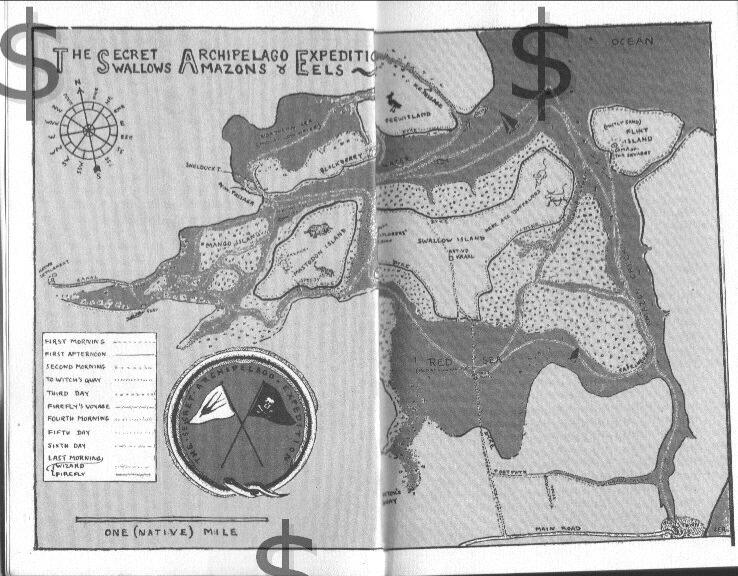
(Tillman in one hand and laptop with Google Earth is interesting)

I was rather proud this year when the 4yo cabin boy "drew" a "chart" of the IOW (Ryde, Bembridge, forts, Steam Railway, etc) and *then* added the airstrip "So that $FRIENDS_WITH_MICROLIGHT can use it too!"

Mind you, it's strictly 'not for navigation' ;-)
 
I still like books with maps in the covers.
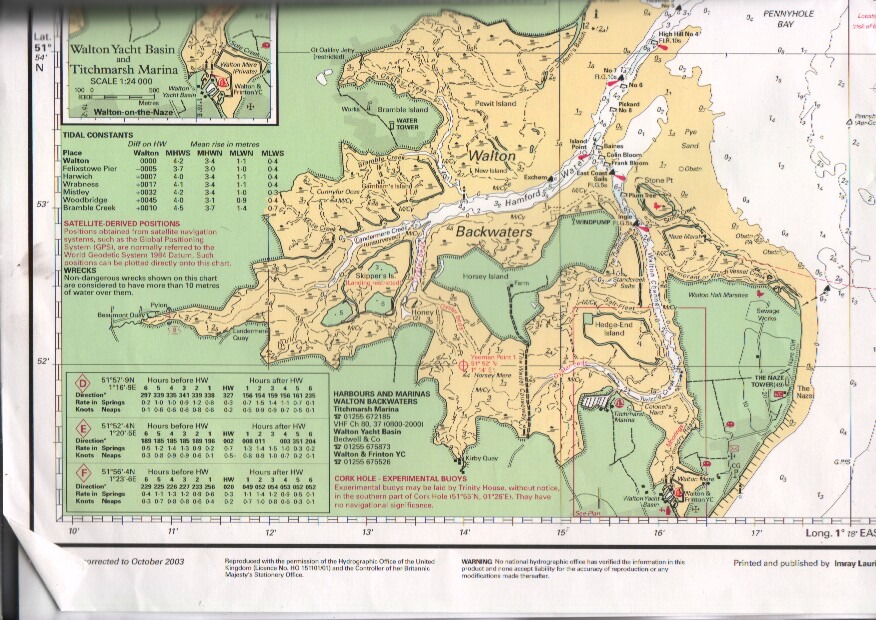
So much so that I did my Coastal exam at Tichmarsh

Compare:

secretwater.jpg


With:

imray-chart.jpg
 
Top
