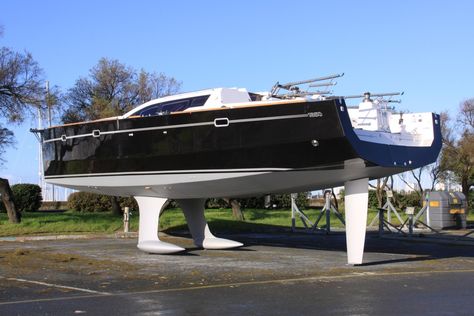
Are twin rudders as vulnerable as they look?

It means they are more likley to encounter rudder damage........

That kind of assumes you know the percentages of rudder damage caused by different factors:
- impact with floating debris (twin rudders may be worse)
- results of rudder groundings (twin rudders may be better)
- structural failure of rudder stock and/or blade (potentially twin rudders may be better)
Easy to over simplify and generalise that one type is “good”and one type is “bad” (generally related to ones previous experience and preferences).
 
I've sailed a twin for more than 10 years and never had a problem with damage or picking up lines, nets etc. I accept that my sailing is coastal Atlantic Portugal and Spain and not long distance cruising but there are more lobster pots where I sail than out there in the ocean I'm sure. And yes I do sail at night.

Greeny - that also is the sort of empirical evidence I was looking for, and to my mind at least, begins to put the question of rudder exposure into the 'acceptable risk' category. A lifetime of coastal sailing has seen me move from boats with the rudder hung behind a full keel, to a substantial (full) skeg to a half-skeg with balanced rudder. Each of those moves was associated with a degree of trepidation at the time, which - so far - has proven unfounded. I quite like the notion that with twin rudders the loadings on each are considerably less than for a single rudder. Provided the stock remains substantial, that suggests a potentially robust installation.

My biggest fear of collision is probably that of hitting a container, in which case the rudder argument is only one consideration. Questions of scantlings, hull construction and the provision of watertight bulkhead(s) are probably just as relevant as the type of rudder.

Thank you all who have contributed your thoughts on this question. It's been most helpful.
 
My biggest fear of collision is probably that of hitting a container, in which case the rudder argument is only one consideration. .
That's possible quite a way down the list of possibilities crossing oceans. Hitting whales probably further up. Way up closer to the top is running over a mess of fishing nets c/w floats still attached and a big tangle of polyprop ropes. All sorts of stuff floating out there.

Might make a bit of sense look at what the really experienced bluewater guys with a few hundred thousand offshore miles under their keel have to say >

https://www.google.com/search?q=best+rudder+for+bluewater+boat
 
The rudder and boat parted company about 600 miles east of Antigua several years ago. Fortunately it was transom-hung and we were able to retrieve it thanks to the control wires which remained intact.

I was at the helm and we were proceeding at about 17 knots in a westerly direction when a squall came through; nothing horrendous but the wind was suddenly about F7 instead of the F4-5 previously. We accelerated to 25 knots and there was significant weather helm but everything seemed OK until the stainless steel gudgeons on the rudder sheared. We dropped the sails, deployed the sea anchor and then had lunch. We subsequently used a spinaker pole and floorboard to create a jury-rig rudder but we could only do up to 4 knots and retain directional stablity; more than that and the boat would only close-reach, which wasn't much use as the wind was easterly and we were sailing west to Antigua.

Having retrieved the rudder, we took it down below and cobbled together some extremely Heath-Robinson gudgeons using the brass main hatch slide rails and a Spanish windlass. After shipping this creation back on the stern, we were able to proceed at 10 knots to our destination.

We didn't hit any submerged objects:- in our case it was purely metal fatigue that caused the failure.
 
This is great imho, and brings home just how much of a compromise bluewater boats are. Considering just what rudder you think is best in isolation might not be the best way to be thinking, it's all interconnected. Since 90% of time will be on the hook and even when sailing getting in and out of tight spaces will occurrence, spinning on a sixpence isn't needed or being fastest round the cans doesn't matter. Another day or 2 on passage is nothing.

 
+1 GHA - all boats are a compromise regardless of the type of sailing you do.
And for me the ability to dry out (in tidal latitudes), to effect hull, rudder, anode, seacock and prop maintenance, would be one of the criteria to take in account when making that risk based decision.
 
It is Ok suggesting that if a rudder was damaged a helmsman could use the other rudder, but if the damaged rudder was fixed in an angled position then I cannot imagine the working one having much effect.
The damaged one could be bent at 20-30 degrees to the vertical & 25 degrees to the horizontal with the top edge pinned to the hull. It would be a massive drag & cause too much side force for the other to steer against.
It would mean that the crew would have to drop it out of the boat. But, if it went so far &, say, the last 6 inches of shaft stuck. The leverage against the hull could be devastating; if a wave forced the rudder sideways, like a long arm lever. Most foam filled spade rudders float, so it might not want to just drop free, but want to float up as the crew pushed the shaft downwards.

If it part split,( very possible in an impact) it could open up like a drogue, causing a one sided brake.

It is a bit like the " carry a spare rudder" argument. A damaged rudder could render any attempt to steer with a reserve rudder useless, if the damaged blade cannot be ejected.

I was so worried about things breaking that I towed a spare boat all the way.
 
I am not arguing against twin rudders. If i was younger & looking for a new larger boat I would not baulk at twin rudders or twin wheels. .

Hey, that's a great idea. Why not have twin rudders and twin wheels, each being independently driven (his and hers), and then you have real redundancy in the system. The only trouble I can see is getting both people to steer in the same direction at the same time.
 
I know I'm treating this as a bit of a joke, but come on guys, get real.

There is nothing wrong with twin rudders. If they were majorly floored, the big manufacturers would not use them as their reputation would suffer when things started breaking or falling off.
 
We have a monohull yacht with twin rudders and two wheels - new in Feb 16.

Since then we’ve sailed from the U.K. to Greece over the last three summers.

The rudders picked up some odd bits of fishing gear a couple of times but that doesn’t seem too unusual in about 4000 - 4500 miles. We just wrestled them off with brute strength and a sharp knife.

I believe that our boat (Beneteau Oceanis 38) does have a lifting keel option which alllows the boat to dry out on the keel stub and the two rudders. Though our boat is the fixed keel version I think that all versions have the same rudders since the (shortish) rudders do have shoes. I think that the rudder stocks must be strong if they take a part of the weight when drying out.

I just thought that I’d mention this to illustrate that twin rudder yachts can vary from one model to another. I imagine that my rudders are built a bit stronger with the drying out requirement, whereas the racier boat rudders are built for speed.

As for manoeuvering, one just gets used to it. Reversing is a good strategy in Med marinas and twin rudders work well in reverse.

Garold.
 
I really don't think it does. Every other rudder configuration sits behind a keel of some sort. Twin rudders do not. Back to the river full of logs, which rudder type is vulnerable? It only takes one log to do the damage. Hitting a log at sea with any boat can be a big problem. Twin rudders is just more likely
 
See that a lot of the new Oysters and Amels have gone twin rudder.. Does that mean they can't be classed as blue water cruisers any more?

Also remember that a twin rudder will typically have less draft than a single one. Comes in handy when backing in med style where it gets shallow close the dock and also reduces the chance of colliding with something under way.

Quite right. If you're intending to moor stern to then you'd be mad to choose a single rudder over twin rudders. Simple.

Richard
 
I really don't think it does. Every other rudder configuration sits behind a keel of some sort. Twin rudders do not. Back to the river full of logs, which rudder type is vulnerable? It only takes one log to do the damage. Hitting a log at sea with any boat can be a big problem. Twin rudders is just more likely

where is this river full of logs that boats have to navigate to prove to you that they are seaworthy?
 
I really don't think it does. Every other rudder configuration sits behind a keel of some sort.

ashore-qtr.jpg


b56cfb7431f2e1081977fd70847c3640--yachts.jpg
 
I've clearly got too much time on my hands and have been thinking about what I might choose as my ideal long-term cruising yacht. I'm tempted by some more modern designs, but have no experience of using a twin-rudder boat. Specifically what sort of practical problems this configuration poses.

I'm familiar with many of the hydrodynamic arguments in favour or twin rudders and limitations when manoeuvring, but what about the sheer liability of having two short spades stuck out in clear water without anything ahead of them? I appreciate that the likelihood of damage is a function of how strong the construction is, but for those of you who sail with twin rudders, just how common are impacts with hard debris, or just how much fouling (weed/rope/plastic) do you tend to pick up? I presume it's worse with twin rudders, or is that perhaps a misconception also?

I'd be interested to learn whether those with twin rudders consider them a good choice for offshore sailing or not...

... Ta.

The Belgian guy who designed/built the Boreal range installed a single rudder (but with dagger boards to augment directional stability) specifically because he had bad experience with twin rudders on his previous boat, self-built steel Chatham design. The constant snagging of kelp in Patagonia was annoying, but then his boat apparently nearly sank when he grounded one of the rudders causing it to bend up and pierce the hull. He only saved his boat by transferring all the movable stores to the opposite corner to lift the breach out of the water until he could effect a repair.

I like the solution adopted on the Boreals and I'm surprised that some of the newer aluminium centreboard designs have not copied it. For example the recent Garcia, Allures and Alubat designs now all have twin rudders. On the Boreal, the single rudder has to be short so that the boat can be beached, so when the boat hardens up you just drop the lee daggerboard and apparently it instantly goes back on the rails. The daggerboards are "fused" so that they break off if you hit something.
 
The Belgian guy who designed/built the Boreal range installed a single rudder (but with dagger boards to augment directional stability) specifically because he had bad experience with twin rudders on his previous boat, self-built steel Chatham design. The constant snagging of kelp in Patagonia was annoying, but then his boat apparently nearly sank when he grounded one of the rudders causing it to bend up and pierce the hull. He only saved his boat by transferring all the movable stores to the opposite corner to lift the breach out of the water until he could effect a repair.

Steel boat, grounded, nearly sank? Shurely shome mistake?
 
Top