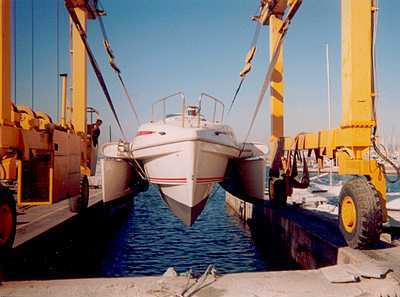
Are trimarans safe?

  • Thread starter Thread starter lyc
  • Start date Start date
[ QUOTE ]
Quick answer is there are very few true cruising tris because their only advantage over a cat is speed which is very low down the order of requirements for true cruising. Cats have more structural strength, loads more room on board and don't evacuate your bowels in a gale. The dragonfly is fun as an offshore day sailor but the novelty soon wears off as they are not actually very fast anyway as they have a very fat hull.

[/ QUOTE ]

Dont know about the dragonfly but I have done a genuine (ie not just a flash reading surfing down a wave) 16 kn in a Farrier 10m. The only point of sail on which it was not faster was dead downwind - and yes I know you dont normally do that in a fast multi....
I was impressed by the boats easy handling.
 
Some comments on your post...

[ QUOTE ]
as they have a very fat hull

[/ QUOTE ]

Well here're some Dragonfly hulls...

i22.jpg


Only the antifouled bit ever goes in the water, because they don't heel significantly. The width of the main hull is all above the Shuttleworth shelf, a standard tri main hull feature. If that's very fat, what do you call thin?

[ QUOTE ]
they are not actually very fast anyway

[/ QUOTE ]

Have you sailed one in a breeze? I've been 18.3 knots in one. I have also averaged 14.4 knots over 38 miles in a 920. What's your definition of fast? That seems quite rapid to me for a 30 foot main hull length.

[ QUOTE ]
The dragonfly is fun as an offshore day sailor

[/ QUOTE ]

Well another poster to this thread and I went on a 650 mile round trip in all the grotty weather we had in August, starting from Wales. So to add some fun, where did we get to...

wheresthis.jpg


...and this is the poster on this thread that also made the trip. Who's this ugly mutt examining the mustard...
DSC00908.jpg


There are plenty of criticisms of Dragonflies that are true - expensive, limited space, capsizable. They are not for everyone. However, I don't quite agree on your views on Dragonflies. Methinks maybe you have never sailed one.
 
I have sailed both. There isn't a lot between the DFs and the Farriers, apart from their folding mechanism.

Farriers have a slight edge on performance for a given size, DFs are much better fitted out inside.
 
On the positive side, there's virtually no slamming because of the narrow beam of the hulls. There's very little heel either, cups stay where you put them, and heel acceleration is slow because of the beam - you never get thrown from one side of the cockpit to the other.

On the down side, pitching and heaving motion is more rapid, and can feel somewhat strange at first compared to a mono. If there's not enough heel to get the windward float right out of the water, there can be an annoying slap as the top of every wave hits the bottom of that hull, which reverberates right through the boat. The aft leeward beam catching the top of a wave can flick spray forwards into the cockpit, which can come as a bit of a surprise.

There's a video here of sailing hard on the wind in about a F5 which may give you an idea...

Cooking in the Irish Sea
 
Safer than Cats 'cause the righting moment increases with heel untill!!!
Wheras the cat's RM decreases straight away...I think ?!! However didn't they all pitchpole??
Cheers Bob E..
 
[ QUOTE ]
Safer than Cats 'cause the righting moment increases with heel untill!!!
Wheras the cat's RM decreases straight away...I think ?!!

[/ QUOTE ]

Not in any form of physics I've ever come across!

And incidentally, while the righting moment decreases when the weather hull lifts, so does the wind pressure on the rig which is why it's possible to sail with a hull flying without immediately flipping over.

Most multihull capsizes are rotations around a diagonal with the lee bow digging in or by stalling and going backwards with the lee stern digging in.
 
Top