Are they anchor lights or not?

Nostrodamus

Well-Known Member
Joined
7 Mar 2011
Messages
3,659
www.cygnus3.com
Bobbing around in this anchorage I can see all manner of lights on boats which I presume they say are anchor lights.
There are the normal anchor lights on top of the mast, flashing white LED's, Blue lights, lights half way up the mast, lights on deck and in cockpits from solar or battery lamps.
I was just wondering, if some other boat was to hit one of the boats with a non standard anchor light could they blame the boat they hit for not having an all round white light and where would insurance companies stand?
 
The boat underway should not have hit the boat at anchor, irrespective of lamps being shown. Could blame be proportioned in some manner, say an insurance claim, maybe? If the vessel at anchor was in a no anchoring zone or fairway, channel and failed to make it clear that they were at anchor, then perhaps some blame could be proportioned. However, again the boat underway should have avoided a collision anyway. I doubt I would get much support if I stormed into an anchorage and struck the commodores yacht festooned with fairy lights and later stated that it was his fault for not having anchor light switched on. I can’t remember the Col Regs verbatim on anchoring but I think it suggests that ships should switch on their deck lights as well. I may be getting mixed up with a Col Reg tutorial on what one could expect to see in reality i.e. the anchor light is not the only light on an anchored vessel.
 
Reason for collision:
I deliberately steered into a light not knowing what it represented but thinking it was perhaps a firefly. If it was, it was a big 'un.

Reason for denying claim:
The claimant was an idiot.

In the situation as described. Insurance would cover, Stupidity is not a valid reason to deny a claim.;)
Neglegence is. Fortunatly negligence is very difficult to prove.

Seeing the strange light in front thinking it might be a boat with odd lights or a gient fire fly then deciding not to bother to do anything could be. Negligent, The insurance company would have to prove you knew it might be a boat and did not care.;)

After hitting an unlit anchored boat you might have a claim against unlit boat. If the unlite boat had an anchor light knew it was a requirment and chose not to show light the owner may have bit of a problem getting covered until he says oh I didn't know you had to show an anchor light I thought it was optional. back to being a fully covered idiot.

Sailing single handed, going below for a nap. hit the boat with funny lights. you are not covered failure to keep lookout. same boat same situation, no minimum crew requirment in policy. went bellow to look at chart and fell asleep. probabaly covered, sailing single handed is not ileagle. there was no intent to fall asleep. not negligent. just very tired. one might think going below and falling asleep while sailing through a crowded achorage was stupid. But stupidity is covered.

You can have disco lights on boat and still be covered as long as you are stupid. ;)

In any case where an insurance company denies claim due to negligence or ileagle operation they are still on the hook for liability. its only your own losses they can refuse to cover. the damage or injury done to someone else is still covered.
 
Last edited:
Bobbing around in this anchorage I can see all manner of lights on boats which I presume they say are anchor lights.
There are the normal anchor lights on top of the mast, flashing white LED's, Blue lights, lights half way up the mast, lights on deck and in cockpits from solar or battery lamps.
I was just wondering, if some other boat was to hit one of the boats with a non standard anchor light could they blame the boat they hit for not having an all round white light and where would insurance companies stand?

An anchor lightis an all round white light of the required range for the boats legnth.
any other light may be pretty, brighter, easier to see, could be a neon anchor, but its not an anchor light.
The anchore boat could be found partialy resonsable. in the case of large cost with big ships might be worth the leagal costs involved.
for small yachts insurance companies will probabally just work it out between them selves to avoid the legal costs. could buggere up your no claims bonus.
 
Assuming G2/95 is still a current set of IRPCS, then Rule 30 says:
a) A vessel at anchor shall exhibit where it can best be seen:
i) in the fore part; an all round white light or one ball;
ii) at or near the stern and at a lower level than the light prescribed in sub-para (i), an all round white light

b) A vessel of less than 50 metres in length may exhibit an all round white where it can best be seen instead of the lights prescribed in para (a) of this Rule


...

The yottie practice of using a mast head all round white complies with (b) but an all round white within the fore triangle is a better fit to (a) and, being lower, often easier to spot.
 
Last edited:
In Scotland fishing boats frequently use two red lights vertically in line when anchoring overnight, and otherwise completely dark - any idea why they do this? It's clearly a deliberate choice, so there must be some weird logic to it.

I always fear that the vertical reds are marking a new (ie uncharted) pier for a fish-farm when sailing into an anchorage on a pitch dark night, when in fact, so far, it's always been an anchored trawler.
 
In Scotland fishing boats frequently use two red lights vertically in line when anchoring overnight, and otherwise completely dark - any idea why they do this? It's clearly a deliberate choice, so there must be some weird logic to it.

Two reds is Not Under Command. On yachts we don't fit these (I think coded yachts have to have a portable set) but ships have them installed and ready. Presumably fishing boats also have them fitted and available at the flick of a switch. Why they choose to turn on NUC instead of an anchor light, though, I have no idea.

Pete
 
Knowing as I do, 2 barristers who specialise in mitigating claims in the instance of marine collisoins, damage etc. I am absolutely clear that a boat not displaying the "correct" light/s would have very little defence.

Interestingly, once these barristers get involved, it is not just the issue in hand that they investigate, they look all around the boat, chart corrections, flare expiry dates, licenses etc etc and any anomalies are also used to prove lack of due diligence and reduce any claims even further.
 
Reason for collision:
I deliberately steered into a light not knowing what it represented but thinking it was perhaps a firefly. If it was, it was a big 'un.

Reason for denying claim:
The claimant was an idiot.

"The accident was caused by me waving to the man I hit last week".

Sorry, I couldn't resists one of Jasper Carrott's insurance claim form funnies. :)
 
"The accident was caused by me waving to the man I hit last week".

Sorry, I couldn't resists one of Jasper Carrott's insurance claim form funnies. :)

A little along the lines of this true one from long ago:
"I drove into a drive that wasn't mine and hit a tree I don't have."

A good reason why houses (and boats?) shouldn't all look the same?
 
yes but a light in the fore triangle is never going to be an all round light - so you will have to supplement it with another light as rule A ii - so a masthead light is it!

that said out here in the eastern med we either see boats with no lights or balls or boats lit up like Christmas trees - the single masthead light - we have one - is a bit of a novelty.
 
yes but a light in the fore triangle is never going to be an all round light

An "all round" light is allowed to be obscured for up to six degrees out of the 360, in recognition of the fact that it's otherwise impossible in many cases to mount the thing! It would be a simple piece of GCSE geometry to work out how far forward of a typical sized mast this means, but in any case I'm quite satisfied that mine is visible from all around. The lamp moves in the wind, the boat yaws to and fro, the observing boat moves, and the light is reflected off my boat (actually the whole forward part is illuminated). It's absurd to suppose that another vessel could unwittingly approach in a cone of total darkness behind my skinny mast.

Pete
 
Whilst the light showing all round is important for the regs, I've always thought that the boat being illuminated (e.g. a deck flood) is more useful. You may not be able to do so all night but must be able to get a deck flood with LCD bulb that wouldn't destroy the batteries and use that for a while. Perhaps more valuable late evening/ early night and would need to sensitive about light pollution in a peaceful anchorage but an illuminated foredeck is a hell of lot more visible than the usual anaemic light left dangling in the fore triangle
 
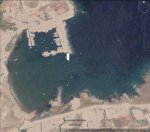
A couple of weeks ago we were advised by the Marina staff in Loutra, Greece, to Medmoor on the end of the main breakwater in such a way that our anchor chain was across the entrance to the marina, and our bow was sticking out into the entrance fairway. (position approx as shown by the white rectangle). Fierce debate then ensued among my crew as to whether we should show anchor light, as although we were tied to the quay, our anchor chain was a potential hazard to boats entering the marina.
Later, another boat moored alongside us, and seemed to have the problem solved by attaching a bright strobe light to his anchor chain a couple of feet below the bow roller.

loutra2.jpg
 
While an anchor light meeting Rule 30a or 30b is required, Rule 30c provides that:-

"A vessel at anchor may, and a vessel of 100 metres and more in length shall, also use the available working or equivalent lights to illuminate her decks."
 
Knowing as I do, 2 barristers who specialise in mitigating claims in the instance of marine collisoins, damage etc. I am absolutely clear that a boat not displaying the "correct" light/s would have very little defence.

Interestingly, once these barristers get involved, it is not just the issue in hand that they investigate, they look all around the boat, chart corrections, flare expiry dates, licenses etc etc and any anomalies are also used to prove lack of due diligence and reduce any claims even further.

The sound of scurrying to switch on anchor lights was deafening! :)
 
Knowing as I do, 2 barristers who specialise in mitigating claims in the instance of marine collisoins, damage etc. I am absolutely clear that a boat not displaying the "correct" light/s would have very little defence.

Interestingly, once these barristers get involved, it is not just the issue in hand that they investigate, they look all around the boat, chart corrections, flare expiry dates, licenses etc etc and any anomalies are also used to prove lack of due diligence and reduce any claims even further.

A little along the lines of this true one from long ago:
"I drove into a drive that wasn't mine and hit a tree I don't have."

A good reason why houses (and boats?) shouldn't all look the same?
The guy was all over the place. I had to swerve several times before I hit him! :)
 
As far as I understand it if it is a designated anchorage [special anchorage ?? ] no light is required.

However in my experience you do need an anchor light in busy anchorages especially if there is nighttime dinghy traffic AND IT SHOULD NOT BE A MASTHEAD LIGHT. Dinghy drivers wending there weary way home look forward not up. You best light is one in the fore triangle or under the bimini. The bimini light shows up best IMHO as it lights up the cockpit and is generally more visible close up. Distance visibility is much less important than 25 yard visibility.

BTW I have now seen 3 boats [ all French ] displaying quite visible anchor lights which change colour, RED TO GREEN TO BLUE AND BACK TO RED. Took me quite a while to work out what was going on the first time.
 
Top