Anyone used sheet to tiller

PabloPicasso

Well-Known Member
Joined
12 Feb 2010
Messages
2,929
Visit site
I've seen pictures of sheet to tiller steering but can't quite grasp what makes the sheet tiller line move. The main or jib sheet somehow is supposed to control the tiller but I can't see what generates the movement as sails n sheets don't normally move under usual sailing. Can anyone explain this?
 
Depending on boat & how well balanced, you might be able to achieve some success by experimenting with different strengths of bungee cord, see:
http://www.youtube.com/watch?v=ZN3MS1vYv_4
I was on board with a mate last year when he started to experiment with sheet to tiller, but the version where the line runs from the end of the boom, same as in the clip linked to in jamie N's post, with some success, his boat being a heavy wooden long keeler...
 
I'm still not getting what causes the tension and movement in the steering line. If it is attached to the boom or main sheet these bits don't move on their own. Or am I still missing something
 
I'm still not getting what causes the tension and movement in the steering line. If it is attached to the boom or main sheet these bits don't move on their own. Or am I still missing something

I think what happens, the sails stay taught applying tension against the bungee, if the boat starts to steer too close to the wind the sails slacken and the tension of the bungee steers you back to fill the sails and aplly tension again, against the bungee. Is that right?
 
Colhel,

Yes, some use a line to the boom ( with the mainsheet slackened off ) and others prefer a jib sheet but the principle is the same, varying tension in the sheet balanced by bungee.
 
Last edited:
I use tiller to main sheet and tiller to genoa. You need to play around and make up a set of bungee cords to suit your boat under various conditions; it is not easy to do, but when you get it right the results are very good; the sails must be very well balanced to start with. The principle is simple, the tiller is connected directly to the sail, via a line and pulleys (see youtube and other schematics) when the wind increases the sail pull harder and in the turn it pulls the tiller in the opposite direction.

The difficulty is that the sail may pull the tiller too much, or too little, this is why you need the correct strength of bungees; it is good fun. I think it will be easier to achieve good results with the long keeler boat than a fin keeler as the latter is much more sensitive to small movements and therefore too erratic for a sheet to tiller method.
 
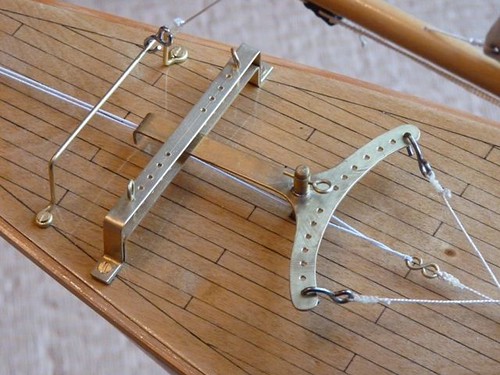
Years ago, a standard method of steering model yachts was "Braine Gear Steering". the main-boom was attached to the rudder by cross-over sheets attached to a multi-hole quadrant. The various holes gave selectable mechanical advantage. The quadrant was centralised by a rubber band. The system was quite effective in countering variations in wind strength to maintain course. Wind vane gear later became more popular, then R/C.
 
Years ago, a standard method of steering model yachts was "Braine Gear Steering". the main-boom was attached to the rudder by cross-over sheets attached to a multi-hole quadrant. The various holes gave selectable mechanical advantage. The quadrant was centralised by a rubber band. The system was quite effective in countering variations in wind strength to maintain course. Wind vane gear later became more popular, then R/C.

here it is

8046819948_73210d4e13.jpg


8518570008_129304cc5b.jpg
 
I use tiller to main sheet and tiller to genoa. You need to play around and make up a set of bungee cords to suit your boat under various conditions; it is not easy to do, but when you get it right the results are very good; the sails must be very well balanced to start with. The principle is simple, the tiller is connected directly to the sail, via a line and pulleys (see youtube and other schematics) when the wind increases the sail pull harder and in the turn it pulls the tiller in the opposite direction.

The difficulty is that the sail may pull the tiller too much, or too little, this is why you need the correct strength of bungees; it is good fun. I think it will be easier to achieve good results with the long keeler boat than a fin keeler as the latter is much more sensitive to small movements and therefore too erratic for a sheet to tiller method.

I have 26ft Seawolf with fin keel and rudder hung on a small skeg. I'm hoping to try it, mainly for fun but also to allow easier single handed/short handed sailing. Anyone tried it on a fin keeled boat?
 
If you can balance your boat to sail to wind or on a reach without doing much steering it may work. Problem with most coastal type sailing is that you are rarely sailing to the wind for long because of changes in wind strength and direction.

Not worth relying on it - better to spend money and get a tiller pilot which is reliable and will steer the course you want, although its life is easier if you can also balance your boat well.
 
I've seen pictures of sheet to tiller steering but can't quite grasp what makes the sheet tiller line move. The main or jib sheet somehow is supposed to control the tiller but I can't see what generates the movement as sails n sheets don't normally move under usual sailing. Can anyone explain this?
Yes I have used it. If you are sailing a standard sloop with main and jib, it is only really effective on a reach, though there it does work. The jib sheet is not cleated off as usual, but led through two turning blocks to the windward side of the tiller. The pull of the sheet is balanced by a rubber strap. As the boat comes up too much into wind, the apparent wind increases, and the extra load on the sheet pulls the tiller to turn the boat downwind.

As the boat turns too far downwind, the apparent wind drops, and the jib starts getting blanketed by the main, the sheet load reduces, and the elastic pulls the tiller to turn the boat back into wind.

On a reach you get a bit of an S-shaped course, but you are able to cook/clean/fix something whilst singlehanded, and the boat carries on in the right general direction. There are variants of the technique for going downwind, but to make them work you need two jibs and poles and no mainsail set. It is generally unnecessary when sailing to windward, as just oversheeting the jib slightly, easing the main, and lashing the tiller will take most boats happily to windward for hours.

Shockcord is not a good elastic for the job, pure rubber strips like physiotherapy rubber work better - a more linear response to stretching.
 
Yes I have used it. If you are sailing a standard sloop with main and jib, it is only really effective on a reach, though there it does work. The jib sheet is not cleated off as usual, but led through two turning blocks to the windward side of the tiller. The pull of the sheet is balanced by a rubber strap. As the boat comes up too much into wind, the apparent wind increases, and the extra load on the sheet pulls the tiller to turn the boat downwind.

As the boat turns too far downwind, the apparent wind drops, and the jib starts getting blanketed by the main, the sheet load reduces, and the elastic pulls the tiller to turn the boat back into wind.

On a reach you get a bit of an S-shaped course, but you are able to cook/clean/fix something whilst singlehanded, and the boat carries on in the right general direction. There are variants of the technique for going downwind, but to make them work you need two jibs and poles and no mainsail set. It is generally unnecessary when sailing to windward, as just oversheeting the jib slightly, easing the main, and lashing the tiller will take most boats happily to windward for hours.

Shockcord is not a good elastic for the job, pure rubber strips like physiotherapy rubber work better - a more linear response to stretching.

Ah yes I was wondering what all the fuss about surgical tubing was about. Any rubber could do could it? Bicycle inner tubes?
 
I,v use the genoa sheet looped over the tiller and secured by the winch cleat, working against a bungy shock cord.
Worked fairly well on a forward to broad reach. The sheet can be adjusted easily for slight course correction
Going to experiment with the main sheet this year.
 
Top