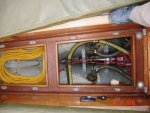
Anyone recognise this anti vibration coupling?

Slowboat35

Well-Known Member
Joined
4 Apr 2020
Messages
2,655
Visit site
In particular, whether it was any good and what problems it displays when worn out?

I'm trying to track down a deep and severe roughness and noise (rather than obvious physical vibration) in my new engine installation with old shaft - this old vibration coupling - new Featherstream that is eluding everyone so far.

Engine runs sweet as a nut. Shaft was fine with old setup - 1 ¼ " by a metre long so pretty bulletproof, Any ideas?
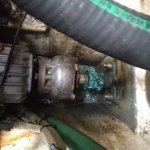
IMG_2917.jpg
 
I would recheck the alignment and ensure the shaft is sitting correctly in its tube and not resting against one
Side . It may be an illusion in the picture but the alignment doors not appear correct and suggests the front of. The engine is off to Starboard
 
In particular, whether it was any good and what problems it displays when worn out?

I'm trying to track down a deep and severe roughness and noise (rather than obvious physical vibration) in my new engine installation with old shaft - this old vibration coupling - new Featherstream that is eluding everyone so far.

Engine runs sweet as a nut. Shaft was fine with old setup - 1 ¼ " by a metre long so pretty bulletproof, Any ideas?
View attachment 124590
It's a Centerflex coupling.
 
As trevorr says. Here is some information:

cf-marine--04-09.pdf (centa.info)

There is nothing to wear out really. As long as the nuts holding the gearbox spider are tight and the shaft is not loose it should be ok. The thing is filled with rubber, it's doubtful if this would fail and lead to noise, more likely that you would lose drive. You could test it by looking into the back of it and noting any debris plus swinging on the propshaft and noting any movement between it and the Centaflex body.
It's more than an AV coupling and will cope with a degree of engine misalignment, so unless the engine is miles out you might discount that possibility?

My bet would be on the new prop. Or perhaps you are now hearing hull noise because your new engine is much quieter than the old?

.
 
The M8 bolts that clamp the shaft dont have to be very tight, it's only a few Newton metres I cant remember of the top of my head but it's quite easy to over tighten them! The cone can then get off centre
 
The M8 bolts that clamp the shaft dont have to be very tight, it's only a few Newton metres I cant remember of the top of my head but it's quite easy to over tighten them! The cone can then get off centre

Centaflex shaft coupling torques

Coupling flange to gearbox 45N-m = 4.59kgf-m = 397lb-in
Cone sleeve = 25N-m = 221lb-in
(spanner size 13mm a/f)

Mine was installed 19 years ago (Centaflex M) and has never given any trouble.

It has to be properly aligned, radially and axially. The 2 degree maximum tolerance is not intended to allow of it being installed out of line but to allow for the engine moving on its rubber mounts.

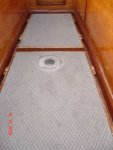
Cockpit hatches (2).jpg
 
Last edited:
Centaflex shaft coupling torques

Coupling flange to gearbox 45N-m = 4.59kgf-m = 397lb-in

Cone sleeve = 25N-m = 221lb-in

(spanner size 13mm a/f)

Mine was installed 19 years ago (Centaflex M) and has never given any trouble.

It has to be properly aligned, radially and axially. The 2 degree maximum tolerance is not intended to allow of it being installed out of line but to allow for the engine moving on its rubber mounts.

View attachment 124594
That's the kind of shaft access most Twister owners can only dream of!! ??
 
"The 2 degree maximum tolerance is not intended to allow of it being installed out of line but to allow for the engine moving on its rubber mounts."


From the literature:

• Accept considerable misalignment

• The couplings compensate for all types of misalignment


.
 
"The 2 degree maximum tolerance is not intended to allow of it being installed out of line but to allow for the engine moving on its rubber mounts."


From the literature:

• Accept considerable misalignment

• The couplings compensate for all types of misalignment


.
If you install it properly you have +/- 2 degrees. If you install it with all the tolerance taken up in one direction, then there is no tolerance left in that direction.
 
"The 2 degree maximum tolerance is not intended to allow of it being installed out of line but to allow for the engine moving on its rubber mounts."


From the literature:

• Accept considerable misalignment

• The couplings compensate for all types of misalignment


.
So long as the inner end of the shaft is not pulled to one side of the stern tube and wears against it.
 
Top