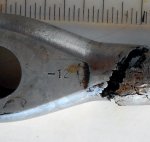
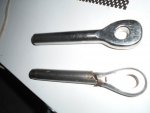
Anyone recognise the maker of this [broken ] eye fitting

TQA

Well-Known Member
Joined
20 Feb 2005
Messages
6,815
Location
Carribbean currently Grenada
sailingonelephantschild.blogspot.com
I broke the eye fitting on my inner forestay. It was connected to a Norseman Staylock swageless fitting.

It is a 1/2 inch thread on the Norseman and a 5/8th hole in the eye.

It has the number 12 on one side and a logo of two superimposed ovals on the other.see attached photographs. NOPE NEXT POST

Does anyone know the maker or can suggest where I can get such a thing?
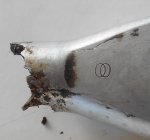
 
I acknowledge Vyv Cox's comment re stress corrosion, but looking at the severity of the failure, I wonder if the component has been fabricated by welding, ie cheap, with corrosion in the heat affected zone?
 
I acknowledge Vyv Cox's comment re stress corrosion, but looking at the severity of the failure, I wonder if the component has been fabricated by welding, ie cheap, with corrosion in the heat affected zone?
I don't think so. Look at photo 1. Cracks are visible in the flat section to the right of the photo. Cracking is clearly extremely branched and extends widely. HAZ corrosion is known as 'knife- line attack' because the corrosion occurs along a narrow line where the chromium content has been reduced by carbide formation. The fitting looks like a forging or cold stamping to me. SCC is quite common in on-deck fittings where temperatures can reach surprising levels and there is plenty of chloride.
 
I broke the eye fitting on my inner forestay. It was connected to a Norseman Staylock swageless fitting.

It is a 1/2 inch thread on the Norseman and a 5/8th hole in the eye.

It has the number 12 on one side and a logo of two superimposed ovals on the other.see attached photographs. NOPE NEXT POST

Does anyone know the maker or can suggest where I can get such a thing?
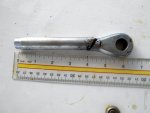
It's either a Norseman or a Sta-Lok swageless fitting, not both :)

How is it connected to that, and why? Your fitting looks a lot like a normal swaged eye - you're saying it has a thread cut inside, so what connects to it is like this? Is it possible someone cut a thread into a normal swaged eye?

Worst case you could simply replace the entire lower terminal with a swageless long eye (so that you do not need to replace the stay - if you do, just fit a normal length eye instead).
 
I can't help with the maker sorry but it is a supdrb example of stress corrosion cracking. May I use it on the website please?

Yes sure When O get the time and a good connection I will add a pic of the bottom of the fitting which is badly cracked.

I am a little pissed as I paid a rigger to give my entire rig a once over 6 months ago. He could have missed the start of breakage at the neck but not the crack.
 
Last edited:
If you can't find one, you could use a bottle screw and remove the end that has the correct (RH/LH) thread.


The trouble is that the fitting is relatively short and mates to an overcenter lever tensioner. I thing any bottle screw will be too long. At a push I will use a bottle screw and do without the over center lever fitting. I can then go direct to the deck fitting. I am a cruiser in the West Indies and life rarely involves short tacking so don't need the quickly removeable inner stay.
 
Did the rounds of the riggers and chandlers in Guadeloupe, nobody had a suitable bottle screw or any imperial fitting at all.

The Caraibe Greement rigger who was very helpful said he believe it to be a swage fitting size 12 which had been modified with an internal thread.

He supplied a swage eye size 12 but nobody in the yard had an imperial tap 1/2 UNF. The new fitting is distinctly beefier.

UMC In Jarry cut the thread for me. Nice guys did it in their lunch hour and would not accept anything. Much good karma too them.

So I will see if it all fits together tomorrow.

Noted that on examination the old one is cracked at the base of the eye, a big serious crack.1-DSCN0729.JPG
 
So it was a swage fitting with a thread cut in where normally the fitting is deformed around the wire rope. Apparently this worked okay, apart fro the corrosion. Interesting that it failed at the bottom of the cavity, where water wicking past the threads would pool. Using thread sealant upon assembly might be a good idea?
 
Top