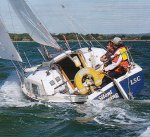
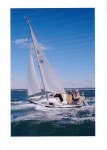
Anybody tried this?

Even when cruising, if you need to tack, it's because you need to go upwind.
The set up in the article might work OK with a high clew jib with low overlap.
If you have a low clew it won't.
Maybe you could reef a roller jib to make it work?

I've sailed RS800's a bit, they have a self tacker on a track and negligible overlap. It works great until you fluff a tack trying to beat back to the slip, when you suddenly really wish you could back the jib.
I find backing the jib pretty handy for sailing on/off moorings in a yacht too.
 
For a non-overlapping jib (and no babystay) you could do this but add a jib-boom to achieve tension in the foot. This is done to great effect on the Hunters Yard yachts on the Norfolk broads:

https://www.google.co.uk/search?q=l...h=997#imgrc=fQPUsE6LTO2q1M:&spf=1516279586764

The balanced lug style jib-boom also maintains leach tension, meaning the sheet only influences sheeting angle. The jib is small enough to back by hand if necessary (these are engineless yachts so good manoeuvrability under sail is required).

I don't think it is ever possible to have good self tacking with an overlapping jib?

Edit - URL
 
I am only asking as we are about to rig the boat, I might just fit a bowsprit and an extra forestay for later experimentation
If you are going to fit an self tacking sail to a bowsprit, it will be a major modification to the boat.
The new bowsprit/bobstay/stay must be designed to carry the load of the existing forestay so that you can remove that.

That will probably be more cost and hassle than making a proper self tacking arrangement using the existing forestay and live with reduced sail area.

 
It's a pretty horrible setup, on most boats/sails it won't be efficient, as others have said on overlapping jibs it will not really work. My other dislike is for a block on the clew of the sail, especially if not on a roller-furled sail. Blocks whipping around can be dangerous.
 
In your original photo the jib has a horribly hooked leach, destroying any possible performance going !

The whole trick on the wind with headsails is THE SLOT EFFECT where the headsail just slightly overlaps the luff of the mainsail giving a venturi jet effect.

This is why a sloop with one sail up performs a lot less than 50 % to windward or on a reach.

The slot can be achieved with self tacking headsails, but they need to be shaped and set up with slot effect in mind; if you just bung up a jib which will happily go side to side to side across the foredeck, chances are you won't get a decent slot.

Here's - ahem - a pic of a decent uniform slot between the trailing edge of the foresail and leading edge of the main;

SR stern on st.jpg
 

Attachments

  • NX1.jpg
    NX1.jpg
    365.4 KB · Views: 1
Last edited:
In your original photo the jib has a horribly hooked leach, destroying any possible performance going !

The whole trick on the wind with headsails is THE SLOT EFFECT where the headsail just slightly overlaps the luff of the mainsail giving a venturi jet effect.

This is why a sloop with one sail up performs a lot less than 50 % to windward or on a reach.

The slot can be achieved with self tacking headsails, but they need to be shaped and set up with slot effect in mind; if you just bung up a jib which will happily go side to side to side across the foredeck, chances are you won't get a decent slot.

Here's - ahem - a pic of a decent uniform slot between the trailing edge of the foresail and leading edge of the main;

View attachment 68581

Show off! Now we are so close to completion I am starting to have stupid ideas, you can count this as one of them.
Spent last the half hour at work mucking about with the mast. Many coats of paint on it, such a bore.
 
Uncle who cruised his 27ft boat on the Chesapeak had a self tacking jib with a windsurfer type wishbone. Problem was, that there are sudden squalls, so one needs to drop the sails quickly. The geometry of the 'snotter' controlling the tension of the clew, meant that it would come down a bit then jam. At mid 80s, he was not about to scramble forward to clear it. So we came up with a line running up the hanks, out to the forward end of the wishbone with a block, then up the rest of the hanks to the head of the sail. Tensioned from the cockpit, but as soon as you released the halyard, the wishbone tension was also released, so the sail dropped quickly. He went back to the States and tried it. Worked first time and created interest from his sailing friends.
He popped his cloggs last year at 95, but gave the boat to a friend, who still uses it with the mod.
 
My other dislike is for a block on the clew of the sail, especially if not on a roller-furled sail. Blocks whipping around can be dangerous.

For a properly set up self tacking jib the block does not whip around like,say, a genoa as the jib is much smaller & forward of the mast. One does not release it for each tack & it stays sheeted in. Hence, it is not as dangerous as one might think. Not necessary, for instance, to go forward to release a snagged sail on the tack manouver. Still can be painful though
 
If you are going to have a self tacking jib then it must be quite small in area to fit in the fore triangle then a bit less to make room for track if you use one. In which case you might as well just use a hank on, or furling small jib which will be easy to sheet but still retain the ability to back the jib for manoeuvrability. (very desirable)
A jib must be pulled at the clew both down and aft and this pull must be from a suitable angle out from centre line. In fact it is just like a mainsail except the "mast" is very raked. Main sails can be made to work loose footed ie with no boom but are difficult to set and adjust correctly. It is also difficult to get a sheeting point far enough aft to pull out the foot and if you set it up for close hauled it is not very good for running.
The equivalent for a jib is however is most common.
So for a well setting jib you really need a boom. It should have a gooseneck at the foot of the forestay and be long enough to stretch the foot of the jib in an adjustable manner like main sail out haul. The boom must be held downward and this can be done by a traveller (track) (like a main sail) or by a boom vang almost impossible to fit unless it is above the boom pushing down. Then finally you need a sheet to set distance from centre line. Lastly perhaps a couple of extra sheets to enable it to be back winded.
I think the jib set is absolutely vital to any proper sailing (upwind) Don't listen to those lazy b who reckon gentlemen don't sail up wind. Sailing up wind is the real joy of sailing to me. Sorts out the sheep from the goats.
So to reiterate have a small jib for strong winds and when you want easy sheeting but have a large genoa for power in light winds. (and find the energy for sheetng it in) Or a furler if you must. olewill
 
On my A22, as seen in the photo's above, I have a very efficient blade jib which just overlaps the main to give the slot effect.

It isn't self tacking, but is so easily handled with cheek blocks and cam cleats I can handle her like a dinghy, have spent whole seasons without touching the sheet winches.

The ideal rig I and other A22 owners lust for would be a blade jib like this - hanked, so a storm jib could be set on it - and a short, possibly retractrable sprit with a medium cloth asymmetric on a furler.
 
Uncle who cruised his 27ft boat on the Chesapeak had a self tacking jib with a windsurfer type wishbone. Problem was, that there are sudden squalls, so one needs to drop the sails quickly. The geometry of the 'snotter' controlling the tension of the clew, meant that it would come down a bit then jam. At mid 80s, he was not about to scramble forward to clear it. So we came up with a line running up the hanks, out to the forward end of the wishbone with a block, then up the rest of the hanks to the head of the sail. Tensioned from the cockpit, but as soon as you released the halyard, the wishbone tension was also released, so the sail dropped quickly. He went back to the States and tried it. Worked first time and created interest from his sailing friends.
He popped his cloggs last year at 95, but gave the boat to a friend, who still uses it with the mod.

It does seem to get a bit complex, this simple sailing where you don't need to adjust the jib sheets every tack....
 
On my A22, as seen in the photo's above, I have a very efficient blade jib which just overlaps the main to give the slot effect.

It isn't self tacking, but is so easily handled with cheek blocks and cam cleats I can handle her like a dinghy, have spent whole seasons without touching the sheet winches.

The ideal rig I and other A22 owners lust for would be a blade jib like this - hanked, so a storm jib could be set on it - and a short, possibly retractrable sprit with a medium cloth asymmetric on a furler.

A low-overlap jib is pretty easy to tack singlehanded on many boats.
Some boats the mainsheet, cockpit tables etc seem placed to prevent the helm tacking the jib.
 
Top