Any thoughts, advice or experience of lithium ion battery systems please?

The Glassman

Well-Known Member
Joined
14 May 2013
Messages
101
Location
Streatley
Visit site
Not too far off needing new batteries for the domestic bank - about 400ah presently .
2 x 100amp alternators through Sterling alternator booster/controller plus power management system - all getting on a bit (not unlike the skipper!). 2kwh inverter, all LED lighting, 2 Isotherm fridges. Do have a 2kwh gennie and a 100w solar panel too, but don’t want to use them very often.
Seems a good time to at least have a good look at this topic.
Over to you please….
 
Many have concerns (esp insurance companies) about the safety of li ion, and you are looking at a very large bank of energy

Most now fit LiPO batteries, very different

Edit: LiFePO, ie not Li-ion. Sorry, silly typo
 
Last edited:
I've had lithium batteries for a couple of years. They have transformed the boats completely. Also put large solar panels on both craft.

I'm quite hands on so it's not your usual system although I did get some Mastervolt Lifepo4 batteries cheap. The other ones are ex electric bus batteries with no battery management system.

Risky in terms of battery life.

Branded drop on lithium batteries are not cheap. It depends what you do and how you use them but if the existing system is lead acid batteries and is only a problem because they are getting old it could be sensible to change like for like.

Bit of a gamble and the DIY side of lithium batteries is even more of a gamble !
Many have concerns (esp insurance companies) about the safety of li ion, and you are looking at a very large bank of energy

Most now fit LiPO batteries, very different

LiFePO4 is the normal chemistry.

There is LTO but they are a bit specialist however very safe with virtually zero chance of runaway.

Any batteries are capable of starting a fire if the wiring is done wrong or the charge voltage is too high.

I have LiFePO4 and LTO on my boats but they are slightly ad hoc and not drop in replacements for the lead acid.

I also know about the dangers of some lithium batteries as I experienced a full scale thermal runaway on a jump start pack. It ended up flaming out rather like when you pour petrol out and light it.

Luckily I had removed it from the boat before that happened!

Wiring is the main thing and voltages.

Drop-in replacement batteries which are usually LiFePO4 have protection circuits. They also have significant wallet-emptying capabilities and sometimes quite short warranties.

I'm not convinced for the normal user that Lithium batteries are all that cost effective.n

Yes they do work, very good round trip efficiency but unless you are hands on they will hit the pocket rather hard.
 
We have had a DIY 560AH LIfePo4 battery on ours for a couple of years now and would never go back to lead acid now if you can swallow the cost over the long period of use then you wont be disappointed.

here are some points and ramblings at a high level you and others may find useful when considering changing to lithium

There is a lot of "FUD" on the internet and at marinas with people telling you that "your boat will catch fire" or "lithium is way too expensive" or "lithium is way more complicated" all of which is nonsense even the cost and complexity piece when compared to a properly installed lead acid setup

the first thing you need to know is you cant just think of lithium's as a replacement battery even with the so called "drop ins". you have to look at it as a whole system of stored capacity, charging and ongoing management & protection

for simplicity I'm going to make some generalisations when i say lithium i mean LifePo4 and when i say lead acid i know there are many different chemistries like agm, lead carbon etc that have somewhat better capabilities than traditional flooded lead acid

a lithium battery is made up of individual lithium cells in the case of a 12V battery there are 4 cells which run from 2.8v (flat) - 3.65v (full) each lithium battery require a battery management system or BMS to manage these individual cells and does 4 main jobs:

- 1st to protect over voltage of any of the cells (any cell going over 3.65V whilst charging),
- 2nd to protect against under voltage of any of the cells (any cell going under 2.8v when discharging)
- 3rd to protect against large imbalances between any of the cells
- 4th prevent charging below 0c temperature (see disadvantages below)

"drop ins"
batteries will have 4 cells in a plastic case which looks just like a lead acid and a circuit board (BMS) inside which monitors the individual cells and can disconnect the output if there is an error state.

be aware that generally all the current usually flows through this BMS so they have limitations on how much continuous current they can deliver (generally around 100amps) and how much current they can charge at (again around 100amps) worth checking the specs as some are better than others, because of all the current going through the BMS you cannot use "drop ins" for engine starting.

it should also be noted that some drop ins do not like being wired in series and or parallel due to the BMS so be careful when choosing a battery for high current drains like immersion heaters or large inverters.

DIY
in the case of DIY you buy individual cells and buy a separate external BMS wire it all yourself which gives you more flexibility around size and capacity, there are 2 main types of DIY BMS one where the current flows through the BMS which are typically limited to about 150a max or ones where the BMS controls an external relay which can offer much larger loads.

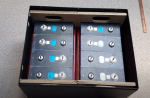
this is our DIY battery made up of individual cells
1655808642343.png

people make a big thing about BMS's with lithium but a 12v lead acid battery is made up of 4 x 3v cells too and ideally you should have some means of disconnecting the load when it gets to 50% capacity to prolong the lifespan of the battery!

Generally seen pros of lithium batteries
lithium's can charge at as many amps as you can throw at them from 10% right up to 99% charge which means they can charge much faster unlike lead acids where they only take the full current during the bulk stage to about 75% charge where they have to switch to a lower trickle charging rate in absorption and then float so take much longer to charge.

lithium's provide a very flat power output of about 13.2 volts from 90% - 10 % capacity (the voltage then falls of a cliff) where as lead acid batteries suffer from massive voltage sags under load dropping down to around 11.5v

lithium's weigh half as much as lead acids (probably not a major consideration but definitely a plus)

lithium's are seen to have have a much longer life span, if you look after them potentially thousands of charge cycles against hundreds on lead acids

Generalised Cons of lithium batteries
higher perceived upfront cost of the batteries (though remember it's potentially 2 lead acids to 1 lithium from a capacity perspective)

charging systems might need to be upgraded to support lithium charge profile; shore power chargers, generators, alternators, solar etc

due to low internal resistance and massive charging capability measure need to be put in place to protect your alternator from burning out over long periods this can be either DC to DC charger or smart alternator regulator this adds cost and complexity

Lithium batteries ideally require a battery management system to maintain and protect them however if there is a fault it will literally disconnect the output of the battery which if being charged by your alternator will immediately blow up your alternator so you need an alternator protection device or use a dc to dc charger to isolate your alternator from disconnects

lithium batteries do not like being charged below 0 degrees Celsius so protection need to be put in place to protect against this

lithium batteries don't like being in a hot environment so if you can put them somewhere other than the engine bay this is preferable

there are 2 main things to consider:

1 - How Much Stored capacity do you actually need
as stated above lithium batteries can provide nearly all of there capacity from 90% - 10% without ill effects where as Lead acids generally only like being discharged to 50% so in theory you only need half the lithium capacity (always best to add in a little headroom for a rainy day) so if you have 400ah of lead acid you could get away with 200-300ah of lithium for the same useable capacity.

You need to work out what you average use is between recharges to work out how much capacity you actually need plus a little extra (do you stay moored up for days at a time or do you motor every day or so).

2 - How much Charging potential do you have
it's all very well having a massive bucket of stored energy you can use without restriction but how many amps can you get back into them on an average motor, we upgraded to 2 100a alternators but found that at low revs on the Thames they would rarely give out more than 30 amps each

When charging from the alternator you have 2 main options 1 is to use a DC to DC charger (sometimes called a battery to battery charger) where you have the alternator charger a lead acid battery and then you charger the lithium battery from that this means if you have a high voltage disconnect from the BMS then the alternator will not blow up and you can manage the charging amps so as not to overload your alternator.

you need to find out how many amps your alternator can give out at cruising speeds and then calculate the DC to dc size (generally these come in 30 amp units than can be paralleled together to increase size (Victron Orion TR smart or sterling battery to battery charger))

The second alternator charging option is to use a smart regulator such as the Balmar mc 614 or Wakespeed ws500 these use temperature probes on the alternator and can vary the output of the alternator so as not to burn it out over long periods these are the most efficient option as you are charging directly from the alternator and dont have any losses through DC to DC charge and will take the full output the alternator can provide. HOWEVER they do not support BMS high voltage disconnects so it is recommended to use an alternator protection device to protect against disconnect.

the other thing to note about smart regulators is you need to get your alternator modified to be able to get a field output connection to the regulator though you may already have this with your old sterling system.

for reference we have twin engines with 100a balmar alternators on each engine controlled by Wakespeed WS500 smart regulators and sterling alternator protecton devices.

a REC BMS connects to the regulators and solar MPPT via a CAN Bus to control charging and the victron inverter and vicron GX so we can monitor individual cells.
1655810245874.png
i have installed smaller pulleys on our alternators so whilst cruising up the river at the regulations 8KPH we are putting 120 amps back in the batteries which allow us to use an immersion heater to heat water, Nespresso machine, and even switched from gas oven to electric combination oven.

I hope this isn't too boring and or puts you off if you want any more information i am happy to help
 
Nice setup.

I should clarify that the reason for my jump pack running away was my fault.

They come with a set of leads with an Anderson SB50 plug. I lost the leads so made a new set. However I didn't realise the original leads had a diode pack to prevent reverse charging.

So what happened is that I ended up putting 14v (engine alternator) into a 3 series pack of pouch cells. This will cause expansion and eventual runaway if it goes above about 12.6v. which it did.

Other than that lithium batteries are very safe.

There have been some discussions about insurance companies -possibly- adding clauses about lithium batteries but I don't know if it's a big deal.

Could be quite interesting if they were included in a get-out clause.

I agree they are massively better than Lead Acid but for people who don't want to get into the technical side of it the drop-in replacements are expensive.

They also have fairly short warranties and being a bit of a sceptic I suspect that is for a reason.

To make a LiFePO4 battery work the same as a lead acid in the sense of "drop in" you have to accept a slightly higher than ideal charge voltage from the alternator.

This is not going to burn the boat down but it could reduce the lifespan of the battery and -might- explain the warranty.

Example.

Sterling 100ah LiFePO4 battery. About £600. 5 year warranty.

Call me cynical but I wonder if they have worked this one out and that battery will be unusable in about 5 years and a couple of months.

IF that were the case, and I am not saying it is, then would it be worth buying ?

Definitely an interesting topic.
 
All of nfushers post is why I’d stick to conventional chemistries.
There is so much extra to worry about.
Why go Lithium?
If capacity is an issue why not just increase the size of the current bank?
 
On my own boat which is a 30ft steel cruiser, I have 1x 160amp Lead Carbon which does everything. It both starts the engine (has sufficient CCAs) and is the house battery.

I also have a smaller 70amp battery in reserve, this never gets used and is always kept at 100% charge.

I have a Victron smart monitor which tells me that on a typical overnight stop over I use 20% of my capacity during the summer, rising to 25% in the winter with the Ebberspacher on.

I'm berthed in a marina, the boat is always plugged into a smart charger there, which charges and maintains both batteries.

Boat use is a critical issue.
95% of the time I only stop for one night between cruising days, on a two night stopover I’d typically use 40-50% of my battery capacity.

My alternator is just 50 amps and my battery monitor tells me that after an overnight stop it charges at about 35amps at startup and on tick over.
Due to the lead-Carbon battery having lower resistance than a standard lead acid, it charges at a higher rate than a standard lead acid would, and it’s normally back to 100% charge after 3-4 hours of cruising.

I have no solar as I have no need for additional generation.
I also have an onboard diesel generator but never use it.

On board life is kept simple, thus power consumption is low, the most I can use in a 24hr period during the winter is 50 amps
 
We have had a DIY 560AH LIfePo4 battery on ours for a couple of years now and would never go back to lead acid now if you can swallow the cost over the long period of use then you wont be disappointed.

here are some points and ramblings at a high level you and others may find useful when considering changing to lithium

There is a lot of "FUD" on the internet and at marinas with people telling you that "your boat will catch fire" or "lithium is way too expensive" or "lithium is way more complicated" all of which is nonsense even the cost and complexity piece when compared to a properly installed lead acid setup

the first thing you need to know is you cant just think of lithium's as a replacement battery even with the so called "drop ins". you have to look at it as a whole system of stored capacity, charging and ongoing management & protection

for simplicity I'm going to make some generalisations when i say lithium i mean LifePo4 and when i say lead acid i know there are many different chemistries like agm, lead carbon etc that have somewhat better capabilities than traditional flooded lead acid

a lithium battery is made up of individual lithium cells in the case of a 12V battery there are 4 cells which run from 2.8v (flat) - 3.65v (full) each lithium battery require a battery management system or BMS to manage these individual cells and does 4 main jobs:

- 1st to protect over voltage of any of the cells (any cell going over 3.65V whilst charging),
- 2nd to protect against under voltage of any of the cells (any cell going under 2.8v when discharging)
- 3rd to protect against large imbalances between any of the cells
- 4th prevent charging below 0c temperature (see disadvantages below)

"drop ins"
batteries will have 4 cells in a plastic case which looks just like a lead acid and a circuit board (BMS) inside which monitors the individual cells and can disconnect the output if there is an error state.

be aware that generally all the current usually flows through this BMS so they have limitations on how much continuous current they can deliver (generally around 100amps) and how much current they can charge at (again around 100amps) worth checking the specs as some are better than others, because of all the current going through the BMS you cannot use "drop ins" for engine starting.

it should also be noted that some drop ins do not like being wired in series and or parallel due to the BMS so be careful when choosing a battery for high current drains like immersion heaters or large inverters.

DIY
in the case of DIY you buy individual cells and buy a separate external BMS wire it all yourself which gives you more flexibility around size and capacity, there are 2 main types of DIY BMS one where the current flows through the BMS which are typically limited to about 150a max or ones where the BMS controls an external relay which can offer much larger loads.

this is our DIY battery made up of individual cells
View attachment 137208

people make a big thing about BMS's with lithium but a 12v lead acid battery is made up of 4 x 3v cells too and ideally you should have some means of disconnecting the load when it gets to 50% capacity to prolong the lifespan of the battery!

Generally seen pros of lithium batteries
lithium's can charge at as many amps as you can throw at them from 10% right up to 99% charge which means they can charge much faster unlike lead acids where they only take the full current during the bulk stage to about 75% charge where they have to switch to a lower trickle charging rate in absorption and then float so take much longer to charge.

lithium's provide a very flat power output of about 13.2 volts from 90% - 10 % capacity (the voltage then falls of a cliff) where as lead acid batteries suffer from massive voltage sags under load dropping down to around 11.5v

lithium's weigh half as much as lead acids (probably not a major consideration but definitely a plus)

lithium's are seen to have have a much longer life span, if you look after them potentially thousands of charge cycles against hundreds on lead acids

Generalised Cons of lithium batteries
higher perceived upfront cost of the batteries (though remember it's potentially 2 lead acids to 1 lithium from a capacity perspective)

charging systems might need to be upgraded to support lithium charge profile; shore power chargers, generators, alternators, solar etc

due to low internal resistance and massive charging capability measure need to be put in place to protect your alternator from burning out over long periods this can be either DC to DC charger or smart alternator regulator this adds cost and complexity

Lithium batteries ideally require a battery management system to maintain and protect them however if there is a fault it will literally disconnect the output of the battery which if being charged by your alternator will immediately blow up your alternator so you need an alternator protection device or use a dc to dc charger to isolate your alternator from disconnects

lithium batteries do not like being charged below 0 degrees Celsius so protection need to be put in place to protect against this

lithium batteries don't like being in a hot environment so if you can put them somewhere other than the engine bay this is preferable

there are 2 main things to consider:

1 - How Much Stored capacity do you actually need
as stated above lithium batteries can provide nearly all of there capacity from 90% - 10% without ill effects where as Lead acids generally only like being discharged to 50% so in theory you only need half the lithium capacity (always best to add in a little headroom for a rainy day) so if you have 400ah of lead acid you could get away with 200-300ah of lithium for the same useable capacity.

You need to work out what you average use is between recharges to work out how much capacity you actually need plus a little extra (do you stay moored up for days at a time or do you motor every day or so).

2 - How much Charging potential do you have
it's all very well having a massive bucket of stored energy you can use without restriction but how many amps can you get back into them on an average motor, we upgraded to 2 100a alternators but found that at low revs on the Thames they would rarely give out more than 30 amps each

When charging from the alternator you have 2 main options 1 is to use a DC to DC charger (sometimes called a battery to battery charger) where you have the alternator charger a lead acid battery and then you charger the lithium battery from that this means if you have a high voltage disconnect from the BMS then the alternator will not blow up and you can manage the charging amps so as not to overload your alternator.

you need to find out how many amps your alternator can give out at cruising speeds and then calculate the DC to dc size (generally these come in 30 amp units than can be paralleled together to increase size (Victron Orion TR smart or sterling battery to battery charger))

The second alternator charging option is to use a smart regulator such as the Balmar mc 614 or Wakespeed ws500 these use temperature probes on the alternator and can vary the output of the alternator so as not to burn it out over long periods these are the most efficient option as you are charging directly from the alternator and dont have any losses through DC to DC charge and will take the full output the alternator can provide. HOWEVER they do not support BMS high voltage disconnects so it is recommended to use an alternator protection device to protect against disconnect.

the other thing to note about smart regulators is you need to get your alternator modified to be able to get a field output connection to the regulator though you may already have this with your old sterling system.

for reference we have twin engines with 100a balmar alternators on each engine controlled by Wakespeed WS500 smart regulators and sterling alternator protecton devices.

a REC BMS connects to the regulators and solar MPPT via a CAN Bus to control charging and the victron inverter and vicron GX so we can monitor individual cells.
View attachment 137210
i have installed smaller pulleys on our alternators so whilst cruising up the river at the regulations 8KPH we are putting 120 amps back in the batteries which allow us to use an immersion heater to heat water, Nespresso machine, and even switched from gas oven to electric combination oven.

I hope this isn't too boring and or puts you off if you want any more information i am happy to help
Hi - and many, many thanks for your most thorough and helpful advice. Much appreciated ???
Of course, I was referring to LifePO4 batteries, not Li-on’s.
Will probably look at an ‘integrated’ system with majority of components (and further tech-advice/support) from say, Mastervolt or Sterling.
The only alternative I came up with was to keep the lead batteries and install a fuel cel, not so sure about that though.

As to cost etc., we haven’t spent much at all on holidays and so on for the last couple of years or so - and don’t fancy resuming regular air travel again, so the boat will get a lot more use in future. Improving its comfort and utility makes sense to me.
All the best - and thanks for the offer of further advice too!
 
The place to start, and one often overlooked, is to do an accurate energy audit to assess how much you use.

Step two is to think about how long you want to stay off grid.

Only after doing those, can you come up with realistic energy storage solutions without over complicating things unnecessarily, and to assess if you need supplementary charging equipment.
 
Last edited:
One of the best batteries I have ever had is a tiny little Victron AGM 7ah 12v block. The type you put in burglar alarms. I have used and abused it, discharged it very badly and recharged and it still works well. Seems to be bullet proof. About ten years old now it has outlived other similar size batteries.

In one of the boats I put a Victron AGM starter battery on because it was the same size as the rubbish SLA battery that was in there.

I do like the lithium stuff but on my off grid boat all of the domestic power comes from solar. I don't even use the engine alternator when underway for domestic as it makes no difference because there is always enough power from the solar.
The idea of lots of solar is so that the boat is also still getting power in winter and there is never under any circumstances a requirement to run the engine when not underway.

If your electrical main power source is the engine then as mentioned above you probably need to buy a whole load more equipment if you go for lithium chemistries, and expensive batteries.


My boat usage is unusual. One boat on residential mooring with services and one boat off grid never connected to any services and used as much as possible all year round.

AGM batteries are pretty good and I think probably more cost effective for most people when compared to lithium batteries.

I am a big fan but it really does depend how you use the boat, you attitude to diy and how much you want to spend on upgrades.
 
If that's the case then anyone with a mobile phone would be technically in breach of the insurance T&C.

One would imagine that the insurance companies in question would be referring specifically to the battery installations on boats. It's definitely an interesting question as to whether they would discriminate between individual battery chemistries.

Seems more likely it would affect all Lithium chemistries.

There is a lot of confusion and general lack of knowledge around in this area. Something that will be exploited by less than scrupulous people.
 
Lithium ion batteries are known to ignite if damaged.
I have seen tests where a nail is driven though one, and other chemistry’s, to asses their safety.
The battery in most portable devices such as a phones are very small, whilst the battery fitted to a boat or car, whilst still being classified as portable, is very much larger and can store thousands of watts of energy.
 
People worry about the safety of batteries in electric cars (I have one), but they seem to forget that 50 litres of highly inflammable unleaded petrol under the rear seat is also rather dangerous.

As an ex motorcyclist, it always makes me laugh thinking that at some point in the future, our grandchildren will look at us in bemusement when we tell them that we used to drive around with 20 litres of highly inflammable liquid in a tin can between our legs doing 70 mph down the road?
 
I'm no expert, preferring to use the-day-before-yesterday's technology in my boat (that's al that was available in those days)...
However looking at other boating forum(s) I see the awful things that folks do with their conventional batteries, I wonder how lithium would / will fare in a boat?
 
Top