Antifouling whilst afloat

superheat6k

Well-Known Member
Joined
10 Jan 2012
Messages
6,798
Location
South Coast
Visit site
This weekend I will be trying out International's new antifouling coating that can be applied with the boat still afloat.

I have read some good reviews and the haul out cost savings will be significant. The idea is only to coat the first 0.5m or so of hull surface closest to the surface where sunlight encourages the strongest growth. The slime on the lower hull has less effect on the boats performance so can generally be ignored anyway below ~20 knots hull speed.

But I am having difficulties working out the best method of application - brush, spray or roller. I read International are developing an electrostatic method, broadly similar to powder coating, but have had difficulties with the stuff coating the anodes preventing them working, but if they can solve this one they will be onto a real winner. This month they are claiming this as a first.

Any advice or opinions appreciated please.
 
I saw the press release for this and think it's a great idea.

As I understand it though, the intention is that it is only really suitable for sailing boats. Method of applying is simple. Wait until there is enough wind to require the first reef then sail WITHOUT REEFING. This will cause the boat to heel over and voila - new coating applied.

I suppose it could work with MOBOs - just put the boat into a sharp turn and then apply.

I thnk the down side is the slightly shorter lifespan. I know they claim that as fouling doesn't usually occur in the colder months they recommend that you don't apply until this time of year and it should last 5 months but i'm not convinced on that. I suspect they take us for fools.

I'll let you try it first!!!
 
..of course with brexit 'n all, we are now allowed to use this technology..remember to use the special snorkel supplied though.
Good luck.
 
I saw the press release for this and think it's a great idea.

As I understand it though, the intention is that it is only really suitable for sailing boats. Method of applying is simple. Wait until there is enough wind to require the first reef then sail WITHOUT REEFING. This will cause the boat to heel over and voila - new coating applied.

I'll let you try it first!!!

Well it is April fools day where I am. Not quite in UK. If it is a serious attempt to make a fast drying or at least water proof after application then that might be good. I am a bit dismayed at fouling on my little boat. I have spent 2 sessions this last week in water scraping what appears to be a coral reef off the bottom of the little boat. That has grown in just 2 weeks since I last cleaned it and raced it. No weed just this horrible white growth and actual barnacles. Or do you call them limpets? I have the cut hands to show for the effort.
Yes I have mostly scrubbed the a/f off over this last summer. The difference this year seems to be that we had a lot of unseasonal rain which brought nutrients into the river. Made it impossible to see under water but did not impede the growth. Anyway it might be time to bring it ho me for the winter. Or maybe even antifoul again and relaunch for some of that lovely autumn sailing.
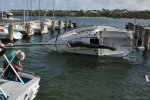
If that a/f is dinkum then a pull down would be the way to apply. I could even do the keel to the bottom but that idea is only for little boats. You attach the bow and stern so boat can't move sideways then pull hard on a halyard to pull the boat down to horizontal. Mine takes about 30kg to hold it down but a lot more to get it down. Sorry I have posted this photo before but you get the idea. In fact of course you could almost use ordinary a/f paint if you waited for a while. olewill
DSC_1897.jpg (96.1 KB)
 

Attachments

  • DSC_1897.jpg
    DSC_1897.jpg
    96.1 KB · Views: 0
Last edited:
Well it is April fools day where I am. Not quite in UK. If it is a serious attempt to make a fast drying or at least water proof after application then that might be good. I am a bit dismayed at fouling on my little boat. I have spent 2 sessions this last week in water scraping what appears to be a coral reef off the bottom of the little boat. That has grown in just 2 weeks since I last cleaned it and raced it. No weed just this horrible white growth and actual barnacles. Or do you call them limpets? I have the cut hands to show for the effort.
Yes I have mostly scrubbed the a/f off over this last summer. The difference this year seems to be that we had a lot of unseasonal rain which brought nutrients into the river. Made it impossible to see under water but did not impede the growth. Anyway it might be time to bring it ho me for the winter. Or maybe even antifoul again and relaunch for some of that lovely autumn sailing.
If that a/f is dinkum then a pull down would be the way to apply. I could even do the keel to the bottom but that idea is only for little boats. You attach the bow and stern so boat can't move sideways then pull hard on a halyard to pull the boat down to horizontal. Mine takes about 30kg to hold it down but a lot more to get it down. Sorry I have posted this photo before but you get the idea. In fact of course you could almost use ordinary a/f paint if you waited for a while. olewill
DSC_1897.jpg (96.1 KB)

First thing I noticed was that it was posted at 00:00 1st April, fine for UK though tardy for antipodean places.
 
If that a/f is dinkum then a pull down would be the way to apply. I could even do the keel to the bottom but that idea is only for little boats. You attach the bow and stern so boat can't move sideways then pull hard on a halyard to pull the boat down to horizontal. Mine takes about 30kg to hold it down but a lot more to get it down. Sorry I have posted this photo before but you get the idea. In fact of course you could almost use ordinary a/f paint if you waited for a while. olewill
DSC_1897.jpg (96.1 KB)

You do not have to do any pulling down. You anchor by the mast tip at low water & wait for the tide to rise & the boat will slowly tilt. ( Imagine the reverse of normal anchoring where you anchor in "deep" water & run aground in the middle of the night & fall out of bed). Once it starts you can be in the dinghy with the scraper & roller painting away to your hearts content.
You have the roller on an arm, with a scraper out the other side, & the outboard going full pelt & just keep swooping on it like a Spitfire strafing a Panzer. Scrape one way, paint the other, then a bit lower on the next run.
 
The electrostatic reference intrigues me, as the possibility of magneto-hydrodynamic spraying is something that has exercised the MoD for some time.

Apparently a positive charge is applied to the spray nozzle, and a negative one to the boat hull, with the sea water acting as a conductor between the two. Paint is specially prepared using a metallic ionised component (copper seems to be particularly successful) and a swivelling 'hood' surrounds the paint nozzle which is then moved under control of a video monitor along and down the hull. A two nozzle system with a preliminary water jet to ablate the weedy slime is used to clear the hull before the charged paint is sprayed towards the hull, to be attracted to the hull by the normal electro-magnetic attraction between opposite poles.


How Superheat got hold of the principles of such a system (which is highly Classified and used only on Astute class boats) remains to be investigated.
 
The electrostatic reference intrigues me, as the possibility of magneto-hydrodynamic spraying is something that has exercised the MoD for some time.

Apparently a positive charge is applied to the spray nozzle, and a negative one to the boat hull, with the sea water acting as a conductor between the two. Paint is specially prepared using a metallic ionised component (copper seems to be particularly successful) and a swivelling 'hood' surrounds the paint nozzle which is then moved under control of a video monitor along and down the hull. A two nozzle system with a preliminary water jet to ablate the weedy slime is used to clear the hull before the charged paint is sprayed towards the hull, to be attracted to the hull by the normal electro-magnetic attraction between opposite poles.


How Superheat got hold of the principles of such a system (which is highly Classified and used only on Astute class boats) remains to be investigated.

Are the MOD trying to re-invent the paint brush and roller - no wonder those subs are so expensive
 
Just to spoil the fun. I was talking to one of Akzo Nobel’s (International’s) R&D scientist last week. He mentioned an antifoul that can be applied underwater where it will adhere and cure. It’s designed for the legs of oil rigs which don’t get lifted out of the water.
 
Top