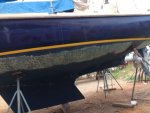
Antifouling removal ideas!

I am experimenting since morning with making the home made striper with caustic soda!. I used some all purpose flour for thickener, but it does not dissolve well. I applied to an acrylic paint that i applied to the ceramic tiles ( that was bad taste and needs removal..lol). It worked really good!

Now i just tried a new recipie with cornstarch and the result is a great thixotropic product like one you buy from the store. Cornstarch dissolves in cold water fully and when the soda is added the heat makes the sweet thick! So tomorrow i ll try the recipie at the yard!
 
Chemical strippers will soften the anti-foul and might work. However, most people don't seem too happy with it and if it turns to a sticky goo then it will be even more difficult to remove.

I think that the SKIL scraper uses the same blades as my old BOSCH power chisel. I have used that several times with success but only on brittle anti-foul. It does nothing on softer ant-foul but things like Cruiser UNO etc. flake off quite well. My dust mask ended up perfectly clean last time I used it and I swept up 2-3 bucket loads from the concrete. It tends to shatter into pieces with little dust.

It might be worth trying the SKIL again as long as your anti-foul isn't a soft type.

Tips
1) Don't bother with the flexible scraper blade, it never worked well
2) Reverse the widest chisel blade, blunt it slightly on a grinding wheel and try to find the best angle

I usually dig into the gel coat slightly 1-2 time before I get the hang of it. The tiny nicks are easily filled and remainder of the hull isn't damaged. I don't find it too tiring and think I did my 42' boat in a couple of days (with quite a few stops).

Short example video here:

I am afraid that was a soft antifoul applied last year. That's why i cant get under it with the scraper
 
When AF has just come out of the sea, many types are quite soft and respond well to wet sanding with coarse w+d paper, those sponge pads, 3M mesh etc etc. Keep it very wet and add a little detergent to the water.

When it's been out of the water for a few months, it goes more brittle and the scrapers become favourite. Often it will come off in chips. A slightly blunt chisel from the pound shop is often useful, as is a Carbide two handed scraper. The chips and flakes are less dangerous than fine dust, but I still use a vacuum where I can, a dust mask and clean up as best I can.
 
If I am not interested in speed can I just clean off any loose anti fouls and redcoat ,what is the upside of stripping back?

Yes, of course, just get rid of loose bits and re-antifoul. If you want a completely smooth hull, stripping back is the solution. Over time, with multiple coats of antifoul building up, the adhesion of older layers can break down, leading to quite thick bits flaking off. This can then lead to a rather uneven hull surface; but whether any speed loss is important for the average cruiser is probably minimal. The problem is obviously worse with hard antifouling.

I only use eroding antifoul, and find that thorough washing with a running hose and a Scotchbrite pad will remove a lot of what's remaining, minimising build-up.
 
The future will be controlled antifouling application and removal in commercial establishments as environment concerns get traction.What about a clean hull without antifoul and just cleaning off on piles or if a bilge Keeleron the hard during the summmer
 
I am experimenting since morning with making the home made striper with caustic soda!. I used some all purpose flour for thickener, but it does not dissolve well. I applied to an acrylic paint that i applied to the ceramic tiles ( that was bad taste and needs removal..lol). It worked really good!

Now i just tried a new recipie with cornstarch and the result is a great thixotropic product like one you buy from the store. Cornstarch dissolves in cold water fully and when the soda is added the heat makes the sweet thick! So tomorrow i ll try the recipie at the yard!

DO NOT SPLASH ANY OF YOUR THICKENED GOO IN YOUR EYES.
It won't do your skin much good but at least you should be able to wash it off immediately.

Caustic solutions penetrate more rapidly than acids and Sodium Hydroxide is probably the most rapidly penetrating common alkali. I seem to remember that rinsing with water actually increases penetration initially and a phosphate buffer solution is much better. Thickened goo will be difficult to remove.

I was told that even a 0.1 Molar caustic soda solution would cause the eye to cloud over in under 30 seconds. This was about 50 years ago when studying chemistry.
 
The decision usually comes when rollering new coat and flakes of old stick to roller or, the boatyard idiot power washing uses too much pressure and blasts some areas off but not others.

My previous boat built up about 12-15 years of anti-foul and if left longer might have been basis for a hull mould (with lots of big holes :D). Big flakes on the roller did cause problems and I decided it was time to strip back.

I didn't get the chance for more than 5-6 years build-up with my next boat as a yard blew holes in the a/f and even took off the primer in some places. I wasn't very happy as it had been perfectly smooth until that point. At least I didn't get to the stage of having flakes on the roller as the remainder was still solidly attached. However, I decided to strip it back as the finish was going to be very lumpy and probably flake in a year or so.
 
I back from a 2 day battle under the hull! I still have my vision and i dont have any ski spots from the caustic soda cocktail. I am very consious in every step of the job and what ever i do i am focusing on eye protection every single moment. I rolled the misxture under the hull and then started scraping it. One coating of striper removes the latest antifoul and then i am sanding to the gelcoat with full body white suite, gas mask and eye protection. I finished scraping the 3/4 of the hull today , and on next visit i ll attack sanding with an angle grinder with soft pad as i want to be done with this. So far i cant recall of doing anything more tiring for the body than this job...

The worse thing is that i had small cockroach inveders at the cockpit area as i had there the cornstach box for the striper cocktail....My boat is almost a small Chernobyl...caustic soda bellow and cockroach poison on deck, supports and keel... As many others have said...this is the first and last time i am doing this...
 
I back from a 2 day battle under the hull! I still have my vision and i dont have any ski spots from the caustic soda cocktail. I am very consious in every step of the job and what ever i do i am focusing on eye protection every single moment. I rolled the misxture under the hull and then started scraping it. One coating of striper removes the latest antifoul and then i am sanding to the gelcoat with full body white suite, gas mask and eye protection. I finished scraping the 3/4 of the hull today , and on next visit i ll attack sanding with an angle grinder with soft pad as i want to be done with this. So far i cant recall of doing anything more tiring for the body than this job...

The worse thing is that i had small cockroach inveders at the cockpit area as i had there the cornstach box for the striper cocktail....My boat is almost a small Chernobyl...caustic soda bellow and cockroach poison on deck, supports and keel... As many others have said...this is the first and last time i am doing this...

Good job :encouragement:
We have all said those beatiful words never again :D
 
We did exactly the same. We did tried those chemical but didn't work at all, wasted £50.00 and all day on antifouling paint striper.
Good quality scrapper like Bahco does the job.

Took ours back to the epoxy this January, quite an easy job using Sandvik (or Bahco) two handed scraper with carbide blade (corners rounded to stop it digging in), followed by light dry sand with dust extraction. Primed with Jotun Vinyguard.

View attachment 77756
 
I tried the angle grinder with 120 grit at a wooden chair. Using it for removing antifoul is out of question as it will dig into the hull in a blink. Great tool for beveling but not as sanding tool unless its a metal surface underneath. So the steps are stripper application, scrapping the melted paint, and then continue patiently with orbital sander and net mesh paper. Thanks for all the feedback, helped a lot! sand.jpg
 
Top