Antifoul removal...sorry

Nickcreak

New Member
Joined
15 Aug 2018
Messages
3
Visit site
Dear all,
I have read loads of the threads on this and so I’m sorry for posting yet another. But I’m still a little confused and would love some input.

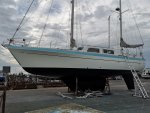
I have just bought a Westerly Oceanlord 41. It has been sat in Trinidad on the hard for 7 years. The AntiFoul is VERY dry, has reacted and cracked...looking like a moonscape.

I want to get the boat in the water in November and have October to get it sorted.

I have read lots that talk about re-epoxying...can I not scrape and then sand back to Gelcoat and then Prime/AntiFoul.

What would people suggest?
 
Apart from your health and covering your neighbours boat in Antifoul dust.

+1. Dry sanding in a yard without putting a tent around the boat is heinously antisocial. You need to do it wet which generally precludes power tools. Forumite Yngmar made a fabulous job of his similarly sized bavaria with hand tools, but it wasn't easy:
https://sdfjkl.org/blog/2018-02-27-coppercoat-I-the-scrapening/
Do wear goggles and a mask. I wet sanded the worst off my oceanlord when I bought it. Despite the mask and goggles I must have managed to ingest something because I spent a night being violently ill. Mine had old turkish antifoul on. Yours may be worse.

An alternative would be getting it blasted. If you've got the cash and there's someone there who can make a good job of it, consider it. Scraping won't be fun.

I'm no expert but I would have thought an epoxy coating on a 20-30 year old hull wouldn't be such a bad idea if you've gone all the way back to the gelcoat
 
I agree that wet sanding is preferable to dry. An Oceanlord is a big boat to sand by hand - I woud use an air powered sander, they are safe when water is flying everywhere.
 
There's a number of ways of removing anti-foul.

I usually wet scour my hull, but that technique is probably not as suitable for your boat with a hefty build-up.

I've longboarded several racers - very handy if you're a method actor wanting to get into role to play a character in a soviet-era work camp.

You could just scrape it. I've helped to do this where the owner got handles fitted to plane blades. Work well but you have to be very careful not gouge the gel coat.

Dry sanding - bit of a health risk and others have said a no no in a crowded boatyard. Even if you could get plenty of space in an out of season boatyard probably still not the best method.

You can apply anti-foul remover. I used to think the stuff was next to useless, but then tried it on one boat after being given a tip to cover it in tin foil after applying it. Leave overnight remove foil and scrape off the mush. Do not leave it for longer as the anti-foul will re-dry and it's hard work getting it and the foil off.

The easiest method is to open your cheque book and get someone to blast it off. You absolutely need to ensure they have the experience, technique & blasting material to do it properly without damaging the gel coat. Or even removing half the gel coat.
 
Agree with all the points above. Blasting will be the route you wished you had gone down, no matter how much it costs. Dry sanding is a no-no for both you and anyone nearby. Wet sanding will be very hard work - more than you ever imagined. Antifoul stripper is slightly better, but not much. I would use clingfilm rather than foil as mentioned above - but I would never actually do it so not really relevant.
Once stripped by whatever method, and even if there is some damage to the gelcoat (which is inevitable) put several coats of epoxy on, not just one. 6 is a good number! Then you can antifoul and go sailing for years without a care in the world
 
I spent today removing the eroding AF buildup from the waterline of my boat, as I am adding a boot top which will be a hard AF.
Used mesh which is designed for sanding plaster etc. Far, far better than normal sandpaper as it doesn't clog. It does lose its edge though- I had to get a new bit every couple of metres of waterline. Acceptable progress for the job I had to do, but I shudder to think how long it would take to do an entire boat!
 
scrape of the loose bits and AF it again. unlikely to make a significant difference to your boat speed.
use eroding AF, with time the old stuff will crack off.
umpteen layers on my boat when i bought it a few years ago, a significant amount has fallen off so far.

I was about to point out the loss of speed from painting over rough old antifoul then I saw you've got a MoBo. Gawd knows how much extra you're spending on fuel. Might be cheaper to pay someone to blast it this winter.
 
Hey Hey 42 ft boat with layers of anti-foul put on with a spade been sitting for about 1 year , baked on , tried paint remover , rubbish and would cost a fortune , tried scrapping with tungsten blades took top layer of only, tried sanding with normal disks , was putting new disks on every five minutes , so invested in Bosh professional sander with mesh pads and attacked the hull lucky enough no one was near me what a bloody mess and one of the hardest jobs I have done and I ve done some in my time, back braking , evil product , you must wear protective clothing and a good respirator and wash the stuff off asap or it burns like hell
it took about 1 week to get back to gel coat , then two coats of epoxy to seal hull 1 coat of primer to tie and 2 coats of anti-foul
as said above maybe consider epoxying your hull
good luck final job IMG_20180727_191010 (5).jpg
 
OP will by now have already started breaking off some of the worst of the antifoul steps in the paint. As said it is a terrible job to do a proper job. OP will almost certainly give up if he is DIYing. In which case don't be too ashamed just paint over it all again cos in another year he will be back to where he is today. But hopefully witha good years use behind him. ol'will
 
I tested some chemical removers on dry cracked antifoul many years ago and most turned it into chewing gum, making it impossible to remove. Luckily, I only tested very small areas. I tried sanding but immediately decided that was silly, very slow and extremely messy.

I was lucky enough to find a Bosch PSE 180E power chisel on sale at a huge discount and it did the job in a weekend. I've kept it on board and used it a few times or given it to others. Unfortunately, Bosch stopped selling it and I haven't ever found a replacement.

Last time it was used on a 42' boat and took around 2 days. Virtually no dust and 2 bucket loads of antifoul "grit" swept up afterwards. What a pity it was discontinued. Modern multi-tools don't work either as the blade vibrates from side to side, not forwards and backwards.

https://www.youtube.com/watch?v=nJdE-dPW3xY
 
Last edited:
Another vote for the Bosch power chisel, The large 50mm wide blade needs to have its bevel squared off & corners radiused slightly so it does not dig into the gelcoat. Out Sabre had 30 years worth of thick antifoul on it when we bought her, It did not take long to shovel it off.
 
Top